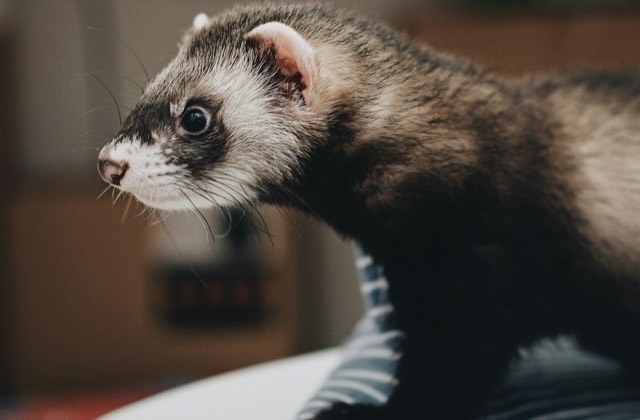
What recent research clarifies about ferret nutritional needs
Published by Planète Pets · managing editor: Clément Lacaille · how our guides are written
That ferrets are obligate carnivores is well established, but a recent scientific update refines some useful benchmarks for choosing kibble. All our food guidance is gathered in the ferret food section.
Contents · 4 sections
What the 2023 scientific update shows
An article by Cayla Iske, a veterinarian affiliated with Omaha's Henry Doorly Zoo & Aquarium, published in 2024 in Veterinary Clinics of North America: Exotic Animal Practice (posted online as early as August 2023), reviews key nutritional factors in ferret care (abstract on PubMed). The article recommends targeting a protein-to-fat ratio close to 2 to 1 with carbohydrate levels kept as low as possible, notes that plant-based ingredients have no real place in a ferret's diet since they risk unbalancing the amino acid profile, and advises offering a combination of dietary formats rather than relying on a single source.
What this means in practice when choosing kibble
- Check that animal protein tops the ingredient list, not a starch or plant-based flour.
- Be wary of "grain-free" labeling: it often swaps wheat or corn for potato or pea, both still high in carbohydrates for an obligate carnivore.
- Compare the stated protein-to-fat ratio rather than just the protein percentage printed large on the bag, as detailed in our comparison of ferret kibble versus kitten kibble.
Varying formats rather than relying on a single food
The recommendation to combine several dietary formats lines up with our guide on whole-prey and raw feeding equipment for households ready to invest in raw feeding alongside everyday kibble. Any switch in format or brand should still go through a gradual kibble transition to avoid digestive upset, and palatability temporarily takes priority over these benchmarks when feeding a sick or recovering ferret.
Frequently asked questions
Can a ferret thrive on kibble alone without ever varying its diet?
Yes, as long as it meets the basic nutritional benchmarks, but recent research suggests a complementary format brings an added benefit.
Why do plant-based ingredients cause problems when some kibble includes them?
A ferret's very short digestive tract poorly processes starch and plant fiber, which also dilutes the intake of essential amino acids.
Does the 2-to-1 protein-to-fat ratio apply at every life stage?
The article targets a general adult benchmark; a growing, pregnant or senior ferret may need adjustments guided by an exotics vet.
Should you switch kibble immediately after reading these benchmarks?
No, any switch should always be prepared through a gradual transition rather than an abrupt replacement. Browse all our guides on the ferret hub.
In our shop, for this use: Bubble-window carrier backpack for dwarf rabbit, guinea pig or ferret (€47.90) · the whole shop
This guide is part of Planète Pets’s Ferrets universe. Our advice is general in nature: for any health concern, your veterinarian remains the only reference.