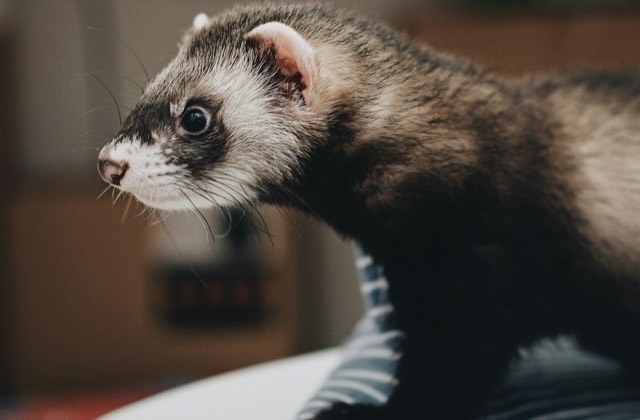
Ferrets have an ultra-fast gut transit: why several small meals work better
Published by Planète Pets · managing editor: Clément Lacaille · how our guides are written
A ferret begging for food every three or four hours is not being fussy: its digestive tract simply runs much faster than a dog's or a cat's. Find all our food resources in the ferret food section.
Contents · 4 sections
What a benchmark radiographic study shows
A study by Schwarz, Solano, Manning, Marini and Fox, published in 2003 in the journal Veterinary Radiology & Ultrasound, performed barium contrast studies in fifteen healthy ferrets (eleven awake, four sedated), with repeated radiographs taken from 5 to 150 minutes after the contrast agent was given (see the study). The standout finding: small intestinal transit took less than two hours in every ferret studied, markedly faster than what is seen in cats under comparable protocols.
Why this matters directly for daily feeding
- A stomach that empties quickly leaves little stored energy available between meals, especially in an animal with an already fast metabolism.
- Nutrient absorption over a very short window, which favors a concentrated protein- and fat-rich food over a large volume that is harder to digest in one sitting.
- A higher risk of hypoglycemia in predisposed ferrets when meals are spaced too far apart, particularly in older individuals or those prone to insulinoma.
What this means at the food bowl
Leaving kibble available at all times remains the simplest way to match this rhythm, topped up if needed with two or three small snacks spread across the day rather than one large meal. This logic directly echoes our guidance on preventing hypoglycemia through frequent meals, especially useful for a senior or recovering ferret. Any change of brand or format should still follow a gradual food transition so as not to disrupt this already rapid transit.
Frequently asked questions
Should you wake a ferret at night to feed it?
No, food available at all times generally covers its needs across a polyphasic sleep cycle.
Does this fast transit explain why ferrets digest fiber poorly?
Largely yes: the passage time is too short for efficient fermentation of plant fiber, which is why a concentrated meat-based food works best.
Does one overly large meal carry a particular risk?
It can trigger digestive discomfort or vomiting, more common in ferrets than a simple overeating episode in other species.
Does this study also apply to young kits?
It looked at adult ferrets; a growing kit needs even more frequent meals, to be adjusted with an exotics vet. Find all our guides on the ferret hub.
See it in the Planète Pets shop: 2-in-1 felt tunnel and hideout for rabbits and ferrets (44 × 60 cm) (€37.90) · the whole shop
This guide is part of Planète Pets’s Ferrets universe. Our advice is general in nature: for any health concern, your veterinarian remains the only reference.