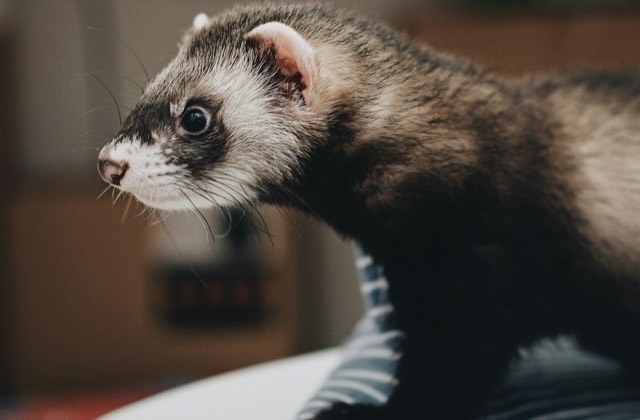
Ferret Swallowed an Object: Recognizing Intestinal Obstruction and Acting Fast
Published by Planète Pets · managing editor: Clément Lacaille · how our guides are written
Ferrets are among the pets most prone to swallowing foreign objects: their curiosity and their taste for chewing foam rubber, stoppers or fabric make this a frequent cause of digestive obstruction, especially before one year of age. A study published in the Journal of the American Veterinary Medical Association detailed three ferret cases with an esophageal foreign body or stricture, treated by endoscopic retrieval or stent placement after signs of regurgitation and anorexia. Find more health pointers in the ferret care and grooming section.
Contents · 5 sections
Why do ferrets swallow so many objects?
Unlike a dog, which mostly explores with its nose, a ferret explores with its mouth: it chews, carries and sometimes swallows whatever it finds, especially cheap toy foam, rubber bands, earplugs or small bits of rubber. A ferret's digestive tract, narrow and relatively short, copes poorly with these objects, which do not break down and end up blocking the passage, most often in the stomach or small intestine.
The signs that should worry you
An obstruction typically shows up as sudden loss of appetite, marked lethargy, repeated vomiting, and stool that is absent or reduced to small, thread-like amounts. These signs move fast in a ferret, whose rapid metabolism leaves little margin: unlike a cat, just a few hours of worsening can tip the situation into a life-threatening emergency.
What to do in the hours that follow
Faced with these symptoms, or if you saw your ferret chew and swallow an object, call the vet right away rather than waiting for things to improve on their own; an x-ray or ultrasound often confirms the presence and location of the foreign body. Never try to induce vomiting in a ferret yourself, a risky move that is rarely effective in this species. The list of supplies worth having on hand while you wait for the appointment is covered in ferret first aid kit.
Prevention beats cure
The best habit is to regularly inspect toys for crumbling foam or rubber, and to favor sturdy, non-toxic materials from the start, as detailed in safe ferret toys: what to avoid in latex and foam. Keeping rubber bands, earplugs and small household items out of reach cuts the everyday risk considerably.
- Warning signs: sudden anorexia, lethargy, repeated vomiting, absent stool
- Immediate step: call the vet, never induce vomiting yourself
- Prevention: inspect toys, avoid crumbling foam and rubber, store small objects out of reach
Frequently asked questions
Can a ferret pass a small swallowed object on its own?
It is possible for a very small, smooth object, but there is no reliable way to predict it in advance: any known ingestion warrants a vet's opinion rather than plain wait-and-see.
How long can you wait before seeing a vet?
As little as possible: in a ferret, an obstruction can become life-threatening within 24 to 48 hours, much faster than in a large dog.
Is surgery always necessary?
No, some objects are removed endoscopically without surgery, but the decision depends on the size, shape and location of the foreign body, assessed by the vet.
An accessory from our shop for this use: 2-in-1 felt tunnel and hideout for rabbits and ferrets (44 × 60 cm) (€37.90) · the whole shop
This guide is part of Planète Pets’s Ferrets universe. Our advice is general in nature: for any health concern, your veterinarian remains the only reference.