Do ferrets choose their food by smell rather than sight?
Published by Planète Pets · managing editor: Clément Lacaille · how our guides are written
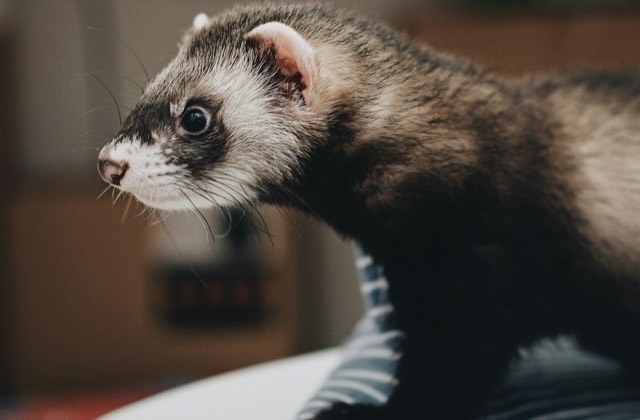
A ferret that ignores a full bowl, then rushes toward a scented food hidden elsewhere, illustrates an ancient trait of its species. In this carnivore, smell far outweighs sight in triggering food-seeking behaviour. Find all our guidance in the ferret food section.
Contents · 5 sections
Why does smell dominate over sight in ferrets?
Like most mustelids, ferrets historically hunted in dark, narrow burrows where sight was of little use. Their olfactory system evolved to guide prey-seeking and recognition, a legacy the domestic ferret keeps intact despite generations away from the burrow.
What does the reference study on polecats show?
A study by Apfelbach, published in 1973 in the journal Zeitschrift für Tierpsychologie, looked at the stimuli that trigger prey-seeking behaviour in polecats, the direct wild ancestor of the domestic ferret. The results show that an adult polecat only reliably triggers food-seeking behaviour in the presence of the scent of already-known prey: visual appearance alone, without an accompanying olfactory cue, is not enough to prompt this response. Scent thus acts as a genuine identification signal for food, learned over the animal's development.
How can this trait be put to use day to day with a ferret?
- Slightly warming wet food or moistening kibble releases more scent compounds and can revive the appetite of a sick or picky ferret, a topic covered in depth in our article on feeding a sick or recovering ferret.
- Favouring scent-based foraging games rather than relying on visual presentation alone, something a snuffle mat soaked in food scent makes possible.
- Introducing a new food gradually by blending it with an already familiar scent, a logic that ties into our guide on switching a ferret's kibble.
Does this trait also explain why some new foods get rejected?
Partly: a food whose scent doesn't evoke anything familiar to the ferret has a harder time sparking its interest, even if it's nutritionally appropriate. This is one reason why an overly abrupt change of brand or format often ends in outright refusal rather than gradual adaptation.
Frequently asked questions
Can a ferret learn to like a new scent?
Yes, through repeated exposure paired with a positive experience, the scent of an unfamiliar food can gradually become a recognised and appreciated signal.
Does sight play no role at all in ferret feeding?
No, it plays a supporting role, but the study shows scent remains the main trigger for food-seeking behaviour in this species.
Is this trait unique to ferrets or shared with other mustelids?
It's shared across the whole family, including the wild polecat studied here, which confirms how evolutionarily old this trait is. Find all our guides in the ferret hub.
See it in the Planète Pets shop: 2-in-1 felt tunnel and hideout for rabbits and ferrets (44 × 60 cm) (€37.90) · the whole shop
This guide is part of Planète Pets’s Ferrets universe. Our advice is general in nature: for any health concern, your veterinarian remains the only reference.