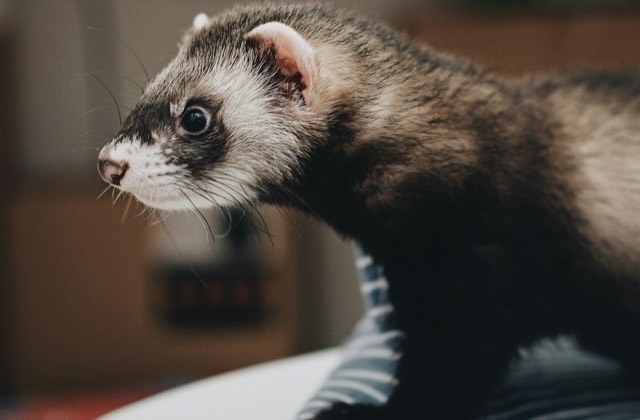
Why does a ferret explore everything without fear? What a comparative polecat study reveals
Published by Planète Pets · managing editor: Clément Lacaille · how our guides are written
A ferret charging headfirst into an unfamiliar box or a new tunnel rarely surprises its owner, the trait feels so natural. A comparative study with its wild ancestor shows this boldness is far from universal among mustelids. Find all our enrichment ideas in the ferret toys and enrichment section.
Contents · 4 sections
What a landmark study shows
A study by Poole, published in 1972 in the Journal of Zoology, compared the behaviour of the European polecat (Mustela putorius), the domestic ferret (Mustela furo) and their hybrids, particularly in terms of exploratory behaviour and fear of humans (see the study). The author found clear differences among the three groups: the domestic ferret explored its surroundings more and showed less fear of humans than the wild polecat, with hybrids falling in between. A repeated rustling-sound test also showed the ferret held its attention on the stimulus for longer than the polecat or the hybrids did.
What this means for a pet ferret
- The exploratory boldness of a domestic-line ferret is partly the product of generations of selection, not just the individual animal's personality.
- A ferret from a reputable, well-socialised breeding line generally explores new enrichment faster than an animal with an uncertain past or little handling as a kit.
- A longer adjustment period for a shy or reserved new ferret isn't abnormal: not every individual shares exactly the same level of boldness, even within a domesticated species.
Encouraging this curiosity day to day
Regularly offering new spaces to explore, rather than always the same objects, keeps this exploratory trait active. Our guide to enrichment preferences measured by effort helps you pick enrichment that genuinely taps into this natural curiosity.
Frequently asked questions
Are all ferrets equally exploratory?
No, domestication shifted the species average for this trait, but substantial individual variation remains, as in any domestic animal.
Do polecat-ferret hybrids really turn up in family breeding lines?
It's extremely rare among ferrets sold as pets; the study mainly compares research populations to isolate the effect of domestication itself.
Can a shy ferret become more exploratory over time?
Yes, gentle and regular handling combined with novelty introduced gradually usually improves a reserved ferret's confidence.
Does fear of humans tie into this study too?
Yes, the study specifically found markedly stronger fear of humans in the wild polecat than in the domestic ferret, illustrating the overall effect of domestication. Find all our guides in the ferret hub.
An accessory from our shop for this use: 2-in-1 felt tunnel and hideout for rabbits and ferrets (44 × 60 cm) (€37.90) · the whole shop
This guide is part of Planète Pets’s Ferrets universe. Our advice is general in nature: for any health concern, your veterinarian remains the only reference.