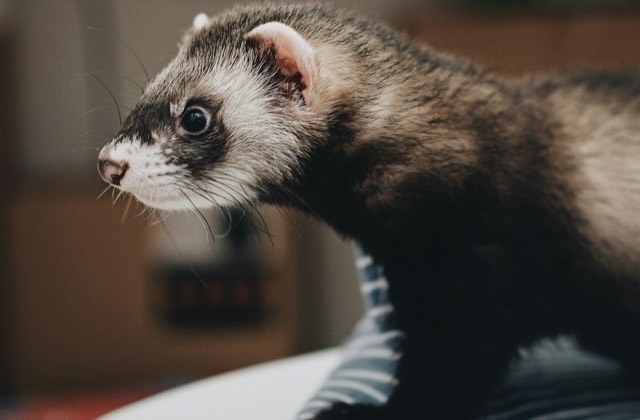
A dark hiding spot in the cage: what a cat study reveals about ferret stress
Published by Planète Pets · managing editor: Clément Lacaille · how our guides are written
A ferret retreating into a tunnel or under an opaque cloth isn't just chasing warmth: having a closed, dark shelter directly affects its stress level, as shown by a study carried out in another companion carnivore. Find all our habitat guidance in the ferret bedding and habitat section.
Contents · 4 sections
What a landmark cat study shows
A study by Kry and Casey, published in 2007 in Animal Welfare, compared shelter cats given a hiding box to cats without one, measuring their stress level with a validated behavioural scale. Cats with access to a hiding box showed markedly lower stress scores and adapted faster to their new environment than those without one. The study focuses on cats rather than ferrets, but it illustrates a need shared by many small carnivores placed in a new or unpredictable environment: being able to remove themselves from sight and light on demand.
Why this principle fits ferrets well
- Ferrets are burrowing animals that naturally sleep in dark dens in the wild, a behaviour their domestic counterparts retain in full.
- A cage open on every side, even a spacious one, offers nowhere to fully escape sight and light.
- Periods of change — a new ferret arriving, a house move, a visit — are exactly when this kind of refuge matters most.
How to set up a real hiding spot
An enclosed hammock or an opaque sleep sack, tucked away from the busy spots rather than left in plain sight, follows this same visual-refuge logic covered in our comparison of sleep sacks and hammocks by season. The overall cage location matters just as much, as our guide on a quiet spot away from light and noise explains.
Frequently asked questions
Does an open hammock play the same role as an enclosed hiding spot?
Only partly: a hammock closed on the sides, or a sleep sack, shields against sight far better than an open hammock laid flat.
Should a large cage have more than one hiding spot?
Yes, especially with multiple ferrets, so each one can withdraw without depending on a single shelter's availability.
Is a ferret that hides a lot necessarily stressed?
Not necessarily: seeking darkness to sleep is normal for this species; only unusual, prolonged isolation should raise concern.
Does a hiding spot replace enough out-of-cage time?
No, it complements but doesn't replace the exercise and out-of-cage time a ferret needs for its well-being. Find all our guides in the ferret hub.
See it in the Planète Pets shop: Double-layer plush hammock for rats, squirrels or ferrets (€18.90) · the whole shop
See it in the Planète Pets shop: Electric pet heating pad 45 × 45 cm (17.7 in) with chew-resistant cord ($48.90, ships from the US) · the US shop
This guide is part of Planète Pets’s Ferrets universe. Our advice is general in nature: for any health concern, your veterinarian remains the only reference.