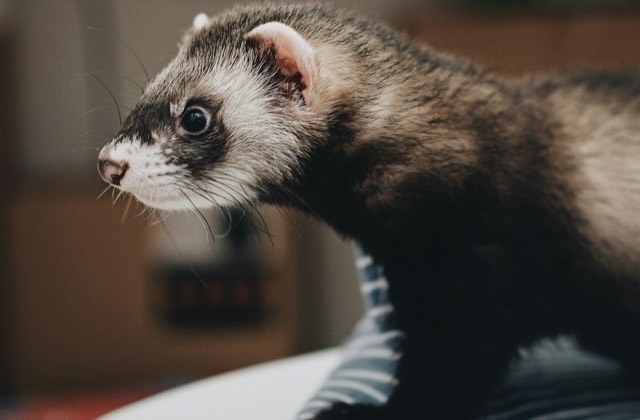
Training a ferret to its carrier before the first trip: what a cat study teaches
Published by Planète Pets · managing editor: Clément Lacaille · how our guides are written
Pulling out the carrier only when it is time to leave remains one of the most stressful triggers for an animal that is not used to it. Find all our travel safety guidance in the ferret travel and safety section.
Contents · 4 sections
What a controlled study in cats shows
A study by Pratsch, Mohr, Palme, Rost, Troxler and Arhant, published in 2018 in the journal Applied Animal Behaviour Science, compared a group of cats progressively trained to enter their carrier voluntarily against an untrained control group, ahead of a ten-minute car trip followed by a vet exam (see the study). Trained cats showed markedly fewer signs of stress during the ride, and their vet exam went faster than that of the control group's cats.
An important nuance alongside habituation by mere repetition
This finding complements an already established observation in dogs, detailed in our article on the lack of habituation to transport from simply repeating trips: repeating trips without changing the approach does not always reduce physiological stress. The nuance is in the word "training": it was not repetition of the trip that made the difference in the feline study, but prior work, done outside any departure context, to link the carrier with a positive experience.
Applying the method to a ferret
- Leave the carrier out permanently in the living space, weeks before any planned trip, so it becomes a familiar spot rather than a signal that a departure is coming.
- Place treats and toys inside it, outside of any travel context, to build the positive association used in the feline study.
- Briefly close the door during short, playful sessions at home, before moving on to an actual car trip, drawing on the guidance in our guide to securing the carrier in the car.
Frequently asked questions
How long does it take to train a ferret to its carrier?
Plan for several weeks of short, positive sessions rather than a last-minute effort the day before departure.
Does this method replace the precautions taken during the trip itself?
No, it adds to them: good prior training does not remove the need for careful securing and regular stops once on the road.
Can an adult ferret already fearful of its carrier still improve?
Yes, the method works at any age, though a younger ferret usually adapts faster than one already marked by a bad experience.
Does the feline study transfer directly to ferrets?
The principle of positive association and gradual training applies to most companion mammals, even though no equivalent study exists yet specifically in ferrets. Find all our guides on the ferret hub.
An accessory from our shop for this use: Bubble-window carrier backpack for dwarf rabbit, guinea pig or ferret (€47.90) · the whole shop
This guide is part of Planète Pets’s Ferrets universe. Our advice is general in nature: for any health concern, your veterinarian remains the only reference.