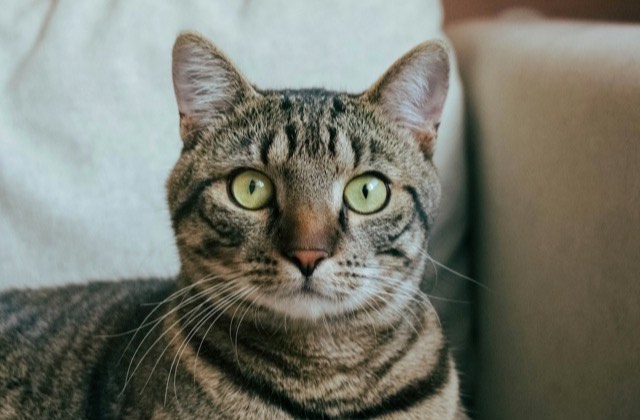
Hairballs in cats: preventing and limiting regurgitation
Published by Planète Pets · managing editor: Clément Lacaille · how our guides are written
A cat that occasionally brings up an elongated hairball isn't sick: it's the normal result of thorough grooming, which makes it swallow an amount of dead hair roughly proportional to its coat length. It becomes a concern once regurgitation happens several times a week. Browse all our food guides in the cat food section.
Contents · 6 sections
What do studies show about diet and hairballs?
A study by Loureiro, Sembenelli, Maria, Vasconcellos, Sá, Sakomura and Carciofi, published in 2014 in the Journal of Nutritional Science, compared several levels of added sugarcane fibre in the diets of 32 cats (study on PubMed): cats fed the highest sugarcane fibre levels showed a linear reduction in the faecal excretion of small and medium hairballs, while cellulose alone showed no significant effect.
Which dietary solutions actually reduce hairballs?
- Kibble formulated for hairball control: enriched with insoluble fibre that helps swallowed hair move through the gut rather than build up in the stomach.
- Malt-based lubricant paste or treat: eases the intestinal passage of hair without reducing how much is swallowed, useful alongside regular brushing.
- Cat grass to nibble on: mechanically encourages controlled regurgitation, a natural behaviour rather than a problem to eliminate, as covered in our cat grass vs. catnip guide.
Is brushing still essential?
Yes, no dietary fix replaces regular brushing suited to coat length: the less dead hair a cat swallows while grooming, the less it regurgitates, no matter how good its food is.
When does a hairball become a reason to see a vet?
Repeated retching without producing a hairball, loss of appetite, or constipation can signal a trichobezoar blocked in the digestive tract, an emergency that sometimes requires surgery if the blockage doesn't clear with medical treatment.
What's the budget?
Hairball-control kibble costs €12–25 per kilo depending on the range, and malt paste €5–10 per tube for several weeks of use.
Frequently asked questions
Do kittens bring up as many hairballs as adults?
No, the issue stays rare before adolescence, since the adult coat and full grooming behaviour only develop gradually.
Is a short-haired cat safe from hairballs?
No, even short hair swallowed in enough quantity can form hairballs, grooming frequency matters as much as coat length.
Do malt supplements have a laxative effect?
Yes, a mild lubricant effect is the goal; overuse can upset the digestive transit, so it's worth sticking to the recommended dose. Browse all our guides on the cat hub.
An accessory from our shop for this use: Raised-edge silicone feeding mat for cats (€25.90) · the whole shop
For your cat, at Le Félin (same family, zero commission): Petit arbre à chat compact (from €84.99)
This guide is part of Planète Pets’s Cats universe. Our advice is general in nature: for any health concern, your veterinarian remains the only reference.