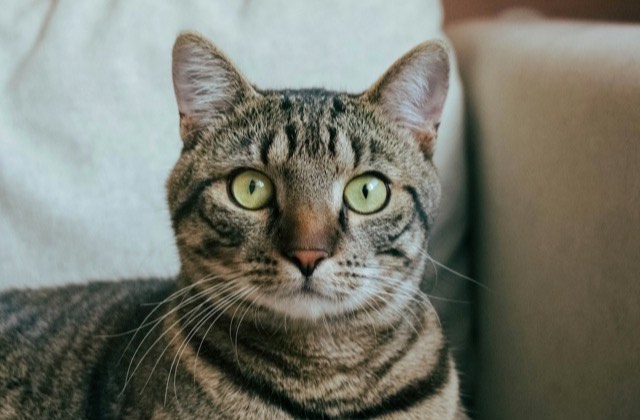
Balinese: why its long coat without an undercoat changes its bedding needs
Published by Planète Pets · managing editor: Clément Lacaille · how our guides are written
The Balinese is often described as a "long-haired Siamese," a label that oversimplifies the genetics of its coat. Unlike other long-haired breeds such as the Maine Coon or the Persian, its coat stays fine, silky and sparse in undercoat — a difference with a precise genetic explanation and real consequences for its bedding. The Balinese breed profile covers the rest of its profile.
Contents · 4 sections
The same gene, very different effects depending on the breed
Jennifer Kehler, Victor David, Alejandro Schäffer and colleagues, including Stephen O'Brien, identified four independent mutations in the FGF5 gene responsible for the long-haired phenotype in domestic cats, in a 2007 study published in the Journal of Heredity (see the study). FGF5 regulates the length of the hair growth cycle: its mutation extends that phase and lengthens the coat, without necessarily changing its density or the presence of a thick undercoat. The Balinese, a direct descendant of Siamese litters that spontaneously developed semi-long hair, inherited this mutation without the additional genes that, in the Maine Coon or the Norwegian Forest Cat, also produce a dense, cold-adapted undercoat.
What that means for thermoregulation
Long hair without a thick undercoat insulates noticeably less than a full double coat: thermally, the Balinese stays closer to a short-haired Siamese than to a Maine Coon, despite appearances suggesting otherwise. It actively seeks out warmth in winter and copes poorly with a persistently cool room, a trait it shares — to a lesser degree — with other fine-coated breeds such as the Cornish Rex.
Setting up bedding that actually works
Raised bedding, kept away from draughts and paired with a fleece blanket the cat can burrow into, makes a real difference in winter. A low-voltage heated pad designed for pets, covered in our guide to the heated cat bed, is a useful addition in a poorly insulated home. On the grooming side, the lack of a thick undercoat thankfully limits matting compared with a Persian; our guide to grooming a Balinese without an undercoat covers the brushing frequency actually needed. The rest of our bedding equipment guides are in cat bedding and habitat.
Frequently asked questions
Does the Balinese shed a lot?
Less than a double-coated breed: the lack of a thick undercoat limits heavy seasonal shedding, though regular brushing still helps.
Does a Balinese need more heating than a short-haired cat?
Not necessarily more than a Siamese, but well-insulated bedding is still preferable to a basket left on the floor in a cool room.
Can a Balinese live in a home that is unheated at night?
That is not ideal: its fine coat does not compensate for a prolonged drop in temperature as well as a cat with a dense undercoat.
An accessory from our shop for this use: Escape-resistant cat harness + 1.5 m leash (€19.90) · the whole shop
See it at Le Félin, a shop from the same family (zero commission): Petit arbre à chat compact et design (from €79.99)
This guide is part of Planète Pets’s Cats universe. Our advice is general in nature: for any health concern, your veterinarian remains the only reference.