How to tame a cockatiel: the steps, week by week
Published by Planète Pets · managing editor: Clément Lacaille · how our guides are written
To tame a cockatiel, you move forward in small steps that the bird chooses to take: a few days without touching it, then your hand resting near the cage, a treat taken from your fingertips, stepping up onto your finger and finally time out of the cage. Expect anything from a few weeks to a few months, depending on the bird’s age and history. The rules stay the same throughout: short daily sessions, no grabbing, and close attention to the crest, which tells you at every moment whether you can go further.
Contents · 7 sections
This page covers what is specific to cockatiels. For the general method that works for most small birds, see our guide on taming a new bird step by step.
What makes cockatiels different
The cockatiel (Nymphicus hollandicus) is a small Australian parrot that lives in flocks in the wild. Most are gentle and curious, which makes them a good first bird, but three traits change how you tame one.
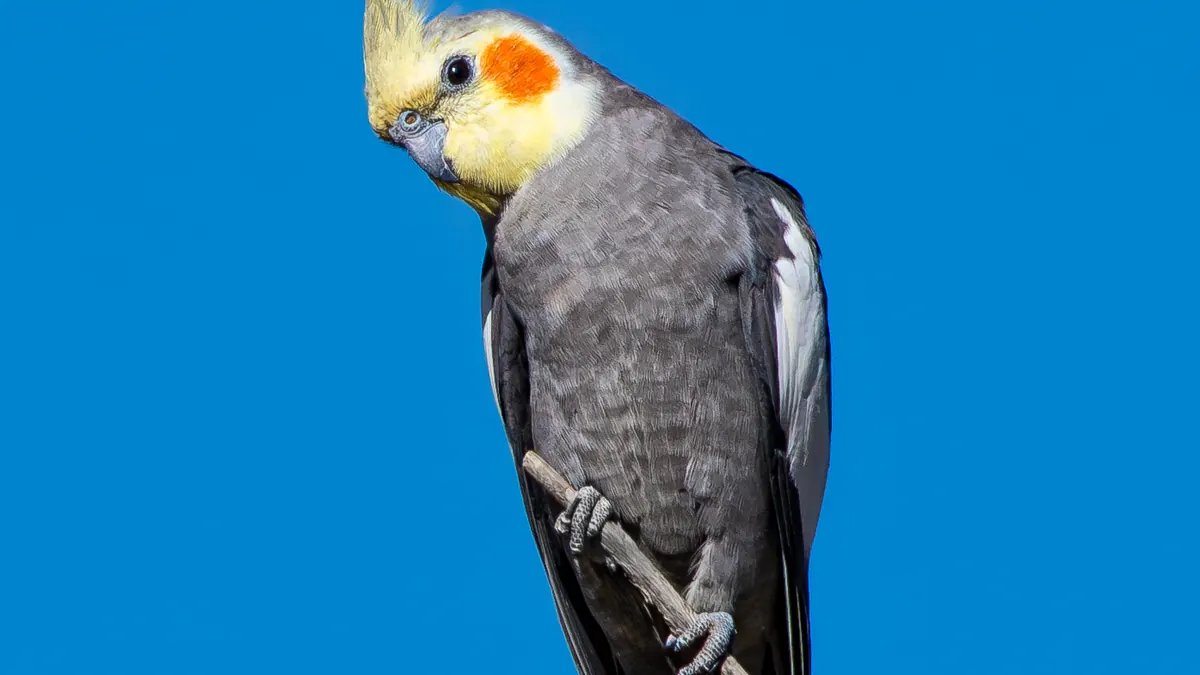
- It talks with its crest. The feathers on top of the head rise, flatten or sit halfway depending on how the bird feels. It is a signal you can see at all times, and far easier to read than anything a budgie offers.
- It startles easily. Cockatiels are among the birds most prone to night frights: a noise or a shadow in the dark can send them crashing around the cage. A bird that panics at night stays wary during the day, so a dim night light and a cage placed away from passing headlights also help taming. Our guide on night frights in budgies and cockatiels explains the setup.
- It is a social bird. On its own, a cockatiel looks for company and will often turn to people. Kept in a pair, it can still be tamed, but its interest in you will usually be lower. That is not a reason to keep one alone; it is a reason to be consistent.
The bond between cockatiels is real and measurable. Agatha Liévin-Bazin and colleagues played cockatiels recordings of distress calls, the calls the birds make when they are caught or forcibly restrained, in a study published in PLOS ONE in 2018 (see the study). The birds were more attentive and more active when they heard these calls than when they heard white noise, especially when the call came from their partner. To score the birds’ reactions, the researchers recorded, among other things, the position of the crest. Two takeaways for owners: the crest really is a window on how the bird feels, and being caught or held down is one of the situations that makes a cockatiel give a distress call.
Reading the crest and body language
Learn these signals before you reach in. They are common observation guides rather than fixed rules: every bird has its quirks, and what matters is the whole picture (crest, posture, eyes, sounds), not one detail.
| What you see | What it usually means | What you do |
|---|---|---|
| Crest halfway up and slightly curved, smooth feathers, bird nibbling or preening | Calm and relaxed | Good time for a session |
| Crest straight up, neck stretched, eyes fixed on you | Surprise, alertness or strong curiosity | Stay still for a few seconds and let it look |
| Crest pinned flat against the head, body stretched, feathers tight | Fear or tension | Pull your hand back and end the session early |
| Crest flat, hissing, beak open, body leaning towards you | Warning: “stay away” | Stop everything and go back one step tomorrow |
| Bird frozen, pressed against the back or top of the cage | Intense fear, not calm | Move away from the cage |
| Feathers slightly fluffed, one foot tucked up, soft beak grinding | Resting and feeling safe | Let it sleep, do not disturb it |
| Whistled tunes, contact calls when you leave the room | It counts you as part of its flock | Answer with your voice, it is a good sign |
A cockatiel that sits fluffed up during the day, sleeps a lot or eats less is not just “shy”: these can be signs of illness and are a reason to see an avian vet.
The week-by-week plan
This timeline is a guide for a young, healthy cockatiel. An adult bird with an unknown past can need two or three times longer at each stage. Only move on when the current step has gone smoothly, with no signs of fear, for several days in a row.
| When | Goal | What you do | How you know it is done |
|---|---|---|---|
| Days 1 to 5 | Settle in | No hands in the cage except to change food and water, slowly; talk and whistle softly as you pass | It eats and preens while you are there |
| Week 2 | Accept a hand nearby | Rest your hand flat against the outside of the cage, then on the open door, for a few minutes, two or three times a day | Relaxed crest, it no longer moves away |
| Weeks 3 to 4 | Treat from your fingertips | Hold a piece of millet spray still inside the cage, away from the bird; bring it a little closer each session | It comes to nibble from your hand |
| Weeks 4 to 6 | Step up | Finger or small hand-held perch just above its feet, the cue “step up”, a treat as soon as one foot lands | It steps up on cue inside the cage |
| Weeks 6 to 8 | First time out | Bird-safe room, cage door open, it comes out on its own; back in on your finger or with a treat in the cage | It comes out and goes back without panic |
| After that | Keep the trust | One or two sessions a day, daily time out, new habits one at a time (carrier, head scratches) | It comes towards you when you approach |
The first days: hands off
A newly arrived cockatiel has lost everything familiar: its flock, its smells, its sounds. It needs to learn that your presence leads to nothing bad. Place the cage at eye level or slightly below, against a wall, in a room where people come and go but away from slamming doors and the TV. A cage set too high or in a busy corridor keeps the bird on edge.
During these days, go about your life around it. Talk to it and whistle the same short tune every time: cockatiels, males especially, often pick up whistles, and a shared tune becomes a first common language. Change the food and water daily, without sudden movements, and take your hand straight back out. Do not cover the cage completely at night: a cover over three sides and a very dim light reduce night frights.
A hand near the cage, then a treat from your fingertips
Once it eats calmly in front of you, rest your hand flat against the bars and keep still for a few minutes. Then do the same with the door open and your hand on the edge. The aim is simple: your hand becomes part of the furniture.
Next comes the treat. Millet spray is the one almost every cockatiel accepts, which makes it a very good training tool. It is still a rich treat: keep it for sessions (a couple of inches a day is plenty) and leave it out of the bowl the rest of the time so it keeps its value. Never cut the bird’s regular food to make it more eager. For a balanced everyday diet, a pellet base topped up with vegetables remains the standard.
Hold the millet still inside the cage, at a distance where the bird notices it without backing off. Do not push it towards the beak: the bird comes to it. The first sessions may end without it touching the millet, and that is normal. Gradually move the millet closer to your fingers until it nibbles while touching your hand.
This patient, little-and-often approach has solid backing. Wendi Aengus and James Millam handled parent-reared orange-winged Amazon chicks for a short time each day in a study published in Zoo Biology in 1999 (see the study). After fledging, the handled birds were clearly tamer than the others on every measure: approaching the handler, perching on a finger, letting their head be touched. Human contact took up less than 2% of their time, and the authors note that continued handling is probably needed to keep that tameness. These were chicks of another species, not adult cockatiels, but the principle carries over: short, regular sessions build trust, and trust needs upkeep.
Stepping up onto your finger
Stepping up is the foundation for everything else: coming out, going back in, vet visits. Teach it inside the cage, where the bird feels safe.
- Hold your index finger out horizontally, just above its feet and against its lower belly, like a branch slightly higher than its perch. Some birds feel safer with your other hand flat behind the finger.
- Always use the same cue, such as “step up”.
- As soon as one foot lands, praise it and give a single millet seed. At first, one foot is enough.
- Keep it on your finger for a few seconds, then let it step back onto its perch. End every session on a success.
If it mouths your finger, that is not necessarily an attack: many parrots test a foothold with their beak first. Keep your hand steady and do not snatch it away. If it bites hard with its crest flat, you went too fast: go back to the treat stage. If your finger worries it, start with a small wooden perch held in your hand. A clicker can also help you mark the right moment precisely; see our guide on clicker training for birds.
The first time out of the cage
Before opening the door, make the room safe: windows shut and curtains drawn (glass is invisible to a bird that does not know the room), no other pets, hobs and stoves off, mirrors covered, nothing toxic within reach, door closed. Open the cage door and let the bird come out by itself: a cockatiel pulled out learns to link going out with fear.
The first flights are often clumsy, and it may land on the floor or on a curtain. Do not chase it. Approach slowly and offer your finger as you did in the cage, or show a piece of millet near its cage door. Plan the first outing at the end of a session, when it is keen on treats rather than overexcited, and leave its usual food in the cage so it wants to go back in. Later on, getting it used to a travel carrier follows the same logic: our guide to cockatiel carrier training walks through the steps.
What not to do
- Grabbing it to get it used to hands. Seizing a cockatiel that is fleeing confirms that hands are a threat. For care or an emergency, guide it into its carrier or wrap it gently in a towel, and do not follow up with a training session.
- Clipping its wings so it will cooperate. Clipping the flight feathers is sometimes sold as a taming shortcut. It does not create trust: it stops the bird from getting away, and a cockatiel that cannot escape is not any less afraid. Flying is also its main form of exercise. It is a decision to make with an avian vet, for a safety reason, not as a training method.
- Long sessions. Five to ten minutes, one to three times a day, beat an hour on Sunday.
- Pushing on when the crest goes flat. Going back one step is not failure; it is what lets you move forward tomorrow.
- Covering it completely in total darkness. A cockatiel that panics at night loses confidence during the day.
- Changing everything at once. While taming, do not move the cage or bring in a new bird without quarantine and preparation.
Frequently asked questions
How long does it take to tame a cockatiel?
Often six to eight weeks for a young bird to step up and come out of the cage, sometimes several months for a wary adult or an aviary-raised bird. The bird sets the pace, not a calendar.
Can an adult cockatiel be tamed?
Yes, with more patience. Stay longer at each step, keep sessions very short and rely on its favourite treat.
Should I get one or two cockatiels if I want them tame?
A pair can be tamed too, usually more slowly, because each already has a companion. Cockatiels are flock birds: if you keep just one, your daily company has to make up for the missing partner.
My cockatiel hisses when I come close. What should I do?
Hissing with a flat crest and an open beak is a warning. Stop, move your hand away and start again tomorrow at the previous step. If it starts suddenly in a bird that was already tame, talk to an avian vet.
This guide is part of Planète Pets’s Birds universe. Our advice is general in nature: for any health concern, your veterinarian remains the only reference.