Travelling with a Maltese: car, crate and rules
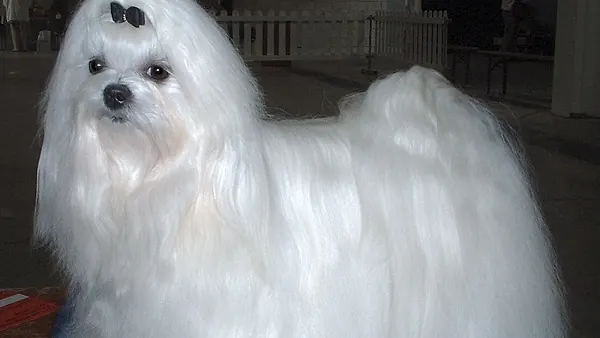

Maltese: At 3 to 4 kg, it travels very well in a carrier bag or approved soft crate, by car or train. A lightweight harness is preferable to a collar to protect its slender neck on walks.
All your small pets in one place, ready to print: Course: Train Your Dog in 8 Weeks — 2 PDF guides (85 pages in English (86 in French)), in English and French, instant download. Get my bundle — €49
In short: A miniature dog of 3 to 4 kg with a long, silky white coat and no undercoat, of moderate energy. A gentle, playful, delicate little dog, very close to its owners and made for indoor life. Its long, silky white coat with no undercoat sheds very little but shows everything: reddish tear stains around the eyes call for daily cleaning of the eye area.
In the car with a Maltese
At 3 to 4 kg, the Maltese travels in a rigid crate of about 50 cm placed in the rear footwell or strapped in, or an approved carrier bag for the lightest. An unrestrained dog of this weight becomes a projectile under braking — and a possible fine for distracted driving.
Trains, planes, holidays
Under 8 kg including the bag, the Maltese is allowed in the cabin on most airlines (approved soft carrier, booking required) and rides trains on a small-dog ticket. Tame the crate weeks ahead — open in the living room, seeded with treats — so that on the day, your Maltese walks in by itself.
Identification and good habits
Before any departure, check the trio: microchip, up-to-date vaccines and an EU passport for trips abroad. In warm weather a Maltese never stays in a parked car: fifteen minutes is enough for tragedy.
Frequently asked questions
What crate size for a Maltese?
The rule: roughly 50 cm, i.e. room to stand and turn without contortion. For air travel, check the specific model’s IATA approval.
Can a Maltese fly in the cabin?
Yes on most airlines: under 8 kg including the bag, in an approved soft carrier booked in advance.
The guides that apply to you
- GPS dog collars: why accuracy varies so much depending on where you walk your dog
A suburban-environment study identifies the factors that make GPS collar accuracy vary: sky availability matters more than vegetation or how close you are to buildings.
- Dog that hates the car: a survey of 907 owners isolates what actually makes the difference
A survey of 907 dog owners measures how common car-travel problems really are, and identifies two factors that matter far more than the rest.
- What your dog actually does to your arm: leash force, measured
A biomechanics study instrumented ordinary walks: half of walkers take at least 125 newtons, and the single hardest spike happens while standing still.
- Lost dog: what actually brings one home, according to two survey datasets
Neighbourhood searching 49 %, coming home alone 20 %, contact through identification 15 %: two US surveys quantify how lost dogs are recovered, with a median two-day timeline.