Living with a Small Dog Breed: Chihuahua, Yorkie, Dachshund, Shih Tzu, Jack Russell
Who it is for: You live with a Chihuahua, Yorkie, Dachshund, Shih Tzu, Jack Russell or another small dog, and want to understand what it really needs day to day.
- 37 pages
- 17 chapters
- 6 studies (DOI)
- FR + EN
- Edition November 2026
€29VAT included · one-off payment
Get my guide — €29Refunded within 14 days on a simple email, no questions asked
After payment
- Download your PDFs straight away, on the page that opens.
- You also get the link by email, sent by “Planète Pets” (subject “Your download:” followed by the guide’s name).
- Lost it? Find my purchases with your email address.
- No calls, no texts; at most one email, a week later, asking for your review.
For €120 more, Complete library: 64 PDF guides, €2.33 per guide.
- Understand your small dog instead of putting up with “small dog syndrome”: what six studies show (including 8,301 dogs of 49 breeds for McGreevy 2013 and 1,276 owners for Arhant 2010), and why consistency and play make all the difference
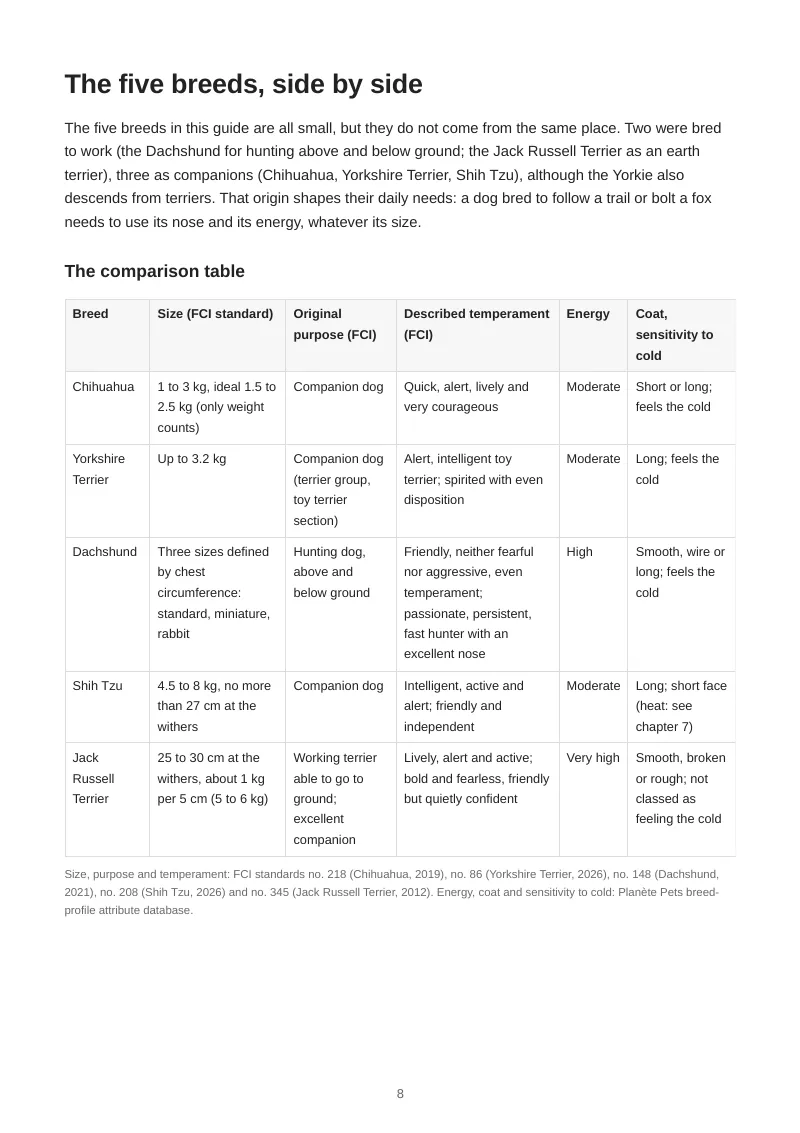
- The comparison table of the five breeds from their official FCI standards (size, original purpose, temperament) and our breed-profile attributes (energy, coat, cold), then a portrait of each with what matters day to day and the trap to avoid
- Concrete plans for the topics that weigh on you: a well-fitted harness, ramps and how to carry, coats, alert barking, house-training small dogs, fear of big dogs, resource guarding, then a 6-week programme with a criterion for moving on each week and seven printable sheets
Checked48 automated checks on every site update (FR/EN parity, internal links, species data, guide PDF files), last checked on 2026-11-0912 sources cited in the guide, including 6 studies with a DOI
Method
- Primary sources: studies with a DOI, official texts
- Every figure linked to its source
- Dated edition, updates included
Card, Apple Pay or Google Pay payment on Stripe’s secure page: your card details never touch our servers. Price VAT included.
“Living with a Small Dog Breed: Chihuahua, Yorkie, Dachshund, Shih Tzu, Jack Russell” is a 37-page printable PDF guide published by Planète Pets (November 2026 edition), sold for €29 VAT included: 17 chapters, 6 studies cited with their DOI, checklists and fill-in sheets, instant download after payment.
What a small size really changes according to six studies, a comparison of the five breeds (temperament, original purpose, activity needs), then daily life topic by topic: walks, harness, stairs and jumping, cold, barking, house-training, fears, handling and resource guarding, with a 6-week reward-based training programme and seven printable sheets.
Key facts
- Price
- €29 VAT included, one-off payment
- Format
- A4 PDF, 37 pages, to read or print
- Languages
- English and French (two PDFs)
- Contents
- 17 chapters, checklists, fill-in sheets
- Sources
- 6 studies with verified DOI; 12 sources in all, full list at the end of the guide
- Edition
- November 2026
- Seller
- Lacangel Group (SAS, France), card payment via Stripe
- Guarantee
- 14-day money-back on a simple email
What the guide contains
17 chapters, 37 A4 pages, with tick-box checklists, fill-in sheets and templates. Studies are cited with their DOI. The French edition is included with your purchase.
- Before you start. Who it is for, what is inside, where the information comes from, what it does not do (no health claims, no medication or doses, no force-based methods).
- What a small size changes, and what it does not. McGreevy (2013), Arhant (2010), Duffy (2008), Mikkola (2021): group trends, the place of fear, the role of consistency and play; a table of what size changes in practice.
- The five breeds, side by side. The comparison table (size, original purpose, temperament, energy, coat and cold) and portraits of the Chihuahua, Yorkie, Dachshund, Shih Tzu and Jack Russell; and if your dog is not on the list.
- Walks: what a small dog needs outside. Three kinds of outing, how to tell if it gets enough, needs by breed, four sniffing games, rewards from the daily food, tug with rules.
- Lead, collar or harness. Harness or collar, the right harness and fit, lead and long line, harness training in six steps, loose-lead walking.
- Stairs, sofa, jumping: life at small-dog height. Setting up the home, teaching the ramp in five steps, carrying your dog with a signal and well supported.
- Cold, rain and heat. Spotting that it is cold, getting it used to a coat, rain and ground, heat and short-faced breeds, never alone in a car.
- Barking: understand before you reduce. The six types of barking, the barking diary, what not to do, the six-step plan for alert barking.
- House-training small dogs. Why it often takes longer, the five-point method, puppy pads, marking, when left alone.
- Fears, encounters and other dogs. Reading signals, the distance rule, the “look at that” game, meeting other dogs, children and visitors.
- Handling, grooming and consent. The consent test, “Up!” to learn to be carried, care in small steps.
- Resource guarding. The ladder of signals, what you never do, management, walking past the bowl, the swap game, the sofa.
- Growling, biting, intense fear: when to seek help. The signs that mean you should seek help, why the vet first and then the veterinary behaviourist, what to do meanwhile.
- Training a small dog: the principles. Why reward-based training (Hiby 2004, Arhant 2010), six principles, the right kit, what you never use, needs first.
- The 6-week programme. Name and marker, mat and harness, lead and recall, discoveries and encounters, swaps and doorbell, generalising: one goal and one criterion for moving on per week.
- Printable sheets. My dog and its thresholds, house-training diary, barking diary, harness and coat measurements, house words and programme log, resource guarding log, when to call the vet.
- Sources. 6 studies with verified DOIs, 5 FCI standards, official texts and pages consulted on 9 November 2026.
Who it is for, and who it is not for
This guide is for you if…
- You live with a Chihuahua, Yorkie, Dachshund, Shih Tzu, Jack Russell or another small dog, and want to understand what it really needs day to day.
- Your small dog barks a lot, is not fully house-trained, pulls on the lead or is afraid of big dogs, and you want a step-by-step plan, without punishment.
- You are choosing between these breeds and want to know what each one asks of you (activity, cold, handling) before welcoming a puppy or an adult.
- You want it to accept the harness, the coat, brushing and being carried, without growling or struggling.
It will not help you if…
- Your dog has already bitten, growls often or is very fearful: see your vet first, then a veterinary behaviourist; the programme is meant for dogs without intense fear or aggression.
- You are looking for breed-specific health information (back, knees, trachea, teeth…): the guide contains none; your vet is the one to advise you.
- You are looking for a method using anti-bark, choke or electric collars: the guide uses none.
- You have a big dog: the principles apply, but the whole guide is designed for small dogs.
In pictures
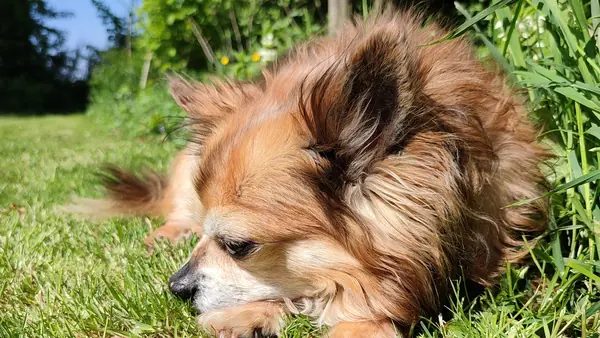


_(Dachshund_(Short)).jpg)


Illustrative photos, published by their authors under free licences.
Free sample
What to take from this
- These are group trends, not fate. These studies describe averages over thousands of dogs. Your Chihuahua is not “aggressive because it is a Chihuahua”: it has its own history, its own character, and above all what you are going to teach it.
- Fear is often at the heart of the problem. Mikkola (2021) links fear to aggression; Arhant (2010) links punishment to fear in small dogs. A small dog that growls when picked up is very often a small dog that is afraid or in pain.
- What you do matters a great deal. A consistent household, play and regular training sessions: exactly what was associated with better behaviour in small dogs in Arhant’s study. It is also the thread of this guide.
- “Small” behaviours deserve to be taken seriously. We more readily let a small dog jump up at our legs, growl when we approach its bed or bark at every passer-by, because there seem to be no consequences. But for the dog, these situations are the same as for a big dog: an emotion it does not know how to manage.
Pick the right option
| Feature | This guide€29 | Best valueComplete library€149 |
|---|---|---|
| PDF guides | 1 | 64 |
| Pages | 37 | 2518 |
| Studies cited (DOI) | 6 | 414 |
| English and French | ✓ | ✓ |
| Price per guide | €29 | €2.33 |
| Refunded within 14 days | ✓ | ✓ |
| Get my guide — €29 | See what’s inside |
Library: €149 instead of €1460 if you buy the 62 guides sold on their own one by one, a saving of €1311 (+ 2 guides only sold in bundles).
€29 one-off payment, updates included
Get my guide — €29Refunded within 14 days on a simple email, no questions asked
Frequently asked questions
What format is the guide?
A PDF to download straight after payment, in English and French, ready to print, with seven sheets: my dog and its thresholds, house-training diary, barking diary, harness and coat measurements, house words and programme log, resource guarding log, when to call the vet.
My dog is not one of the five breeds: is the guide for me?
Yes, if it is a small dog (Bichon, Pomeranian, Pug, French Bulldog, Cavalier King Charles, toy Poodle, small crossbreed…): all of daily life and the programme apply. Chapter 3 explains how to use your breed’s original purpose to place its needs.
Does the guide cover health?
No. It contains no health claims, no medication and no doses. It tells you when to seek help (chapter 13 and sheet 7) and refers every breed-specific health question to your vet.
What training methods do you use?
Reward-based training only: rewards, short sessions, managing the environment. No choke, prong, electric or anti-bark collars, no physical punishment; chapter 14 sums up the studies (Hiby 2004, Arhant 2010) behind this.
My dog growls when picked up: what should I do?
Chapter 11 gives the consent test and how to teach “Up!” in five steps. If the growling is frequent or it has already nipped, see your vet first (pain can explain it), then a veterinary behaviourist (chapter 13).
Where does the information come from?
From 6 published studies with DOIs checked on Crossref, the official FCI standards of the five breeds, our breed-profile attribute database, and common practice among reward-based trainers, flagged as such.
Can I get a refund?
Yes, by simple email to admin@tech-bharat.com within 14 days of purchase, no questions asked.
Free reading on the site
- Harness or collar for your dog: which to choose, and when?
- Dog ramp or stairs: reaching the car and the sofa without injury
- Winter coats for dogs: genuinely useful or just a gimmick?
Seller: LACANGEL GROUP, SAS (French simplified joint-stock company) — SIREN 995 268 018 — registered office: 1 rue Marguerin, 75014 Paris, France — president: Clément Lacaille — EU VAT number FR21995268018 — administration@lacangel.fr. Price VAT included. Digital product delivered right after payment; 14-day money-back commercial guarantee. See the terms of sale.
🩺 Our hygiene and health advice stays general: it never substitutes for an examination by a veterinarian, the only person qualified to advise on your animal.
How it works
Seller: LACANGEL GROUP (SAS), Paris, France, VAT FR21995268018. Prices VAT included. Terms of sale