
Welcoming a Kitten: From Arrival to 12 Months, Week by Week
Who it is for: A kitten is coming home in the next few weeks and you want to prepare everything in order: the house, the equipment, the paperwork, the first vet visit.
- 41 pages
- 17 chapters
- 8 studies (DOI)
- FR + EN
- Edition November 2026
€29VAT included · one-off payment
Get my guide — €29Refunded within 14 days on a simple email, no questions asked
After payment
- Download your PDFs straight away, on the page that opens.
- You also get the link by email, sent by “Planète Pets” (subject “Your download:” followed by the guide’s name).
- Lost it? Find my purchases with your email address.
- No calls, no texts; at most one email, a week later, asking for your review.
For €120 more, Complete library: 64 PDF guides, €2.33 per guide.
- Everything in the order the questions come up: before the arrival (8-week minimum, identification, documents), a kitten-proofed home, the first week day by day, then a week-by-week programme up to 12 months
- The appointment schedule to ask your vet for, based on the WSAVA 2024, AAHA/AAFP and ESCCAP guidelines (vaccines, FeLV, rabies, deworming, neutering), with the questions to ask, and no product names or doses
- The habits that matter for the cat’s whole life: redirecting biting onto toys, scratching posts from day one, a carrier it trusts, introductions to the resident cat or dog, and seven printable sheets (weight, appointments, habituation…)
Checked48 automated checks on every site update (FR/EN parity, internal links, species data, guide PDF files), last checked on 2026-11-0919 sources cited in the guide, including 8 studies with a DOI
Method
- Primary sources: studies with a DOI, official texts
- Every figure linked to its source
- Dated edition, updates included
StandardsBuilt on the guidance of WSAVA, ESCCAP
Card, Apple Pay or Google Pay payment on Stripe’s secure page: your card details never touch our servers. Price VAT included.
“Welcoming a Kitten: From Arrival to 12 Months, Week by Week” is a 41-page printable PDF guide published by Planète Pets (November 2026 edition), sold for €29 VAT included: 17 chapters, 8 studies cited with their DOI, checklists and fill-in sheets, instant download after payment.
Kitten-proofing your home, the first week, the litter tray, kitten food and the switch to adult food, the vet appointment schedule, play and biting, claws, nights, the carrier, introductions and neutering, with a week-by-week programme and seven printable sheets.
Key facts
- Price
- €29 VAT included, one-off payment
- Format
- A4 PDF, 41 pages, to read or print
- Languages
- English and French (two PDFs)
- Contents
- 17 chapters, checklists, fill-in sheets
- Sources
- 8 studies with verified DOI; 19 sources in all, full list at the end of the guide
- Edition
- November 2026
- Seller
- Lacangel Group (SAS, France), card payment via Stripe
- Guarantee
- 14-day money-back on a simple email
What the guide contains
17 chapters, 41 A4 pages, with tick-box checklists, fill-in sheets and templates. Studies are cited with their DOI. The French edition is included with your purchase.
- Before You Begin. Who it is for, what the guide contains, where the information comes from, what it does not do (no products, no doses, no brands).
- Before the Arrival: Age, Paperwork and the Right Questions. The 8-week minimum age, identification, the documents to receive, the certificate of commitment and its 7 days (France), the UK and the US in brief, the questions to ask the shelter, breeder or private owner.
- Preparing Your Home. The safe room, useful equipment with no brands, the hazards to remove (lilies, medicines, windows, cords), the numbers to write down.
- Socialisation: What Happened Between 2 and 7 Weeks, and What You Can Still Do. What McCune (1995) and Casey and Bradshaw (2008) show, and the habituation programme to continue at home.
- The First Week, Day by Day. The journey, the arrival, opening up the house gradually, the first night, what is normal and what is not.
- The Litter Tray. The tray (size, number), the litter, location, cleaning, what to do after an accident.
- Feeding: From Kitten to Adult. Huge needs for a small stomach, complete kitten food, number of meals, switching foods, weighing, moving to adult food.
- The Vet Appointment Schedule. Vaccines (WSAVA 2024), FeLV, rabies, deworming (ESCCAP), fleas: the schedule to ask for and the questions to ask, with no products or doses.
- Play, Biting and Claws. Why it bites, the Strickler and Shull survey, the method to redirect biting onto toys, scratching posts, claw trimming.
- Nights. The evening routine, bedroom or not, meowing and early-morning wake-ups.
- The Carrier and the First Vet Visit. The Pratsch study on carrier training, the 5-step programme, the day of the visit, handling at home.
- Introducing the Kitten to a Resident Cat or Dog. The 5 steps of an introduction, with another cat, with a dog.
- Neutering: What to Ask Your Vet. Sexual maturity and recommended age (International Cat Care), the Joyce and Yates review, the questions to ask, after the operation.
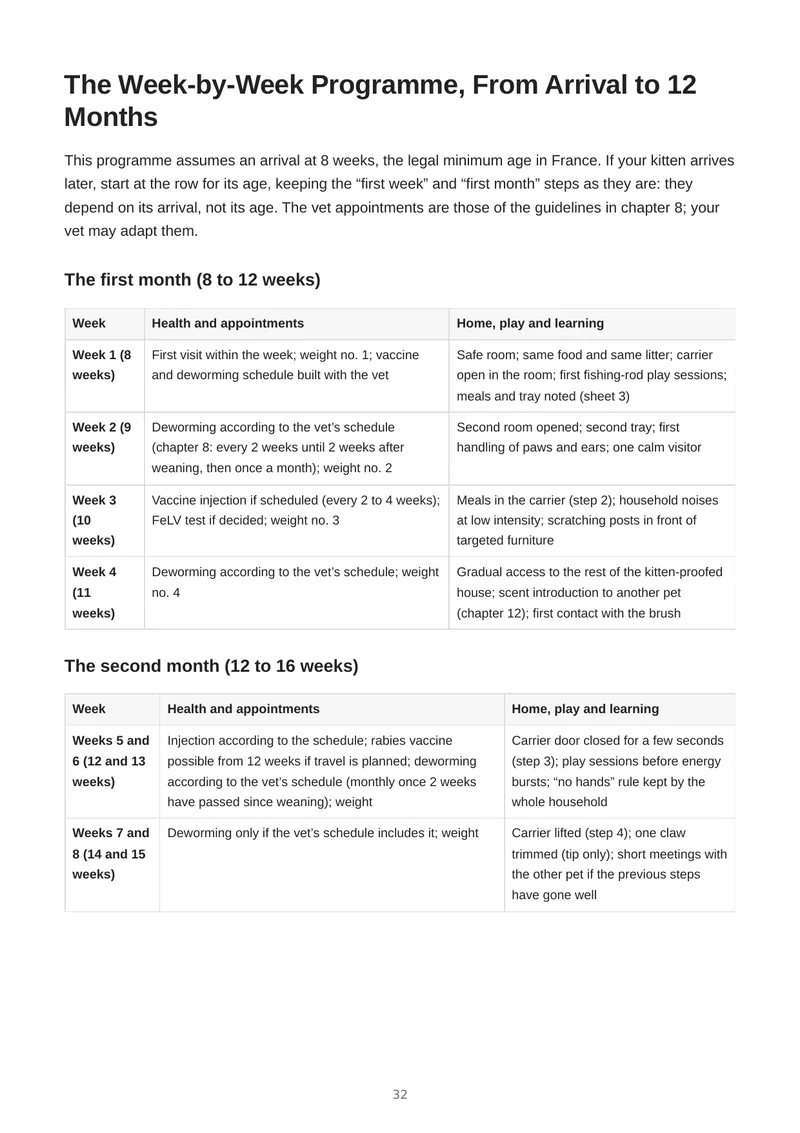
- The Week-by-Week Programme, From Arrival to 12 Months. From 8 weeks to 12 months: health and appointments on one side, home, play and learning on the other.
- When to Call the Vet Straight Away. The signs that call for a same-day call, and those that call for an immediate one.
- Printable Sheets. Questions before adoption, preparing your home, the first week, weight log, appointment record, habituation plan, sheet to pin up by the phone.
- Sources. 8 studies and veterinary guidelines with verified DOIs, official texts, reference organisations.
Who it is for, and who it is not for
This guide is for you if…
- A kitten is coming home in the next few weeks and you want to prepare everything in order: the house, the equipment, the paperwork, the first vet visit.
- Your kitten has just arrived and you wonder whether you are doing it right: it hides, it bites, it meows at night, it does not always use its tray.
- You want to know when to have it vaccinated, dewormed and neutered, and which questions to ask the vet, without getting lost in conflicting advice.
- You already have a cat or a dog and want to introduce the kitten without things going wrong.
It will not help you if…
- You are looking for a vaccine, dewormer or flea product name and its dose: the guide gives the schedule and the questions to ask; the choice of product belongs to your vet.
- Your kitten is ill or has swallowed something toxic: call your vet or an animal poison helpline now, before reading anything.
- You are still deciding on a breed: that is what “Which Cat Breed Is Right for You? 20 Breeds Compared” is for.
- You have found a very young, unweaned kitten outdoors: the guide starts with a weaned kitten old enough to live with you; contact a vet or a rescue organisation.
In pictures



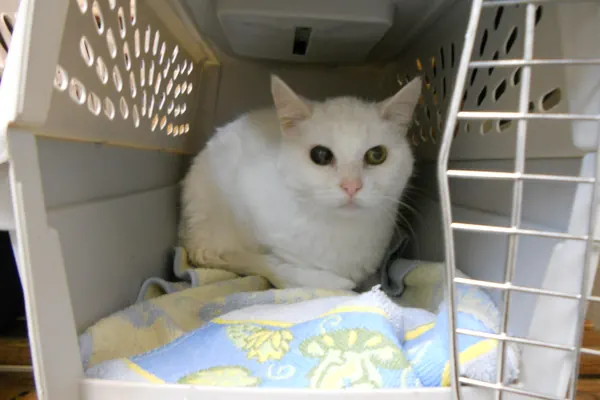
Illustrative photos, published by their authors under free licences.
Free sample
Redirecting the bite: the method
- Anticipate: kittens have bursts of energy (often in the evening and early morning). Before the burst, offer a play session with a fishing-rod toy.
- Play like prey: the feather or string moves away, hides behind furniture, stops, sets off again. Let the kitten catch it regularly: a game with no catch is frustrating.
- Finish with a catch, then a small meal: the natural sequence “hunt, catch, eat, groom, sleep” is calming.
- If it bites a hand or foot: freeze (motionless prey is no longer interesting), without shouting or snatching your hand away, then immediately offer a toy to bite or “kick” with its back legs (a long, soft toy).
- If it does it again: calmly end the game and leave the room for a minute. It learns that biting skin stops the game, while biting the toy keeps it going.
- Never punish physically, do not blow in its face, do not spray water: you would teach it to fear you, and fear often makes biting worse.
House rules, for everyone. No playing with hands, even “for fun”. No wiggling feet under the duvet to amuse it. The fishing-rod toy is put away after play (string left unsupervised can be swallowed). A toy always within reach in the rooms where you sit, to redirect straight away.
Pick the right option
| Feature | This guide€29 | Best valueComplete library€149 |
|---|---|---|
| PDF guides | 1 | 64 |
| Pages | 41 | 2518 |
| Studies cited (DOI) | 8 | 414 |
| English and French | ✓ | ✓ |
| Price per guide | €29 | €2.33 |
| Refunded within 14 days | ✓ | ✓ |
| Get my guide — €29 | See what’s inside |
Library: €149 instead of €1460 if you buy the 62 guides sold on their own one by one, a saving of €1311 (+ 2 guides only sold in bundles).
€29 one-off payment, updates included
Get my guide — €29Refunded within 14 days on a simple email, no questions asked
Frequently asked questions
What format is the guide?
A PDF to download right after payment, in English and French, ready to print, with seven sheets: questions before adoption, preparing your home, the first week, weight log, appointment record, habituation plan and a sheet to pin up by the phone.
Does the guide say which vaccines and dewormers to use?
No, on purpose. It gives the recommended schedule (WSAVA 2024, AAHA/AAFP, ESCCAP) and the questions to ask at each visit; the choice of product and dose belongs to the vet who examines your kitten.
My kitten arrives at 10 or 12 weeks: is the programme still useful?
Yes. The programme assumes an arrival at 8 weeks, the minimum legal age in France, but every row gives the age: you start at your kitten’s row, and the first-week and first-month steps count from its arrival.
Do you recommend a brand of food?
No. The guide explains what matters on the label (complete food, formulated for growth), the number of meals by age, switching foods and moving to adult food at about 9 to 12 months, with no brands and no diets.
Is it written for readers outside France?
The care, feeding, vet schedule and behaviour chapters apply everywhere. The adoption rules are those of France, with a box on the UK (microchip by 20 weeks) and the US (rabies set by state or local law); check the rules where you live.
Where does the information come from?
From 8 published studies and veterinary guidelines (DOIs checked on Crossref), official pages (service-public.fr, ESCCAP France, GOV.UK) and reference organisations (International Cat Care, Merck Veterinary Manual, FDA). Each source is cited where it is used.
Can I get a refund?
Yes, by simple email to admin@tech-bharat.com within 14 days of purchase, no questions asked.
Free reading on the site
- How to litter train a kitten: the gentle, step-by-step method
- Kitten food: how to choose the right kibble from 2 to 12 months
- Kitten or Adult Cat: What Gear You Actually Need by Age
Seller: LACANGEL GROUP, SAS (French simplified joint-stock company) — SIREN 995 268 018 — registered office: 1 rue Marguerin, 75014 Paris, France — president: Clément Lacaille — EU VAT number FR21995268018 — administration@lacangel.fr. Price VAT included. Digital product delivered right after payment; 14-day money-back commercial guarantee. See the terms of sale.
🩺 Our hygiene and health advice stays general: it never substitutes for an examination by a veterinarian, the only person qualified to advise on your animal.
How it works
Seller: LACANGEL GROUP (SAS), Paris, France, VAT FR21995268018. Prices VAT included. Terms of sale