The Indoor Cat: Setting Up and Enriching Life for a Cat That Stays In
Who it is for: Your cat lives indoors, in a flat or a house, and you want to be sure it lacks nothing: enough litter boxes, hiding places, height and play.
- 39 pages
- 20 chapters
- 12 studies (DOI)
- FR + EN
- Edition November 2026
€24VAT included · one-off payment
Get my guide — €24Refunded within 14 days on a simple email, no questions asked
After payment
- Download your PDFs straight away, on the page that opens.
- You also get the link by email, sent by “Planète Pets” (subject “Your download:” followed by the guide’s name).
- Lost it? Find my purchases with your email address.
- No calls, no texts; at most one email, a week later, asking for your review.
For €125 more, Complete library: 64 PDF guides, €2.33 per guide.
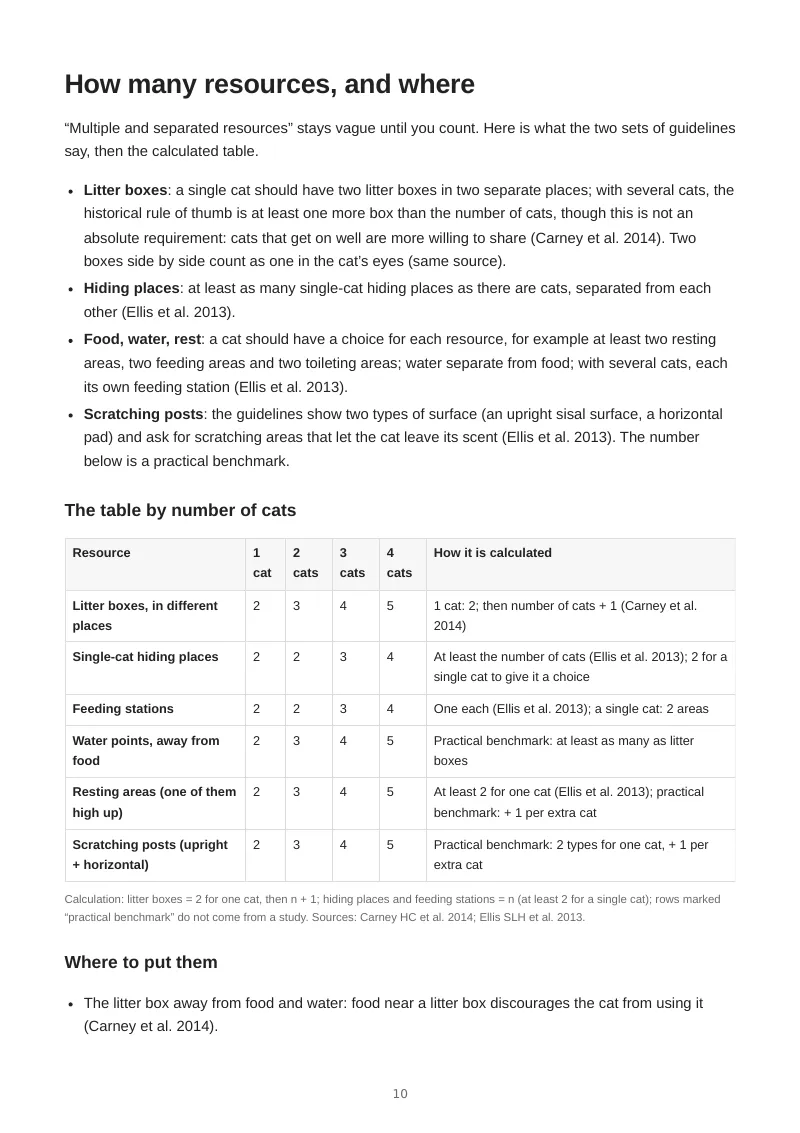
- A home designed for your cat: the calculated table of litter boxes, hiding places, bowls, water points and scratching posts for 1 to 4 cats from the AAFP/ISFM guidelines, a box 1.5 times its length, height and a plan for a studio, one-bedroom or two-bedroom flat
- A safe cat: what 251 cats that fell from buildings in New York and Zagreb show, making windows, tilt-and-turn windows and balconies safe, toxic plants from the ASPCA list and the signs that call for a vet
- A busy, healthy cat: the play session that mimics prey, food puzzles in 5 levels, the smells that work, weighing and a rough calorie guide, a sample schedule for a working day and seven printable sheets
Checked48 automated checks on every site update (FR/EN parity, internal links, species data, guide PDF files), last checked on 2026-11-1612 studies cited with their DOI in the bundle’s guides
Method
- Primary sources: studies with a DOI, official texts
- Every figure linked to its source
- Dated edition, updates included
Card, Apple Pay or Google Pay payment on Stripe’s secure page: your card details never touch our servers. Price VAT included.
“The Indoor Cat: Setting Up and Enriching Life for a Cat That Stays In” is a 39-page printable PDF guide published by Planète Pets (November 2026 edition), sold for €24 VAT included: 20 chapters, 12 studies cited with their DOI, checklists and fill-in sheets, instant download after payment.
Count and place litter boxes, hiding places, bowls and scratching posts for your number of cats, choose a box sized for your cat, gain height, make windows and balconies safe, set up daily hunting play and food to search for, refresh smells, watch its weight, organise the day around your work and know when to call the vet, with seven printable sheets.
Key facts
- Price
- €24 VAT included, one-off payment
- Format
- A4 PDF, 39 pages, to read or print
- Languages
- English and French (two PDFs)
- Contents
- 20 chapters, checklists, fill-in sheets
- Sources
- 12 studies with verified DOI; full list at the end of the guide
- Edition
- November 2026
- Seller
- Lacangel Group (SAS, France), card payment via Stripe
- Guarantee
- 14-day money-back on a simple email
What the guide contains
20 chapters, 39 A4 pages, with tick-box checklists, fill-in sheets and templates. Studies are cited with their DOI. The French edition is included with your purchase.
- Before you start. Who it is for, what the guide contains, where the information comes from (12 publications with DOIs, AAFP/ISFM guidelines, ASPCA), what it does not do (no health claims, no medicines or doses).
- Living indoors: what a cat gains, what it can miss. The risks an indoor life removes (Tan et al. 2020), what a cat can miss, what science knows and does not yet know (review of 61 papers, Foreman-Worsley and Farnworth 2019).
- The five needs, room by room. The five pillars of the AAFP/ISFM guidelines applied to a studio, a one-bedroom and a two-bedroom flat, and the route test.
- How many resources, and where. The calculated table of litter boxes, hiding places, feeding stations, water points, resting areas and scratching posts for 1 to 4 cats, where to put them, a one-bedroom example.
- The litter box in a flat. Box size calculated at 1.5 times your cat’s length (table from 35 to 60 cm), litter, depth, covered or open, placement.
- Height: shelves, cat trees, lookout posts. Why height matters, what makes a good perch, building a route, the window perch.
- Windows, balconies and falls. What 132 cats in New York (Whitney and Mehlhaff 1987) and 119 cats in Zagreb (Vnuk et al. 2004) show, making windows, tilt-and-turn windows, balconies and skylights safe, what to do if your cat falls.
- The daily hunting game. What the trial by Cecchetti et al. (2021) measured, the session that mimics prey, the minute-by-minute breakdown, when to play, the laser.
- Eating by searching: food puzzles and feeders. How cats eat (Delgado and Dantas 2020), the food puzzle guide (Dantas et al. 2016), the 5-level progression with criteria, the rules, the timed feeder.
- Smells: catnip, silver vine, valerian. Respecting its scent, what Bol et al. (2017) measured in 100 cats and Ellis and Wells (2010) in 150 cats, other new smells without buying anything.
- An indoor cat’s weight. The study of 966 Bristol cats (Rowe et al. 2015), the monthly weigh-in, the rough calorie table from 3 to 6 kg and reading a label, free-feeding or meals.
- The rhythm of the day. The principles, a sample schedule for someone out from 8 am to 6 pm, weekends and holidays, changes.
- Stress and the bladder: what the environment changes. The study of 46 indoor cats with idiopathic cystitis (Buffington et al. 2006), what you can prepare, the urinary emergency.
- Plants and household hazards. Lilies, the table of 8 common houseplants from the ASPCA, string and small objects, what to do if your cat swallows something.
- One cat or two in a flat. What the guidelines say about groups of cats, should you get a second cat, if they already live together.
- Fresh air without roaming: enclosed balcony, enclosure, harness. The enclosed balcony, the enclosure, first steps with a harness, what a supervised outing requires.
- From an outdoor life to an indoor one. The four-stage plan with criteria, litter and garden soil, the cat that meows at the door.
- The weekly check and when to see the vet. The daily glance, the weekly check, the table of signs that call for a vet and when to call.
- Printable sheets. The plan of my home, my resources counted, window and balcony safety, the daily schedule, rotating toys and smells, weight and litter box, for the person looking after it and when to call the vet.
- Sources. 12 publications with checked DOIs, one case series cited by its PubMed reference, ASPCA, CNITV.
Who it is for, and who it is not for
This guide is for you if…
- Your cat lives indoors, in a flat or a house, and you want to be sure it lacks nothing: enough litter boxes, hiding places, height and play.
- You are about to welcome a cat that will not go out, or your cat has to move from an outdoor life to an indoor one (a move, a dangerous road, an older cat).
- You work all day and want to organise its meals, play and food puzzles around your hours.
- You have a balcony or windows you would like to open safely, or your cat has been gaining weight since it started living indoors.
It will not help you if…
- Your cat seems ill (straining in the litter box without passing urine, not eating, breathing with its mouth open, has fallen): call a vet first; the guide lists warning signs but does not replace a consultation.
- You are looking for a treatment, a medicine, a dose or a weight-loss diet: the guide contains none.
- Your cat has an established behaviour problem (urinating outside the box, scratching, biting, conflicts): our cat behaviour guide, with a step-by-step plan for each problem, will suit you better.
- You want to teach your cat tricks or walk it on a harness step by step: our cat training course is made for that.
In pictures
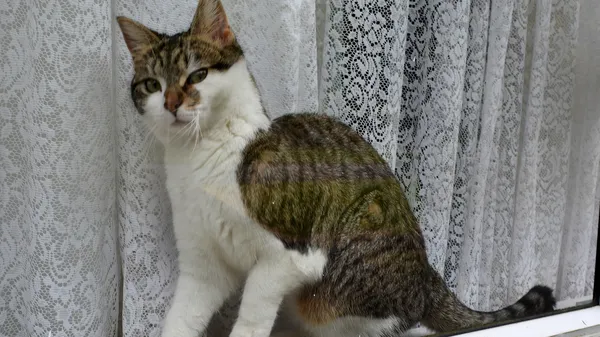



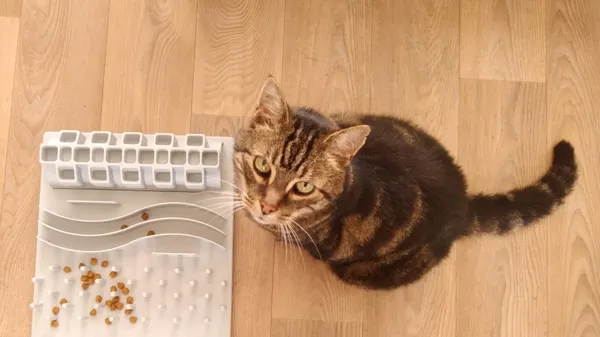

Illustrative photos, published by their authors under free licences.
Free sample
Box size: 1.5 times the cat’s length
| Your cat’s length (nose → base of tail) | Minimum box length |
|---|---|
| 35 cm | 53 cm |
| 40 cm | 60 cm |
| 45 cm | 68 cm |
| 50 cm | 75 cm |
| 55 cm | 83 cm |
| 60 cm | 90 cm |
Pick the right option
| Feature | This guide€24 | Best valueComplete library€149 |
|---|---|---|
| PDF guides | 1 | 64 |
| Pages | 39 | 2518 |
| Studies cited (DOI) | 12 | 414 |
| English and French | ✓ | ✓ |
| Price per guide | €24 | €2.33 |
| Refunded within 14 days | ✓ | ✓ |
| Get my guide — €24 | See what’s inside |
Library: €149 instead of €1460 if you buy the 62 guides sold on their own one by one, a saving of €1311 (+ 2 guides only sold in bundles).
€24 one-off payment, updates included
Get my guide — €24Refunded within 14 days on a simple email, no questions asked
Frequently asked questions
What format is the guide in?
A PDF to download right after payment, in English and French, ready to print, with seven sheets: the plan of my home, my resources counted, window and balcony safety, the daily schedule, rotating toys and smells, weight and litter box, and a sheet for the person looking after your cat with when to call the vet.
How is it different from the cat behaviour guide?
The behaviour guide solves established problems (urinating outside the box, scratching, biting, conflicts between cats, restless nights) with a step-by-step plan for each. This one starts from the home of a cat that does not go out: the number of resources calculated for your number of cats, box size, height, window and balcony safety, play and food to search for, smells, weight, a working-day schedule, toxic plants, supervised outdoor time and moving from an outdoor life to an indoor one.
I live in a studio flat: is the guide suitable?
Yes. Chapter 3 deals with the studio separately (height, separating resources, a single large litter box cleaned twice a day when space is short, the rule remaining two boxes for one cat), chapter 5 calculates the box size from your cat’s length and chapter 6 explains how to gain space up high, including in a rented flat.
Can my balcony be made safe?
Chapter 7 sets out what two series of cats that fell from buildings show (132 in New York, 119 in Zagreb), then how to secure each opening: windows, tilt-and-turn windows, a balcony closed with a full-height net, roof windows, and what to do if your cat falls. Sheet 3 turns it into a tick list.
Does the guide say how much to feed my cat?
It gives a published rough guide (about 55 kcal per kilo per day for an average neutered adult, which varies widely between cats), calculated from 3 to 6 kg, to check a label and spot a large gap (chapter 11). It is not a ration: that is set with your vet, and no diet is proposed.
Where does the information come from?
From 12 publications with DOIs checked on Crossref, including the AAFP and ISFM guidelines on cats’ environmental needs (2013) and on house-soiling (2014), a case series cited by its PubMed reference, and the ASPCA toxic plant database; advice that comes from practice is flagged as such.
Can I get a refund?
Yes, by simple email to admin@tech-bharat.com within 14 days of purchase, no questions asked.
Free reading on the site
- Equipping an apartment cat without a balcony: the complete guide
- Cat window safety: preventing high-rise syndrome
- Feline idiopathic cystitis: what a landmark study shows about environmental enrichment
Seller: LACANGEL GROUP, SAS (French simplified joint-stock company) — SIREN 995 268 018 — registered office: 1 rue Marguerin, 75014 Paris, France — president: Clément Lacaille — EU VAT number FR21995268018 — administration@lacangel.fr. Price VAT included. Digital product delivered right after payment; 14-day money-back commercial guarantee. See the terms of sale.
🩺 Reminder: this page informs, it does not diagnose. For any symptom or health question, your veterinarian remains the only reference.
How it works
Seller: LACANGEL GROUP (SAS), Paris, France, VAT FR21995268018. Prices VAT included. Terms of sale