Backyard Chicken Coop: Choosing, Setting Up and Protecting Your Coop
Who it is for: You are about to get hens and want to choose, buy or build a coop that is the right size, safe and easy to clean.
- 37 pages
- 17 chapters
- 11 studies (DOI)
- FR + EN
- Edition November 2026
€29VAT included · one-off payment
Get my guide — €29Refunded within 14 days on a simple email, no questions asked
After payment
- Download your PDFs straight away, on the page that opens.
- You also get the link by email, sent by “Planète Pets” (subject “Your download:” followed by the guide’s name).
- Lost it? Find my purchases with your email address.
- No calls, no texts; at most one email, a week later, asking for your review.
For €120 more, Complete library: 64 PDF guides, €2.33 per guide.
- The right size first time: space, perch and nest boxes calculated for 2 to 8 hens from four compared sources (EU directive, organic regulation, University of Maryland, Virginia Tech), and how to check a coop sold “for 4 to 6 hens”
- Hens that sleep safely: the right mesh (13 mm, nothing over 6 mm at night), buried and toed-out mesh, netting against birds of prey, catches, and the table that identifies the predator after an attack
- A healthy coop all year: perches following EFSA’s opinion (height, 3 to 6 cm wide, jumps of 80 cm at most), nest boxes, draught-free ventilation, run, red mites, avian influenza, maintenance calendar and seven printable sheets
Checked48 automated checks on every site update (FR/EN parity, internal links, species data, guide PDF files), last checked on 2026-11-1519 sources cited in the guide, including 11 studies with a DOI
Method
- Primary sources: studies with a DOI, official texts
- Every figure linked to its source
- Dated edition, updates included
Card, Apple Pay or Google Pay payment on Stripe’s secure page: your card details never touch our servers. Price VAT included.
“Backyard Chicken Coop: Choosing, Setting Up and Protecting Your Coop” is a 37-page printable PDF guide published by Planète Pets (November 2026 edition), sold for €29 VAT included: 17 chapters, 11 studies cited with their DOI, checklists and fill-in sheets, instant download after payment.
Calculate floor space, perch length and the number of nest boxes for your number of hens, judge a coop before you buy it, choose the site, floor and litter, get perches, nest boxes and ventilation right, set up the run, protect hens from foxes, martens, rats and birds of prey, prevent red mites, prepare for avian influenza and know the planning rules, with seven printable sheets.
Key facts
- Price
- €29 VAT included, one-off payment
- Format
- A4 PDF, 37 pages, to read or print
- Languages
- English and French (two PDFs)
- Contents
- 17 chapters, checklists, fill-in sheets
- Sources
- 11 studies with verified DOI; 19 sources in all, full list at the end of the guide
- Edition
- November 2026
- Seller
- Lacangel Group (SAS, France), card payment via Stripe
- Guarantee
- 14-day money-back on a simple email
What the guide contains
17 chapters, 37 A4 pages, with tick-box checklists, fill-in sheets and templates. Studies are cited with their DOI. The French edition is included with your purchase.
- Before you start. Who it is for, what the guide contains, where the information comes from (11 studies and opinions with DOIs, EU directive, organic regulation, Virginia Tech, University of Maryland), what it does not do (no medicines, no doses, no brands).
- What a hen needs, before the wood and the wire. Sleeping up high, laying in an enclosed nest, dust bathing, scratching, taking cover: what the studies say, and the need-by-need table.
- How many hens, how much space: the calculation. The four sources compared, the benchmark used, the ready-made table for 2 to 8 hens, a worked example for four hens, and how to read a coop sold “for 4 to 6 hens”.
- Bought, flat-pack or built: choosing your coop. Materials compared, fixed or mobile, what a good coop must allow (cleaning, ventilation, pop hole, mesh), feeder and drinker.
- Where to put it in the garden. Drained ground, orientation, wind and shade, visibility, water and power, distance from neighbours, trees and fences.
- Floor, litter and droppings. Slab, raised floor, earth or buried mesh; litters compared; the droppings board; what to do with droppings.
- Perches. Height, jumps of 80 cm at most, 3 to 6 cm width, shape, material, length per hen, spacing, removable perches (EFSA opinion, 2015).
- Nest boxes. How many, what size, where to put them, lining, access before laying, daily collection.
- Ventilation, damp, heat and cold. Ammonia and what it does to hens, ventilating without draughts, winter without heating, light, heat and shade.
- The run. Space, cover that gets hens ranging, dust bath, rotation, netting or a roof overhead.
- Protecting hens from predators. Who attacks and when, shutting up at night, the right mesh, against diggers, climbers and fliers, electric wire, catches, the table of signs left by each predator.
- Rats, wild birds and avian influenza. Feed and eggs, biosecurity, risk levels and housing orders (French order of 25 September 2023), hand and egg hygiene.
- Red mites: a coop that does not harbour them. How the mite lives, what it changes in coop design, weekly monitoring, what to do in an infestation.
- Maintenance: the calendar. Every day, every week, every month, twice a year, by season; the deep clean step by step; holidays.
- Planning rules, neighbours and registration. French formalities by floor area (5 and 20 m²), protected areas, outside France, registering hens, neighbours and cockerels.
- Printable sheets. My coop in figures, before you buy or build, the evening round, maintenance calendar, red mite check, for the person looking after the hens, after an attack.
- Sources. 11 studies and opinions with checked DOIs, Directive 1999/74/EC, Regulation (EU) 2020/464, French order of 25 September 2023, Service-Public.fr, Virginia Tech, University of Maryland, US cooperative extension, CDC.
Who it is for, and who it is not for
This guide is for you if…
- You are about to get hens and want to choose, buy or build a coop that is the right size, safe and easy to clean.
- You are looking at a flat-pack coop and want to know how many hens it really suits.
- Your coop already exists: a hen has gone missing, the hens refuse to go in at night, the litter smells of ammonia or you suspect red mites.
- You want your set-up ready for avian influenza housing orders and to know the planning rules before you build.
It will not help you if…
- A hen is sick, injured or losing weight: take her to a vet who treats poultry; the guide says what should worry you but makes no diagnosis.
- You are looking for a red mite treatment or doses: the guide contains none.
- You want to tame your hens or teach them to go in by themselves: that is what our chicken course is for.
- You are looking for a comparison of coop brands or prices, or a guide to commercial production or incubation: that is not what this guide is about.
Coop ready? For what happens inside it (the ration calculated for your flock, laying month by month, the hen who stops laying, hatching and chicks), read our guide Laying Hens: Feeding, Laying, Winter, Chicks and Hatching.
In pictures
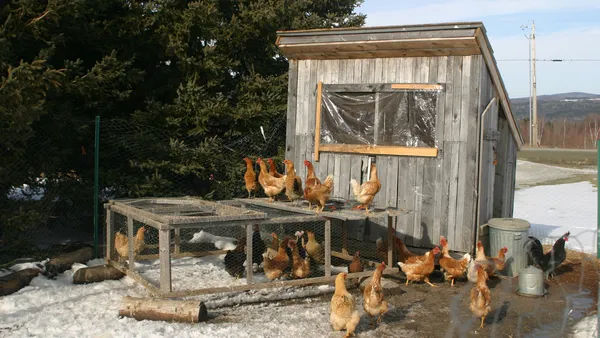

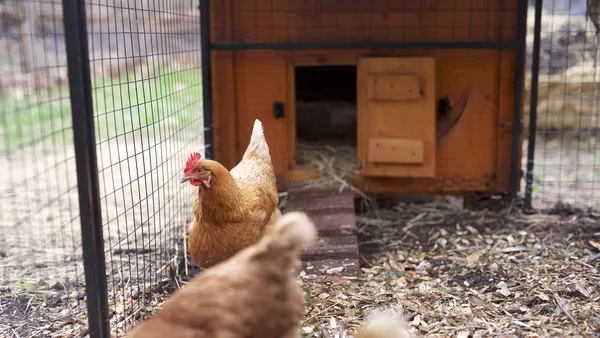

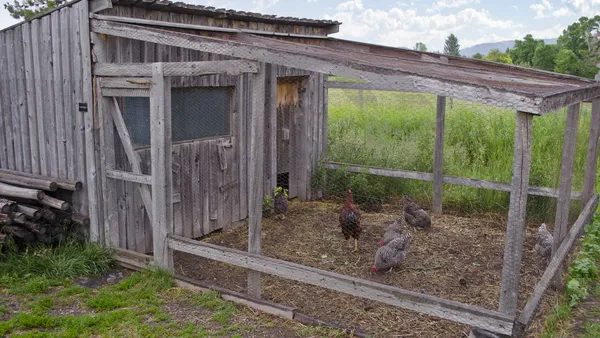

Illustrative photos, published by their authors under free licences.
Free sample
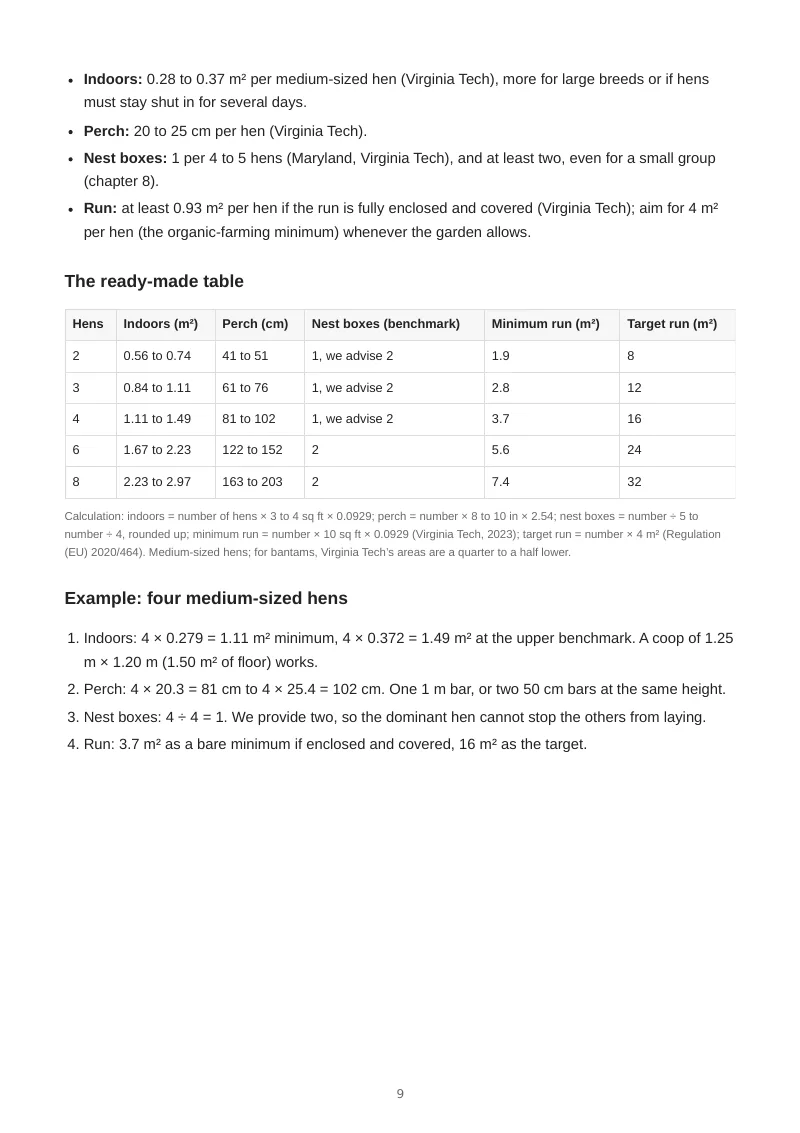
The ready-made table
| Hens | Indoors (m²) | Perch (cm) | Nest boxes (benchmark) | Minimum run (m²) | Target run (m²) |
|---|---|---|---|---|---|
| 2 | 0.56 to 0.74 | 41 to 51 | 1, we advise 2 | 1.9 | 8 |
| 3 | 0.84 to 1.11 | 61 to 76 | 1, we advise 2 | 2.8 | 12 |
| 4 | 1.11 to 1.49 | 81 to 102 | 1, we advise 2 | 3.7 | 16 |
| 6 | 1.67 to 2.23 | 122 to 152 | 2 | 5.6 | 24 |
| 8 | 2.23 to 2.97 | 163 to 203 | 2 | 7.4 | 32 |
Calculation: indoors = number of hens × 3 to 4 sq ft × 0.0929; perch = number × 8 to 10 in × 2.54; nest boxes = number ÷ 5 to number ÷ 4, rounded up; minimum run = number × 10 sq ft × 0.0929 (Virginia Tech, 2023); target run = number × 4 m² (Regulation (EU) 2020/464). Medium-sized hens; for bantams, Virginia Tech’s areas are a quarter to a half lower.
Pick the right option
| Feature | This guide€29 | Best valueComplete library€149 |
|---|---|---|
| PDF guides | 1 | 64 |
| Pages | 37 | 2518 |
| Studies cited (DOI) | 11 | 414 |
| English and French | ✓ | ✓ |
| Price per guide | €29 | €2.33 |
| Refunded within 14 days | ✓ | ✓ |
| Get my guide — €29 | See what’s inside |
Library: €149 instead of €1460 if you buy the 62 guides sold on their own one by one, a saving of €1311 (+ 2 guides only sold in bundles).
€29 one-off payment, updates included
Get my guide — €29Refunded within 14 days on a simple email, no questions asked
Frequently asked questions
What format is the guide in?
A PDF to download right after payment, in English and French, ready to print, with seven sheets: my coop in figures, before you buy or build, the evening round, maintenance calendar, red mite check, for the person looking after the hens, after an attack.
How is it different from your chicken course?
The “Backyard Chickens” course gives one chapter to the coop and the rest to training (taming, going in at night, living with a dog). This guide is entirely about housing: space calculated for 2 to 8 hens, choosing the coop and its materials, siting, floor, perches, nest boxes, ventilation, run, predators, red mites, maintenance and planning rules.
I don’t have hens yet: is it for me?
Yes, it is the best time: chapters 2 and 3 and sheets 1 and 2 are designed to settle size and site before you buy anything.
Does the guide include building plans?
It does not give a joinery plan with dimensions for every board. It gives the measurements that matter (floor space, perch height, nest box size, pop hole, mesh, depth of buried mesh) to build, convert an existing shed or judge a ready-made coop.
Are there prices?
No: coops and materials vary too much. The guide helps you choose by dimensions and security, not by brand.
Does the guide cover health?
It explains how to design a healthy coop (ventilation, dry litter, red mites, hygiene) and when to take a hen to the vet. It contains no medicines, no treatments and no doses.
Where does the information come from?
From 11 published studies and opinions with DOIs checked on Crossref (including EFSA’s opinion on perches), the EU laying hens directive, the EU organic regulation, the Virginia Tech and University of Maryland extension guides, the US cooperative extension network and the CDC; advice that comes from practice is flagged as such.
Can I get a refund?
Yes, by simple email to admin@tech-bharat.com within 14 days of purchase, no questions asked.
Free reading on the site
- Outdoor garden aviary: real budget and health-safety measures
- DIY vs store-bought aviary: which option is really safer and cheaper?
Seller: LACANGEL GROUP, SAS (French simplified joint-stock company) — SIREN 995 268 018 — registered office: 1 rue Marguerin, 75014 Paris, France — president: Clément Lacaille — EU VAT number FR21995268018 — administration@lacangel.fr. Price VAT included. Digital product delivered right after payment; 14-day money-back commercial guarantee. See the terms of sale.
🩺 This health information is general in nature and does not replace a consultation: at the slightest doubt about your animal’s condition, talk to your vet.
How it works
Seller: LACANGEL GROUP (SAS), Paris, France, VAT FR21995268018. Prices VAT included. Terms of sale