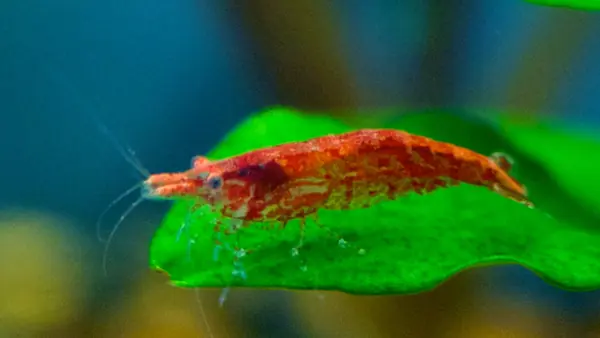
Aquarium Shrimp: Cherry Shrimp, Neocaridina and Caridina, from Tank to Breeding
Who it is for: You want to set up your first shrimp tank and get it right first time, without losing half the shrimp in the first week.
- 32 pages
- 14 chapters
- 12 studies (DOI)
- FR + EN
- Edition November 2026
€24VAT included · one-off payment
Get my guide — €24Refunded within 14 days on a simple email, no questions asked
After payment
- Download your PDFs straight away, on the page that opens.
- You also get the link by email, sent by “Planète Pets” (subject “Your download:” followed by the guide’s name).
- Lost it? Find my purchases with your email address.
- No calls, no texts; at most one email, a week later, asking for your review.
For €125 more, Complete library: 64 PDF guides, €2.33 per guide.
- Water that does not kill them: the GH, KH, pH and TDS to aim for in each group, the calculated table of how much a water change shifts your values, what two studies show about temperature (eggs lost at 32 °C, no spawning at all at 33 °C) and the four copper rules, since French tap-water rules allow more copper than the dose that kills half of Amano shrimp
- Losses you can understand: moulting and the exuvia, the mortality table (what you see, the likely cause, what you do), the small hitchhikers carried by three quarters of 900 imported shrimp, drip acclimation calculated for the bag volume, and the “shrimp are dying, where do I start?” sheet
- A colony that grows: 21 days of incubation at 24 °C and 24 juveniles per brood on average according to a laboratory study, the tank mates that eat or spare juveniles, the black background that makes females redder, the food that matters for the eggs, and the timeline of one generation
Checked48 automated checks on every site update (FR/EN parity, internal links, species data, guide PDF files), last checked on 2026-11-2212 studies cited with their DOI in the bundle’s guides
Method
- Primary sources: studies with a DOI, official texts
- Every figure linked to its source
- Dated edition, updates included
Card, Apple Pay or Google Pay payment on Stripe’s secure page: your card details never touch our servers. Price VAT included.
“Aquarium Shrimp: Cherry Shrimp, Neocaridina and Caridina, from Tank to Breeding” is a 32-page printable PDF guide published by Planète Pets (November 2026 edition), sold for €24 VAT included: 14 chapters, 12 studies cited with their DOI, checklists and fill-in sheets, instant download after payment.
Choose between Neocaridina, Caridina and Amano, size the tank on its real water volume, aim for the right GH, KH and TDS, cycle, avoid copper and swings, plant, drip-acclimate, feed, understand moulting and losses, pick tank mates, get the colony breeding and raise the juveniles, with six printable sheets.
Key facts
- Price
- €24 VAT included, one-off payment
- Format
- A4 PDF, 32 pages, to read or print
- Languages
- English and French (two PDFs)
- Contents
- 14 chapters, checklists, fill-in sheets
- Sources
- 12 studies with verified DOI; full list at the end of the guide
- Edition
- November 2026
- Seller
- Lacangel Group (SAS, France), card payment via Stripe
- Guarantee
- 14-day money-back on a simple email
What the guide contains
14 chapters, 32 A4 pages, with tick-box checklists, fill-in sheets and templates. Studies are cited with their DOI. The French edition is included with your purchase.
- Before you start. Who it is for, what the guide contains, what it does not repeat from the water and planted guides, where the information comes from (12 publications with DOI, one official text, flagged practical benchmarks), what it does not do.
- Choosing your species: Neocaridina, Caridina or Amano. The cherry shrimp and its colours, one species; “bee” shrimp; the Amano, which does not breed in fresh water; the three groups at a glance.
- The tank: size, filter, lid and heating. The 20-litre benchmark, the calculated table of the real water volume of 7 nano tanks, the sponge filter, the lid, heating, the start-up list.
- Shrimp water: GH, KH, TDS, cycling, temperature and copper. The four values that matter, tap water, cycling and biofilm, the calculated table of water-change shifts, temperature (Tropea et al. 2015, Baliña et al. 2018), copper (Ravaux et al. 2025, Daly et al. 1992, French order of 11/01/2007), insecticides (Huang et al. 2006).
- Plants, mosses, substrate and decor. What plants do for shrimp, the table of easy plants, new plants and pesticides, dried leaves, the black background (Tomas et al. 2020), decor.
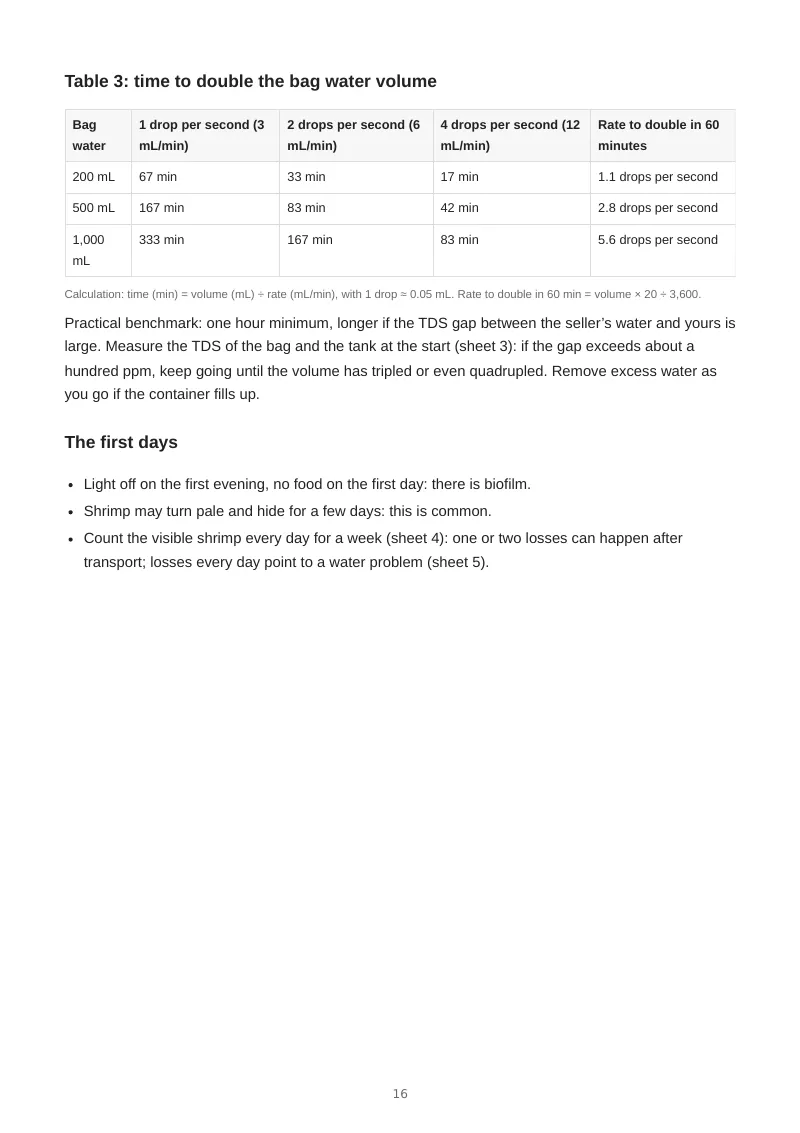
- Bringing shrimp home: choosing, transport, acclimation. Choosing in a shop, epibionts (Maciaszek et al. 2023), quarantine, transport, the calculated drip-acclimation table, the first days.
- Feeding your shrimp. Biofilm, what a study of three commercial foods shows (Sganga and López Greco 2020), a simple diet, the right amount, holidays.
- Moulting and losses. How a moult happens, the exuvia, why moulting is the dangerous moment, life span, the mortality table in 9 situations.
- Living with fish and snails. What a wild population shows (Schoolmann and Arndt 2018), the table of possible tank mates, our view.
- Breeding. Telling males from females, from mating to hatching, the timeline of one generation, if your shrimp are not breeding, females that drop their eggs, Caridina.
- Raising juveniles and managing the colony. The first weeks, keeping a colour, when the colony gets too big, never release (Klotz et al. 2013, Maciaszek et al. 2021), rehoming shrimp.
- The twelve beginner mistakes. Each mistake, why it is a problem and the chapter that covers it.
- Printable sheets. My tank and my water, before buying my shrimp, acclimation log, weekly log, shrimp are dying: where do I start, brood log.
- Sources. 12 publications with checked DOI, the French order of 11 January 2007, Planète Pets data.
Who it is for, and who it is not for
This guide is for you if…
- You want to set up your first shrimp tank and get it right first time, without losing half the shrimp in the first week.
- Your shrimp are dying one by one, or all at once after a water change, and you want to understand why.
- Your cherry shrimp colony is not breeding, is losing its colour, or the females drop their eggs.
- You are torn between Neocaridina, Caridina and Amano, or between a species tank and a tank with fish.
It will not help you if…
- You are looking for a medicinal treatment for sick shrimp: the guide gives none and refers you to a vet who works with aquatic animals.
- You want the full water chemistry (reading tests, blending, step-by-step remineralisation): that is the subject of our Aquarium Water guide, which this one refers to.
- You want to build an aquascape with CO2 and fertilisers: our planted aquarium guide is made for that.
- You keep marine or brackish shrimp: the guide only covers freshwater shrimp.
Free sample
Table 1: real water volume of common nano tanks
| Dimensions (L × D × H, cm) | Gross volume (L) | Real water depth (cm) | Real water volume (L) | For a starting colony of 10 Neocaridina? |
|---|---|---|---|---|
| 20 × 20 × 20 | 8.0 | 14 | 5.6 | No |
| 30 × 20 × 20 | 12.0 | 14 | 8.4 | No |
| 40 × 25 × 20 | 20.0 | 14 | 14.0 | No: a “20 L” tank holds only 14 L of water |
| 40 × 25 × 25 | 25.0 | 19 | 19.0 | Only just |
| 30 × 30 × 30 | 27.0 | 24 | 21.6 | Yes |
| 45 × 30 × 30 | 40.5 | 24 | 32.4 | Yes, comfortable |
| 60 × 30 × 30 | 54.0 | 24 | 43.2 | Yes, very stable |
Calculation: real volume = length × depth × (height − 4 cm substrate − 2 cm gap) ÷ 1,000. 20 L benchmark: Planète Pets attribute database.
Pick the right option
| Feature | This guide€24 | Best valueComplete library€149 |
|---|---|---|
| PDF guides | 1 | 64 |
| Pages | 32 | 2518 |
| Studies cited (DOI) | 12 | 414 |
| English and French | ✓ | ✓ |
| Price per guide | €24 | €2.33 |
| Refunded within 14 days | ✓ | ✓ |
| Get my guide — €24 | See what’s inside |
Library: €149 instead of €1460 if you buy the 62 guides sold on their own one by one, a saving of €1311 (+ 2 guides only sold in bundles).
€24 one-off payment, updates included
Get my guide — €24Refunded within 14 days on a simple email, no questions asked
Frequently asked questions
What format is the guide?
A PDF to download right after payment, in English and French, ready to print, with six sheets: my tank and my water, before buying my shrimp, acclimation log, weekly log, shrimp are dying: where do I start, and brood log.
Which shrimp should a beginner choose?
A single colour of Neocaridina davidi (Red Cherry, Blue Dream, Yellow…), on tap water if its hardness allows. Chapter 2 compares Neocaridina, Caridina and Amano in a table (level, temperature, pH, GH, KH, TDS, tap water, breeding) and explains why you should not mix two colours.
Why are my shrimp dying?
The most common causes are a sudden change in the water, a contaminant such as copper, a tank not yet cycled or acclimation that was too fast. Chapter 8 gives a table of nine situations (what you see, the likely cause, what you do) and sheet 5 the order of checks.
Is tap water OK for shrimp?
Often yes for Neocaridina, after conditioner, if GH is within the benchmarks. Rarely for Caridina, which need remineralised RO water. Chapter 4 also explains why you should run the tap before filling the bucket: French rules allow up to 2.0 mg/L of copper in tap water, and a study measured the dose that kills half of Amano shrimp at 1.15 mg/L.
How long does a shrimp carry its eggs?
About 21 days at 24 °C and 12 days at 32 °C in the cherry shrimp, with 24.2 juveniles per brood on average, according to Tropea et al. (PLOS ONE, 2015). Chapter 10 gives the full timeline of one generation and what to check if your shrimp are not breeding.
How is it different from the aquarium water and planted aquarium guides?
The water guide explains the chemistry (tests, blending, remineralisation) and the planted guide covers substrate, light, CO2 and fertilisers. This one starts from the shrimp: the values that suit it, moulting, losses, acclimation, tank mates and breeding. It refers to the other two for chemistry and plant-growing methods without copying them; you do not need them for a Neocaridina tank.
Where does the information come from?
From 12 publications with DOIs checked on Crossref (most on the cherry shrimp itself: temperature, food, colour, development, epibionts, populations released in Europe; two on copper toxicity in shrimp of the same family), the French order of 11 January 2007 for copper, and Planète Pets data. The GH, KH, pH and TDS ranges common among breeders are flagged as practical benchmarks.
Can I get a refund?
Yes, by simple email to admin@tech-bharat.com within 14 days of purchase, no questions asked.
Free reading on the site
- Water parameters for shrimp (Neocaridina, Caridina): the beginner's guide
- Nano shrimp tank: the essential equipment to start off right
- Copper and algae treatments: what is deadly for Cherry shrimp
Seller: LACANGEL GROUP, SAS (French simplified joint-stock company) — SIREN 995 268 018 — registered office: 1 rue Marguerin, 75014 Paris, France — president: Clément Lacaille — EU VAT number FR21995268018 — administration@lacangel.fr. Price VAT included. Digital product delivered right after payment; 14-day money-back commercial guarantee. See the terms of sale.
🩺 Our hygiene and health advice stays general: it never substitutes for an examination by a veterinarian, the only person qualified to advise on your animal.
How it works
Seller: LACANGEL GROUP (SAS), Paris, France, VAT FR21995268018. Prices VAT included. Terms of sale