Structured Decor: What a Study Reveals About Fish's Real Preferences
Published by Planète Pets · managing editor: Clément Lacaille · how our guides are written
A minimalist aquarium with just a bit of gravel and a plastic plant may not match what fish would spontaneously choose if given the chance. A study by Kistler, Hegglin, Würbel and König published in 2011 in Applied Animal Behaviour Science tested, through repeated choices in a compartmented tank, the preference of zebrafish and checker barbs for more or less structured environments. Find our other pointers in the bedding and habitat section and on the fishkeeping hub.
Contents · 5 sections
How was this preference actually measured?
Researchers offered fish several connected compartments, some bare and others enriched with dense artificial plants or complex decor, then recorded the time freely spent in each zone over several days. Both species tested showed a clear, consistent preference for the most structured compartments rather than a random split between the options.
Why does structured decor matter so much to these fish?
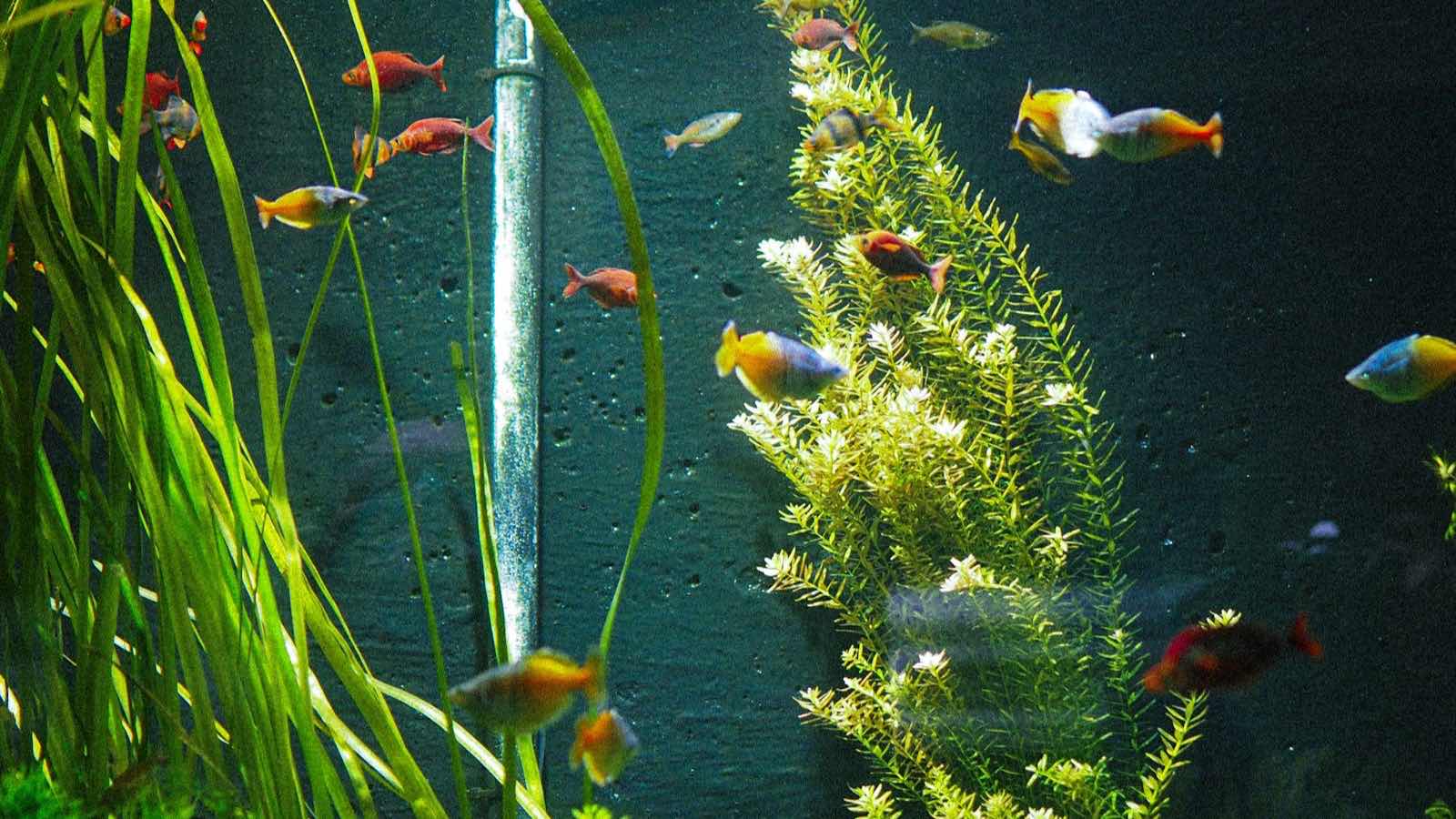
A tank dense with plants and decor multiplies the refuge zones available at any moment, which lowers the perceived risk even without a real threat and reduces purely defensive movement. This echoes observations made about fearful fish in our guide on hiding spots for stressed fish, where the mere presence of refuges already changes observed behavior.
Is a bare, minimalist tank necessarily a bad choice?
Not in every case: some breeding or quarantine tanks stay deliberately sparse to ease cleaning and monitoring, but this study suggests that such a setup doesn't match the fish's spontaneous choice when options are available. A simple compromise is to structure most of the volume while keeping one or two clear passages for observation.
How can this result be applied without complicating tank maintenance?
An aquascape doesn't need to be elaborate to provide this structure: a few hardy plants paired with a root or a rock are already enough to create several distinct zones, as shown in the examples in our guide on easy aquascaping for beginners. The key is to multiply landmarks rather than aim for a perfectly open decor.
- Zebrafish and checker barbs clearly choose the most structured compartments when given the choice
- Dense decor multiplies refuge zones and lowers perceived risk
- A completely bare tank doesn't match the fish's spontaneous choice, even if some setups justify it
- A few plants and simple decor are enough to structure a tank without complicating upkeep
Frequently asked questions
Does this preference for structured decor apply to all fish species?
It was demonstrated in two different species in this study, suggesting a fairly widespread tendency, though the strength of this preference can vary with each species' temperament and natural origin.
Could decor that's too dense actually stress a fish instead?
No, as long as open swimming zones remain: it's mainly the total absence of structure that appears to cause problems, not an abundance of well-distributed plants or decor.
Do artificial decorations have the same effect as live plants on this front?
The study used dense artificial plants among other options with a measured positive effect, suggesting it's mainly the physical structure on offer that matters to the fish, more than the exact material.
An accessory from our shop for this use: Ceramic pebble hide for shrimp and small fish (€20.90) · the whole shop
This guide is part of Planète Pets’s Fishkeeping universe. Our advice is general in nature: for any health concern, your veterinarian remains the only reference.