Do dogs get used to car travel? A beagle study suggests mostly not
Published by Planète Pets · managing editor: Clément Lacaille · how our guides are written
"It'll pass, he just needs to get used to it": the advice comes up for every dog that stresses in the car. Johannes Herbel, Jörg Aurich, Camille Gautier, Maria Melchert and Christine Aurich tested it directly and published their results in 2020 in the journal Animals (see the study). All our safety guides sit in the dog travel and safety section.

Contents · 4 sections
The protocol: transport-naive dogs, followed through repetition
Eighteen beagles that had never been transported before were split into three groups of six and put through one- or two-hour road transports, repeated over time. The researchers tracked salivary and plasma cortisol, heart rate, heart rate variability, the neutrophil-to-lymphocyte ratio (a blood marker of stress) and the dogs' behaviour at each transport.
Result: cortisol spikes every time, without dampening
Cortisol rose consistently during transport, and that rise persisted across subsequent trips: no habituation was observed. Heart rate climbed at the start of every trip, regardless of how much transport experience the dog had already accumulated. Changes in the neutrophil-to-lymphocyte ratio confirmed a measurable stress response at each repetition, and the authors note the possibility of motion sickness in some of the dogs followed.
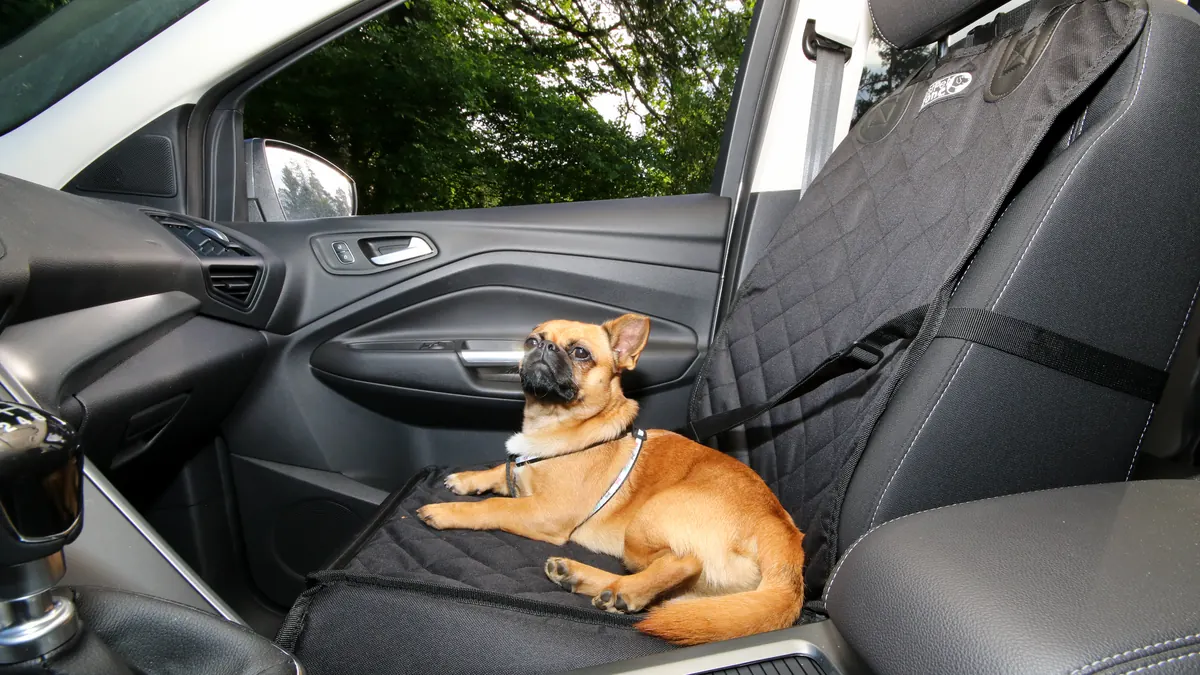
What this changes in practice
Piling on trips in the hope they become neutral for the dog does not rest on a habituation mechanism confirmed by the physiology here. Each trip stayed, in these dogs, a stressful event in its own right. The behavioural side of car stress is covered in detail in our article on the anxious dog in the car.
- Prepare each trip rather than relying on repetition alone: a light pre-departure fast, a well-fitted crate or harness, ventilation and regular breaks.
- Consider a gradual, positive desensitisation programme, built with a behaviour professional, rather than simply stacking identical trips.
- Ask the vet about medication for long or frequent trips if stress stays marked despite preparation.
- Do not treat it as a training failure if the dog stays stressed after several trips: the physiological data shows this is not a sign you did something wrong.
Frequently asked questions
Does taking more trips calm a car-stressed dog on its own?
Not according to this study: cortisol stayed elevated at every transport in beagles that were already experienced, with no sign of habituation.
Does heart rate drop as the dog gains experience?
No: it rose at the start of the trip regardless of how many transports the dog had already been through.
Should owners give up on getting a dog used to the car?
No, but a gradual, positive desensitisation plan works better than simply repeating identical trips. Find all our guides on the dog hub.
This guide is part of Planète Pets’s Dogs universe. Our advice is general in nature: for any health concern, your veterinarian remains the only reference.