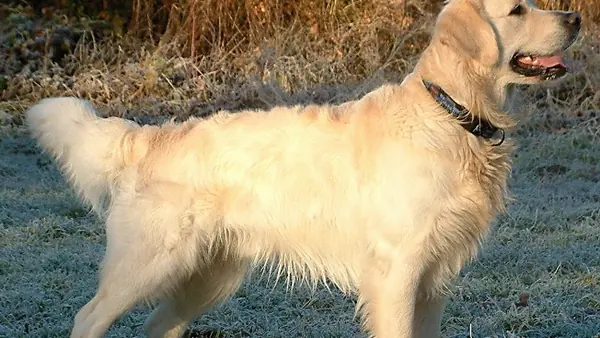
Dog pulling on the leash: the loose-leash walking method, step by step
Published by Planète Pets · managing editor: Clément Lacaille · how our guides are written
A dog pulling on the leash has learned one simple thing: when he pulls, he moves forward. To stop your dog pulling, a tight leash has to lead nowhere and a loose leash has to pay off handsomely. In practice: you stop the moment the leash goes tight, you move on when it slackens, and you reward the dog when he walks by your leg. With a front-clip harness while he learns and short sessions, most dogs walk far better within a few weeks. There is no need to aim for a strict heel: the everyday goal is a leash that hangs in a “J” or “U” shape.
Contents · 8 sections
Why your dog pulls (and why it is not “dominance”)
Dogs naturally walk faster than we do, and the outside world smells wonderful. Every time he pulled and you followed, he was rewarded: he reached the tree, the other dog, the park. Add a reflex trainers know well, the opposition reflex: pull a dog backwards and he tends to push forwards. The result is that the harder you hold back, the harder he pulls.
There is no power struggle to win. There is a habit to replace, and it gets replaced with the same tools as the rest of training: well-placed rewards, consistency and patience.
The loose-leash method in three tools
1. The stop (“be a tree”)
As soon as the leash goes tight, stop dead, arm close to your body, without pulling or talking. Wait. The moment the dog releases the tension (steps back, turns round, sits), say “yes” and walk on. The message is crystal clear: pulling stops everything, slack makes things happen. On the first outings you will not cover much ground. That is normal.
2. The about-turn
If the dog is too excited to release, or the stop no longer works, turn around calmly and invite him with a happy voice, without jerking the leash. When he catches up level with your leg, reward. The about-turn is also your best tool when something sets him off (a cat, another dog): you create distance instead of fighting.
3. Rewarding in the right place
This is the detail people forget most. Deliver the treat exactly where you want the dog to be: beside your leg, level with your trouser seam, on your chosen side. Hand it out in front of you and the dog learns to walk in front of you. At first, reward every two or three steps; then every five, ten, twenty. Say “yes” the instant he is in position, then deliver.
Pick a side (left or right) and stick to it: a dog weaving in front of you is a trip hazard. Treats should be tiny and tasty, taken out of the daily food allowance.
Equipment: front-clip harness yes, prongs and chokes no
Equipment does not replace training, but it makes a big difference to comfort and safety while the dog learns.
| Equipment | What it does | Our view |
|---|---|---|
| Front-clip harness (ring on the chest) | When the dog pulls, the ring turns him towards you; no pressure on the neck | The best ally while training |
| Y-shaped back-clip harness | Comfortable, leaves the shoulders free, but does nothing against pulling | Great once the dog no longer pulls |
| Flat collar | All the pulling force goes through the neck | For the ID tag, not for a dog who pulls |
| Choke chain, chain martingale | Tightens on the neck when the dog pulls | Avoid |
| Prong collar, shock collar | Works through pain or discomfort | Do not use |
| Fixed leash, 1.5 to 2 m (5 to 6 ft) | Enough slack for a loose “J” | The basic tool |
| Retractable leash | Constant tension: the dog learns that pulling makes the leash longer | Put it away while training |
A 2024 study measured that a front-clip harness clearly reduces pulling force compared with a martingale collar: we cover it in our article on the no-pull front-clip harness.
Why not a collar? Anne Carter and colleagues at Nottingham’s two universities tested seven collars and a slip lead on a model neck fitted with a pressure sensor, in a study published in 2020 in the Veterinary Record (see the study). They applied three forces representing a firm pull (40 newtons), a strong pull (70 newtons) and a jerk (141 newtons on average). The collars exerted between 83 and 832 kilopascals on the neck, and no collar tested gave a pressure low enough to rule out the risk of injury when the dog pulls. It is a laboratory model, not a real dog, but it explains why a harness is the better choice for a dog who pulls. Choke chains have the same problem, only worse; our guide to choke collars explains why.
Prong and shock collars promise quick results. The cost shows up elsewhere. Ana Catarina Vieira de Castro and colleagues followed 92 dogs from seven training schools, in a study published in 2020 in PLOS ONE (see the study). Dogs from schools that used a high proportion of aversive methods showed more stress-related behaviours during training, were more often tense, had larger rises in cortisol after training and were more “pessimistic” in a test carried out away from training than dogs from reward-based schools. The authors conclude that these methods compromise dog welfare both during and outside training. Shock collars are banned in England (since February 2024) and Wales.
The 6-week plan
Two rules: only one new difficulty at a time, and step back as soon as the dog slips. During these weeks, “we just need to get there” walks are done on a front-clip harness, or replaced by exercise on a long line somewhere safe.
| Week | Where | What you work on | Sign you can move on |
|---|---|---|---|
| 1 | Indoors, hallway | Reward by your leg every 1-2 steps; the word “yes” | He looks for your leg as soon as you walk |
| 2 | Garden, yard, empty car park | Stop at every tension; reward every 3-5 steps | He releases on his own within seconds of the stop |
| 3 | Quiet street, off-peak | Stops and about-turns; 5 to 10 minute sessions | About 100 m (a city block) with few stops |
| 4 | Quiet street, longer | Reward every 10-20 steps; sniff breaks allowed on a cue | The leash hangs loose most of the time |
| 5 | Busier area, at a distance from triggers | About-turns around distractions; better treats | He turns back to you after glancing at a dog |
| 6 | Usual routes | Rewards at random, back to stopping as soon as he pulls | Everyday walk on a loose leash |
Sniff breaks matter: a dog who is never allowed to sniff will pull to do it. Give a permission cue (“go sniff”), let him explore on a loose leash, then call him back to your side.
Heel or loose leash: what is the difference?
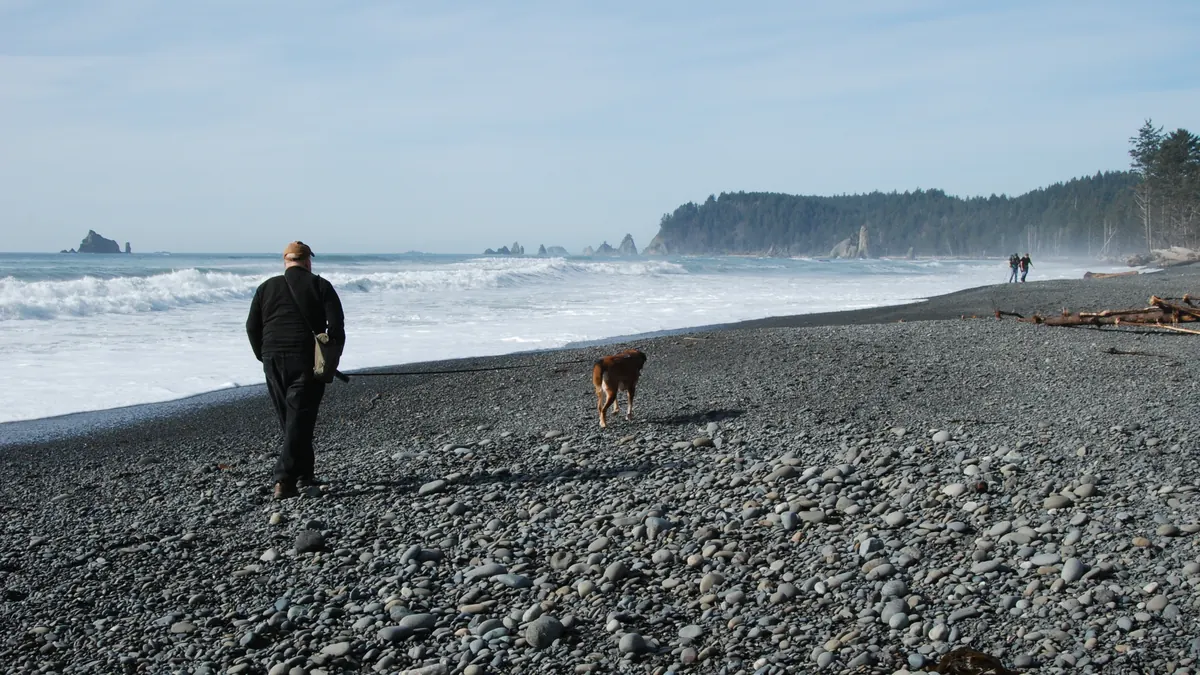
Loose-leash walking means the dog can be a little ahead, behind or sniffing, as long as the leash stays slack. That is the goal on every walk. Heel is a precise exercise: the dog sticks to your leg, shoulder level with your knee, and looks up at you often. You use it over short distances (crossing a road, passing a cyclist, getting through a crowd) and train it as a separate exercise, with its own cue (“heel”) and very frequent rewards. Start with the loose leash: heel comes more easily afterwards.
Your safety matters too
A dog who pulls hard can knock his walker over. A biomechanics team measured the real forces on the leash during ordinary walks: we drew practical pointers from it in our article on leash pulling force and the walker’s balance. A few habits:
- never wrap the leash around your wrist or fingers;
- hold the leash with both hands, elbow close to your body, knees soft;
- avoid slippery ground and stairs with a dog who still pulls;
- do not hand a strong puller to a child or a frail person.
What if it is not working?
If your dog mainly lunges at other dogs or people while barking, starts growling, or panics in the street, the issue is no longer the leash: it is an emotional reaction, to be worked on with a trainer who uses positive reinforcement, or with a veterinary behaviourist. If a dog who used to walk nicely starts coughing on the leash, refusing to go forward or limping, talk to your vet before resuming training: physical discomfort can change the way a dog walks.
Frequently asked questions
How long does it take for a dog to stop pulling?
Allow several weeks of consistency, longer for an adult who has pulled for years. The deciding factor is that pulling never pays again, including when you are in a hurry: that is where the front-clip harness helps.
Is a no-pull harness enough on its own?
It reduces pulling and protects the neck, but it teaches nothing by itself. Use it while training, then switch to a Y-shaped harness once the leash stays loose.
My dog only pulls at the start of the walk: what should I do?
That is common: he is full of energy. Spend the first five minutes on a sniffing game or on a long line somewhere safe, then start the loose-leash work.
Should I give a sharp tug on the leash?
No. Leash jerks hurt the neck, raise excitement or fear and do not teach the dog where to be. Stop, wait, and reward in the right place.
This guide is part of Planète Pets’s Dogs universe. Our advice is general in nature: for any health concern, your veterinarian remains the only reference.