Travelling with a Cavalier King Charles Spaniel: car, crate and rules
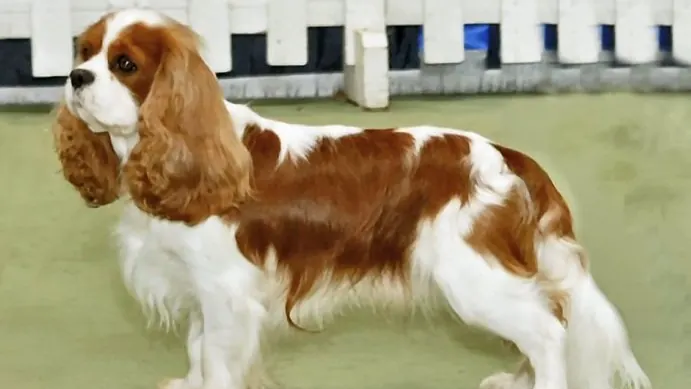

Cavalier King Charles Spaniel: An easy travel companion, it does well in a soft crate or with a small-dog safety harness. Prefer a harness to a collar on walks and schedule regular breaks on long summer journeys.
To go further, our PDF practical guides: Course: Train Your Dog in 8 Weeks — 2 PDF guides (85 pages in English (86 in French)), in English and French, instant download. Get my bundle — €49
In short: A small spaniel of 5.5 to 8 kg with a silky, medium-length feathered coat, moderate energy and a very gentle temperament. A remarkably gentle companion spaniel, easy-going and intensely bonded to its owners. Mitral valve disease affects a large share of the breed with age: regular heart checks and strict weight control are the owner's two priorities.
In the car with a Cavalier King Charles Spaniel
At 5.5 to 8 kg, the Cavalier King Charles Spaniel travels in a rigid crate of about 60 cm placed in the rear footwell or strapped in, or an approved carrier bag for the lightest. An unrestrained dog of this weight becomes a projectile under braking — and a possible fine for distracted driving.
Trains, planes, holidays
Too big for the cabin, the Cavalier King Charles Spaniel flies in the pressurised hold in an IATA-approved crate — an ordeal to reserve for unavoidable trips. On trains, a muzzle and lead meet the rules. Get it used to the crate weeks before departure: left open at home with treats inside, it becomes a den rather than a trap.
Identification and good habits
Before any departure, check the trio: microchip, up-to-date vaccines and an EU passport for trips abroad. In warm weather a Cavalier King Charles Spaniel never stays in a parked car: fifteen minutes is enough for tragedy.
Frequently asked questions
What crate size for a Cavalier King Charles Spaniel?
About 60 cm long: able to stand without hunching and turn around freely. For flying, check the model’s IATA dimensions.
Can a Cavalier King Charles Spaniel fly in the cabin?
No, it exceeds the cabin limit (8 kg including the bag): it travels in the pressurised hold in an IATA crate — avoid it when you can.
The guides that apply to you
- Microchip or tattoo: which ID actually gets a lost dog home?
Dog identification: what a study shows about return-to-owner rates depending on whether the dog is microchipped or not.
- Hot pavement: protecting your dog's paws in summer
In summer, pavement can top 50 °C and burn a dog's paw pads in seconds. How to test the ground, adjust walk times and protect the paws.
- GPS collars for dogs: how to choose the right tracker
Subscription or not, battery life, accuracy, waterproofing: the criteria that matter when choosing a GPS collar so you never lose your dog again.
- Dog muzzle: when it's needed and how to get your dog used to it stress-free
Public transport, the vet, certain regulated breeds: a muzzle is sometimes required. How to choose the right type and desensitise a dog that refuses to wear one.