Enrichment for a Senegal parrot: toys, foraging and free flight
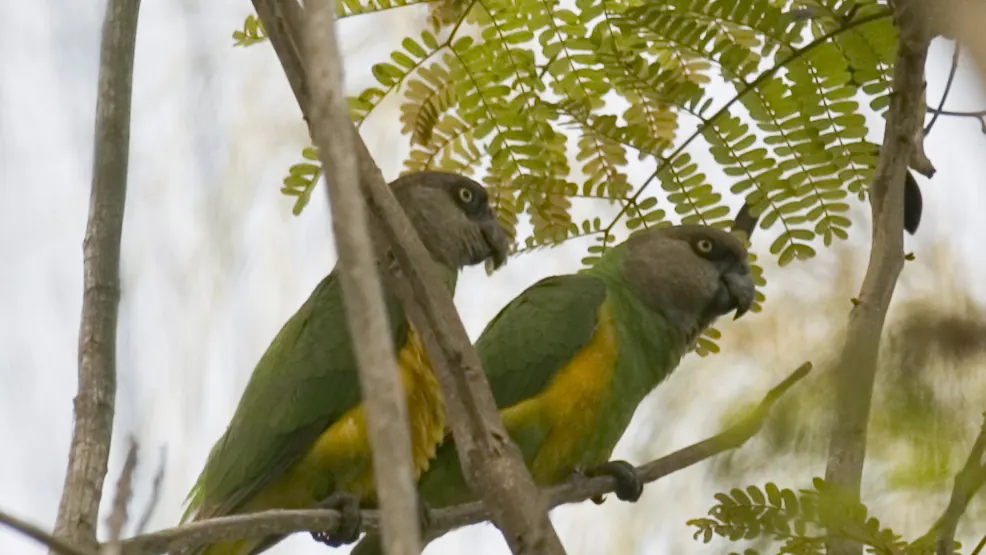

Senegal parrot: Foot toys it happily juggles while lying on its back, small foraging puzzles and chew wood. Vary who plays with it to prevent one-person exclusivity.
Our practical guides together, to download: Bird Bundle: Budgie, Cockatiel, Canary, Parrot, and the Course to Tame Your Bird — 3 PDF guides (109 pages in English (112 in French)), in English and French, instant download. Get my bundle — €49
In short: Around 23 cm, 25 to 30 year lifespan, low to moderate noise level. A calm, steady little African parrot, quieter than average, that bonds strongly and preferably to one person. Its low volume makes it one of the few parrots genuinely suited to apartment life, provided its strong bonding is respected.
Toys: small formats, real needs
Swings, (lead-free) bells, rings and shreddable toys sized to its beak: the Senegal parrot explores everything that comes apart. Three or four toys in the cage are enough, rotated weekly — a toy-saturated cage blocks flight more than it enriches.
Foraging: the queen of occupations
A wild Senegal parrot spends its day finding food: give that job back with foraging — seeds rolled in paper, vegetable skewers to dismantle, boxes to unlock. The intelligence that lets it mimic speech demands exactly this kind of daily challenge. Ten minutes of foraging tires more than an hour on a swing.
Daily free flight: non-negotiable
Whatever the cage, the Senegal parrot must fly every day: secure one room (marked glass, cold hobs, toxic plants removed, other pets excluded) and open the door for one to several hours. This species can live without a companion bird provided massive daily human presence — flight and social life are the two enrichments money cannot substitute. The rest is on the full Senegal parrot profile.
Frequently asked questions
Which toys for a Senegal parrot?
Formats matched to its beak: shreddable toys, swings, simple foraging — rotated weekly to keep curiosity alive.
How much free flight for a Senegal parrot?
One hour daily at the strict minimum, more for active species — in a fully bird-proofed room. The cage is only base camp.
The guides that apply to you
- Cockatiels: does the right enrichment actually cut plucking? A 2025 study puts a number on it
A 2025 study on captive cockatiels measures the drop in feather-damaging behavior under two enrichment types, objects and food, with clear but uneven results.
- A Goffin's Cockatoo That Made Its Own Tool: What the Study on Figaro Reveals
Unlike corvids, the Goffin's cockatoo has no known tradition of tool use in the wild. A landmark study nonetheless shows that a captive individual spontaneously made one of its own.
- Snowball, the Cockatoo Who Dances to the Beat: What the Study on Musical Synchronization Reveals
A cockatoo named Snowball spontaneously adjusts his movements to a song's tempo. A landmark study explains why this rare animal talent sheds light on how parrots perceive rhythm.
- Introducing Two Birds to Form a Pair: The Protocol to Follow
Side-by-side cages, neutral ground, prior quarantine: how to introduce two unfamiliar adult birds to maximize the chances a real pair bond will form.