
Small Pet Training, Step by Step: Taming and Teaching Rats, Hamsters, Guinea Pigs, Gerbils, Mice and Chinchillas
Who it is for: Your hamster, gerbil or mouse hides or runs as soon as your hand comes near.
- 43 pages
- 14 chapters
- 9 studies (DOI)
- FR + EN
- Edition November 2026
€19VAT included · one-off payment
Get my guide — €19Refunded within 14 days on a simple email, no questions asked
After payment
- Download your PDFs straight away, on the page that opens.
- You also get the link by email, sent by “Planète Pets” (subject “Your download:” followed by the guide’s name).
- Lost it? Find my purchases with your email address.
- No calls, no texts; at most one email, a week later, asking for your review.
For €80 more, All training courses bundle: 23 PDF guides, €4.30 per guide.
- A pet that steps into your hand by itself: tunnel, cup and cupped hands instead of grabbing, the best-studied method in mice
- A 4- to 6-week programme for each species (rat, hamster, guinea pig, gerbil, mouse, chinchilla), with clear criteria for moving on
- Skills that make life easier: recall, the carrier, weighing and health checks without catching, and for rats, spin, hoop, weave and fetch
Checked48 automated checks on every site update (FR/EN parity, internal links, species data, guide PDF files), last checked on 2026-11-0112 sources cited in the guide, including 9 studies with a DOI
Method
- Primary sources: studies with a DOI, official texts
- Every figure linked to its source
- Dated edition, updates included
StandardsBuilt on the guidance of RSPCA, AVSAB
Card, Apple Pay or Google Pay payment on Stripe’s secure page: your card details never touch our servers. Price VAT included.
“Small Pet Training, Step by Step: Taming and Teaching Rats, Hamsters, Guinea Pigs, Gerbils, Mice and Chinchillas” is a 43-page printable PDF guide published by Planète Pets (November 2026 edition), sold for €19 VAT included: 14 chapters, 9 studies cited with their DOI, checklists and fill-in sheets, instant download after payment.
Win your pet’s trust without ever grabbing it, then teach it to come, step into your hand, walk into its carrier and, for rats, real tricks: a reward-based programme for each species.
Key facts
- Price
- €19 VAT included, one-off payment
- Format
- A4 PDF, 43 pages, to read or print
- Languages
- English and French (two PDFs)
- Contents
- 14 chapters, checklists, fill-in sheets
- Sources
- 9 studies with verified DOI; 12 sources in all, full list at the end of the guide
- Edition
- November 2026
- Seller
- Lacangel Group (SAS, France), card payment via Stripe
- Guarantee
- 14-day money-back on a simple email
What the guide contains
14 chapters, 43 A4 pages, with tick-box checklists, fill-in sheets and templates. Studies are cited with their DOI. The French edition is included with your purchase.
- Before You Start. What the course contains, how to use it, what it does not do (no medication or supplements), what you need and the legal backdrop (UK Animal Welfare Act 2006, US state laws).
- How Small Pets Learn: Six Species, Six Characters. Highly trainable rats, solitary nocturnal hamsters, timid guinea pigs, gerbils, mice, chinchillas: what frightens them, when to train, what to aim for, drawing on the RSPCA.
- The Principles of the Method and What the Research Says. Nine studies reviewed: tunnel and cupped hands versus tail handling in mice, rat tickling, clicker training in mice, rats and gerbils; seven rules, the four-out-of-five rule, reading signals.
- Rewards: Small, Safe and Chosen by Your Pet. Tiny, safe rewards counted in the daily ration: a chart by species, ways to deliver them, non-food rewards.
- Taming Step by Step: Hand, Tunnel and Cup. The seven taming steps with criteria, the tunnel step by step, the cup, cupped hands, the tickling game, and adjustments for each species.
- The Marker, the Clicker and the Target. Choosing a marker for your species, charging it, touching and following the target, the floor pad, capturing behaviour.
- Everyday Skills: Recall, Stepping Up and the Carrier. Recall in a pet-proofed room, stepping into your hand on cue, walking into the carrier in 7 steps, going home on cue.
- Rat Tricks, and What Other Species Can Learn. Spin, stand, hoop, weave, fetch, high five, step by step with criteria; what gerbils, mice, hamsters, guinea pigs and chinchillas can learn.
- A Safe Agility Course for Small Pets. Safety rules, seven obstacles to make and teach, a course built over four weeks, and what not to do.
- Cooperative Care: Weighing, Health Checks and the Carrier Without Catching. Weighing as a game, a 6-step handling agreement (feet, incisors, eyes, ears, coat), what to look for, the day of the vet visit.
- The Pet That Bites, Runs or Freezes. Ruling out pain, common causes of biting and fixes, what to do when bitten, the pet that runs or freezes, troubleshooting.
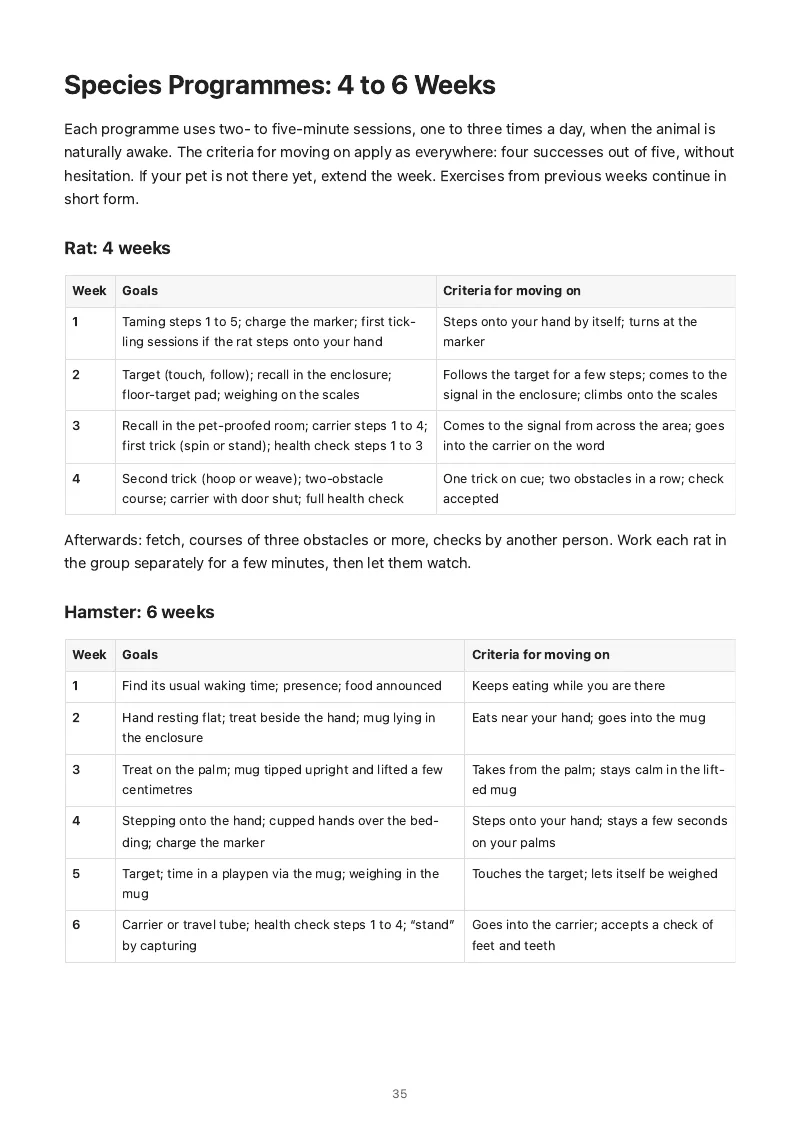
- Species Programmes: 4 to 6 Weeks. Six week-by-week programmes: rat (4 weeks), hamster (6), guinea pig (6), gerbil (4), mouse (4), chinchilla (6), with criteria for moving on.
- Printable Sheets. Session plan, pre-session checklist, progress log, reward chart, weight log, tricks map, house rules for children, contacts.
- Sources. Nine studies with verified DOIs, RSPCA advice, AVSAB 2021, UK Animal Welfare Act 2006, consulted on 2 November 2026.
Who it is for, and who it is not for
This guide is for you if…
- Your hamster, gerbil or mouse hides or runs as soon as your hand comes near.
- Your guinea pigs or chinchilla bolt, and you want to weigh and check them without a chase.
- Your small pet nips or bites, and you want to understand why and start again gently.
- You keep rats and want to teach them real tricks and a course, safely.
It will not help you if…
- You want to know how to house or feed your pet: our care guides “Small Pet Rodents” and “The Complete Chinchilla Handbook” cover that.
- Your pet seems unwell, is losing weight or has suddenly changed its behaviour: see an exotics vet first; the course makes no diagnosis.
- You want a pet that lets itself be carried anywhere, straight away: this method respects the animal’s pace and its right to walk away.
Free sample
The tunnel: the best-documented lift
The tunnel is the method that mouse studies compared most closely with tail handling (see “The Principles of the Method”). It also suits gerbils, hamsters and young rats very well.
- Choose a rigid tunnel (clear or tinted plastic, thick cardboard) wide enough for the animal to walk in without twisting, open at both ends. For mice, the studies recommend a tunnel that lives in the enclosure: it carries the animal’s scent.
- Leave it in the enclosure for a few days: the animal runs through it and sometimes sleeps in it.
- Put a reward in the middle of the tunnel, lying in the enclosure. When the animal goes in to eat it, do nothing. Repeat over several sessions.
- With the animal inside, hold the tunnel in both hands where it lies, without lifting. Reward inside. Let go.
- Lift a few centimetres, keeping it level, for one second. Put it down. Let it come out.
- Gradually increase height and duration, always level, over the bedding.
- To take the animal out: lift the tunnel, put it down on the table or floor of the working area, and let it come out when it wants.
Pick the right option
| Feature | This guide€19 | All training courses bundle€99 | Best valueComplete library€149 |
|---|---|---|---|
| PDF guides | 1 | 23 | 64 |
| Pages | 43 | 966 | 2518 |
| Studies cited (DOI) | 9 | 149 | 414 |
| English and French | ✓ | ✓ | ✓ |
| Price per guide | €19 | €4.30 | €2.33 |
| Refunded within 14 days | ✓ | ✓ | ✓ |
| Get my guide — €19 | See what’s inside | See what’s inside |
Library: €149 instead of €1460 if you buy the 62 guides sold on their own one by one, a saving of €1311 (+ 2 guides only sold in bundles).
€19 one-off payment, updates included
Get my guide — €19Refunded within 14 days on a simple email, no questions asked
Frequently asked questions
What format is the course?
A PDF to download right after payment, in English and French, ready to print (session plan, progress log, reward chart, weight log and tricks map included).
Is my species covered?
The course covers six species in detail: rat, hamster (Syrian and dwarf), guinea pig, gerbil, mouse and chinchilla, with a week-by-week programme for each.
Do I need a clicker?
No. A short word, a tongue click or a retractable pen will do; the course explains which marker suits each species, and why a soft signal is better for a chinchilla.
My hamster bites: will the course help?
Yes: one chapter explains the common causes of bites (being woken, fingers smelling of food, a hand from above) and how to start again. A sudden bite from a previously calm animal should be shown to a vet first.
Does it replace a vet?
No. It makes no diagnosis and recommends no medication or supplement. It teaches you to weigh and check your pet so you can spot a change and report it.
Can I get a refund?
Yes, by simple email to admin@tech-bharat.com within 14 days of purchase, no questions asked.
Seller: LACANGEL GROUP, SAS (French simplified joint-stock company) — SIREN 995 268 018 — registered office: 1 rue Marguerin, 75014 Paris, France — president: Clément Lacaille — EU VAT number FR21995268018 — administration@lacangel.fr. Price VAT included. Digital product delivered right after payment; 14-day money-back commercial guarantee. See the terms of sale.
🩺 Reminder: this page informs, it does not diagnose. For any symptom or health question, your veterinarian remains the only reference.
How it works
Seller: LACANGEL GROUP (SAS), Paris, France, VAT FR21995268018. Prices VAT included. Terms of sale