Labrador and Golden Retriever: Training, Enriching and Living with a Family Dog
Who it is for: You live with a Labrador, a Golden Retriever or a cross of the two, puppy, adolescent or adult, and want to understand what it really needs day to day.
- 40 pages
- 18 chapters
- 7 studies (DOI)
- FR + EN
- Edition November 2026
€29VAT included · one-off payment
Get my guide — €29Refunded within 14 days on a simple email, no questions asked
After payment
- Download your PDFs straight away, on the page that opens.
- You also get the link by email, sent by “Planète Pets” (subject “Your download:” followed by the guide’s name).
- Lost it? Find my purchases with your email address.
- No calls, no texts; at most one email, a week later, asking for your review.
For €120 more, Complete library: 64 PDF guides, €2.33 per guide.
- Understand your retriever instead of putting up with its “faults”: what the FCI standards of both breeds say, a study of 1,978 Labradors (Lofgren 2014) and two studies of future guide dogs, including the one that revealed a real adolescent phase (Asher 2020), and what that changes at home
- Training that uses its love of food without adding to the ration: rewards taken from the daily ration, a scale of value, “life rewards” (a throw, a swim, going to say hello), then step-by-step plans for recall, calm, loose-lead walking, jumping up and mouthing
- Give it the job it was bred for: retrieving in 7 steps with a criterion for each, four scent games, water without needless risk, then an 8-week programme with a criterion for moving on each week and seven printable sheets (including children’s rules and instructions for your visitors)
Checked48 automated checks on every site update (FR/EN parity, internal links, species data, guide PDF files), last checked on 2026-11-0913 sources cited in the guide, including 7 studies with a DOI
Method
- Primary sources: studies with a DOI, official texts
- Every figure linked to its source
- Dated edition, updates included
Card, Apple Pay or Google Pay payment on Stripe’s secure page: your card details never touch our servers. Price VAT included.
“Labrador and Golden Retriever: Training, Enriching and Living with a Family Dog” is a 40-page printable PDF guide published by Planète Pets (November 2026 edition), sold for €29 VAT included: 18 chapters, 7 studies cited with their DOI, checklists and fill-in sheets, instant download after payment.
What is specific to these two retrievers according to their standards and seven studies: the stages from puppy to adult and adolescence, food-powered reward-based training that does not add to the daily ration, recall, calm, loose-lead walking, jumping up and mouthing, retrieving and scent work, water, the balance between activity and rest, children and visitors, with an 8-week programme and seven printable sheets.
Key facts
- Price
- €29 VAT included, one-off payment
- Format
- A4 PDF, 40 pages, to read or print
- Languages
- English and French (two PDFs)
- Contents
- 18 chapters, checklists, fill-in sheets
- Sources
- 7 studies with verified DOI; 13 sources in all, full list at the end of the guide
- Edition
- November 2026
- Seller
- Lacangel Group (SAS, France), card payment via Stripe
- Guarantee
- 14-day money-back on a simple email
What the guide contains
18 chapters, 40 A4 pages, with tick-box checklists, fill-in sheets and templates. Studies are cited with their DOI. The French edition is included with your purchase.
- Before you start. Who it is for, what is inside, where the information comes from, what it does not do (no health claims, no diet or medication, no force-based methods).
- Labrador and Golden: what their origin tells you. The comparison table from the FCI standards (purpose, size, temperament, coat), what “soft mouth” or “keen lover of water” mean at home, working, show and pet lines (Lofgren 2014, 1,978 Labradors).
- From puppy to adult: the stages that change everything. What two studies of future guide dogs show (Serpell and Duffy 2016, Asher 2020), adolescence, the table of stages and priorities, adopting an adult.
- Food-powered training: making good use of food. The Labrador’s appetite (Raffan 2016), rewards taken from the daily ration, the scale of value, what to avoid, why rewards only (Vieira de Castro 2020), the marker.
- Recall for a dog that loves everyone. The four rules, recall as a game, the long line to get through adolescence, retriever distractions one at a time, the whistle.
- Learning to be calm. The mat in six steps, free calm, waiting (bowl, door, car boot, throw), the end signal.
- Walking without pulling. Equipment, the five-step method, “life rewards”, two kinds of walk.
- No more jumping up at people. Four paws on the floor, greetings at home, the toy by the door, visitors, out and about.
- Mouthing, carrying, stealing: a retriever’s mouth. Puppy mouthing, stealing and chase games, “give” in five steps, resource guarding, brushing.
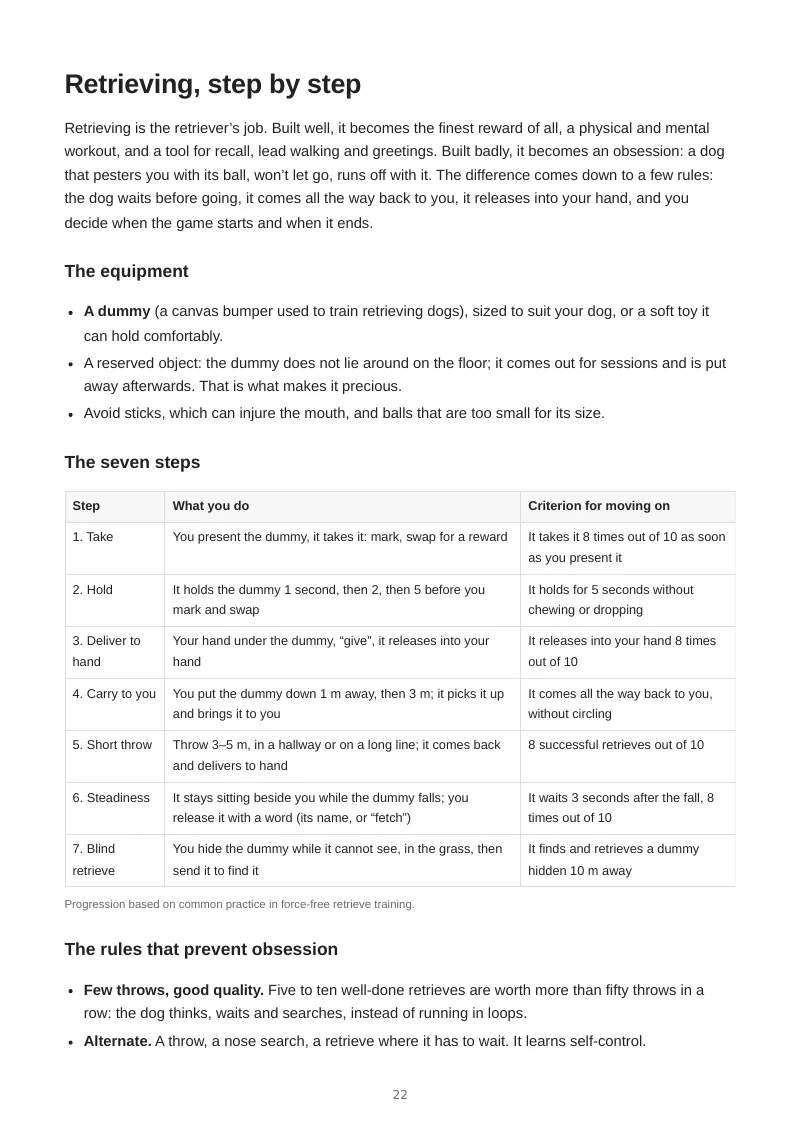
- Retrieving, step by step. Equipment, the seven steps with a criterion for each, the rules that prevent obsession, the dog that runs off with the object.
- Scent work: the outlet that calms. What one study shows (Duranton and Horowitz 2019), four scent games, sniffing on walks.
- Water. The first swim, places to avoid (including cyanobacteria), recall and waiting at the water’s edge.
- Activity and rest: finding the balance. What the studies say (Lofgren 2014, Kis 2017), the ingredients of a day, signs of a dog that has done too much, the rest area.
- Children and visitors. House rules, what children can do with it, reading its signals, visitors.
- When to seek help. The signs that mean you should seek help, the vet then the veterinary behaviourist, bites, what to do meanwhile.
- The 8-week programme. Greetings, mouth, lead, recall, retrieving, scent work, visitors: one goal, exercises and a criterion for moving on each week, the summary table, when you get stuck.
- Printable sheets. My dog, the day’s reward box, programme log, instructions for visitors, children’s rules, typical day, when to call the vet.
- Sources. 7 studies with verified DOIs, 2 FCI standards, official texts and pages consulted on 9 November 2026.
Who it is for, and who it is not for
This guide is for you if…
- You live with a Labrador, a Golden Retriever or a cross of the two, puppy, adolescent or adult, and want to understand what it really needs day to day.
- Your young retriever jumps up at people, pulls on the lead, mouths, steals things, does not come back when it sees a dog or water, and you want a step-by-step plan, without punishment.
- You have children, or often have visitors, and want clear rules so that everyone lives well with a 30 kg dog full of enthusiasm.
- You are about to welcome a puppy or an adult of one of these breeds and want to know what to expect, from arrival to adulthood.
It will not help you if…
- Your dog has already bitten, growls often or is very fearful: see your vet first, then a veterinary behaviourist; the programme is meant for dogs without intense fear or aggression.
- You are looking for breed-specific health information, a daily ration or a diet: the guide contains none; your vet is the one to advise you.
- You are looking for a general obedience programme (sit, down, from scratch) or gundog training: the guide focuses on family life with a retriever.
- You are looking for a method using choke, prong or electric collars, or force-fetch training: the guide uses none.
In pictures






Illustrative photos, published by their authors under free licences.
Free sample
What two studies of future guide dogs show
A study by Serpell and Duffy, published in 2016 in Frontiers in Veterinary Science, followed 978 prospective guide dogs of four breeds or crosses, all from the same organisation and placed with puppy-raising families at 7–8 weeks. Their behaviour was measured at 6 and then 12 months with the C-BARQ questionnaire. The study shows maturational changes in behaviour between 6 and 12 months. It also shows the effect of environment: growing up with more experienced puppy raisers, and in the company of at least one other dog, was associated with better scores on several behaviours at 12 months. Conversely, puppies that had been frightened by a person or threatened by an unfamiliar dog had worse scores for fear of strangers and of dogs. Being frightened by a person, being raised by less experienced raisers or in a home without other pets were associated with less successful training outcomes.
A study by Asher and colleagues, published in 2020 in Biology Letters, also looked at prospective guide dogs. It provides the first empirical evidence of an “adolescent” phase in dogs: a passing phase during which the dog was less trainable and less responsive to commands, and this towards its own carer, not towards other people. The effect was more pronounced in dogs whose behaviour suggested a less secure attachment. Bitches whose behaviour suggested a less secure attachment before adolescence became able to reproduce earlier. The authors conclude that adolescence is a vulnerable time for the relationship between dog and owner.
What to take from this. If your young dog “doesn’t listen any more” when it was responding well a few weeks earlier, it is probably neither a challenge nor ill will: it is a phase, and it passes. What helps is making exercises easier for a while, multiplying successes, and above all not damaging the relationship through punishment or conflict. What makes problems last is getting into a battle with it.
Pick the right option
| Feature | This guide€29 | Best valueComplete library€149 |
|---|---|---|
| PDF guides | 1 | 64 |
| Pages | 40 | 2518 |
| Studies cited (DOI) | 7 | 414 |
| English and French | ✓ | ✓ |
| Price per guide | €29 | €2.33 |
| Refunded within 14 days | ✓ | ✓ |
| Get my guide — €29 | See what’s inside |
Library: €149 instead of €1460 if you buy the 62 guides sold on their own one by one, a saving of €1311 (+ 2 guides only sold in bundles).
€29 one-off payment, updates included
Get my guide — €29Refunded within 14 days on a simple email, no questions asked
Frequently asked questions
What format is the guide?
A PDF to download straight after payment, in English and French, ready to print, with seven sheets: my dog, the day’s reward box, programme log, instructions for visitors, children-and-dog rules, typical day of activity and rest, when to call the vet.
How is it different from the “8-week dog training course”?
The course is an obedience programme for all dogs. This guide does not repeat it: it focuses on what is specific to the Labrador and the Golden (the soft mouth, the love of food, the pull of water and of everyone, adolescence in an already large dog), and its 8-week programme covers greetings, the mouth, recall with retriever distractions, retrieving, scent work and visitors.
My dog is a cross or another retriever: is the guide for me?
Yes for a Labrador or Golden cross: the whole guide applies. For another retriever, most chapters also apply (retrieving, scent work, water, the mouth), but the standards and studies cited concern the Labrador and the Golden.
Does the guide give a ration or a diet to stop it putting on weight?
No. It contains no ration, no diet and no health claims. It explains how to train with food without adding any (rewards taken from the ration recommended by your vet, chapter 4 and sheet 2). Weight and daily ration are decided with your vet.
My young dog doesn’t listen any more: is that normal?
It is often the adolescent phase described by Asher’s study (2020): fewer responses to requests, especially towards the dog’s own carer. Chapter 3 explains what to do (easier exercises, long line, no conflict) and the chapter 16 programme is paced by criteria for moving on, not by a calendar.
What training methods do you use?
Reward-based training only: rewards, short sessions, managing the environment. No choke, prong or electric collars, no physical punishment, no force-fetch; chapter 4 sums up the study (Vieira de Castro 2020) behind this.
Where does the information come from?
From 7 published studies with DOIs checked on Crossref, the official FCI standards of the two breeds, our breed-profile attribute database, official texts (bites, cyanobacteria) and common practice among reward-based trainers, flagged as such.
Can I get a refund?
Yes, by simple email to admin@tech-bharat.com within 14 days of purchase, no questions asked.
Free reading on the site
- Labrador: the POMC gene mutation behind its appetite, and the role of the slow-feeder bowl
- Dog whistle: the most reliable tool for training recall?
- Choosing a leash or long line for your dog: the comparison
Seller: LACANGEL GROUP, SAS (French simplified joint-stock company) — SIREN 995 268 018 — registered office: 1 rue Marguerin, 75014 Paris, France — president: Clément Lacaille — EU VAT number FR21995268018 — administration@lacangel.fr. Price VAT included. Digital product delivered right after payment; 14-day money-back commercial guarantee. See the terms of sale.
🩺 The health watchpoints on this page are for information only: only a veterinarian can examine your animal and make a diagnosis.
How it works
Seller: LACANGEL GROUP (SAS), Paris, France, VAT FR21995268018. Prices VAT included. Terms of sale