Gerbils: Choosing, Housing and Raising Your Pair
Who it is for: You are about to welcome gerbils and want to choose the right pair and the right set-up first time, without trusting cages sold “for gerbils”.
- 43 pages
- 23 chapters
- 7 studies (DOI)
- FR + EN
- Edition November 2026
€24VAT included · one-off payment
Get my guide — €24Refunded within 14 days on a simple email, no questions asked
After payment
- Download your PDFs straight away, on the page that opens.
- You also get the link by email, sent by “Planète Pets” (subject “Your download:” followed by the guide’s name).
- Lost it? Find my purchases with your email address.
- No calls, no texts; at most one email, a week later, asking for your review.
For €125 more, Complete library: 64 PDF guides, €2.33 per guide.
- A pair that gets on from the start: the combinations that work (two sisters, two brothers from the same litter), the questions to ask before taking them (litter, checked sex, age at separation), the RSPCA method for introducing a youngster under 5 weeks and what to do if they fight
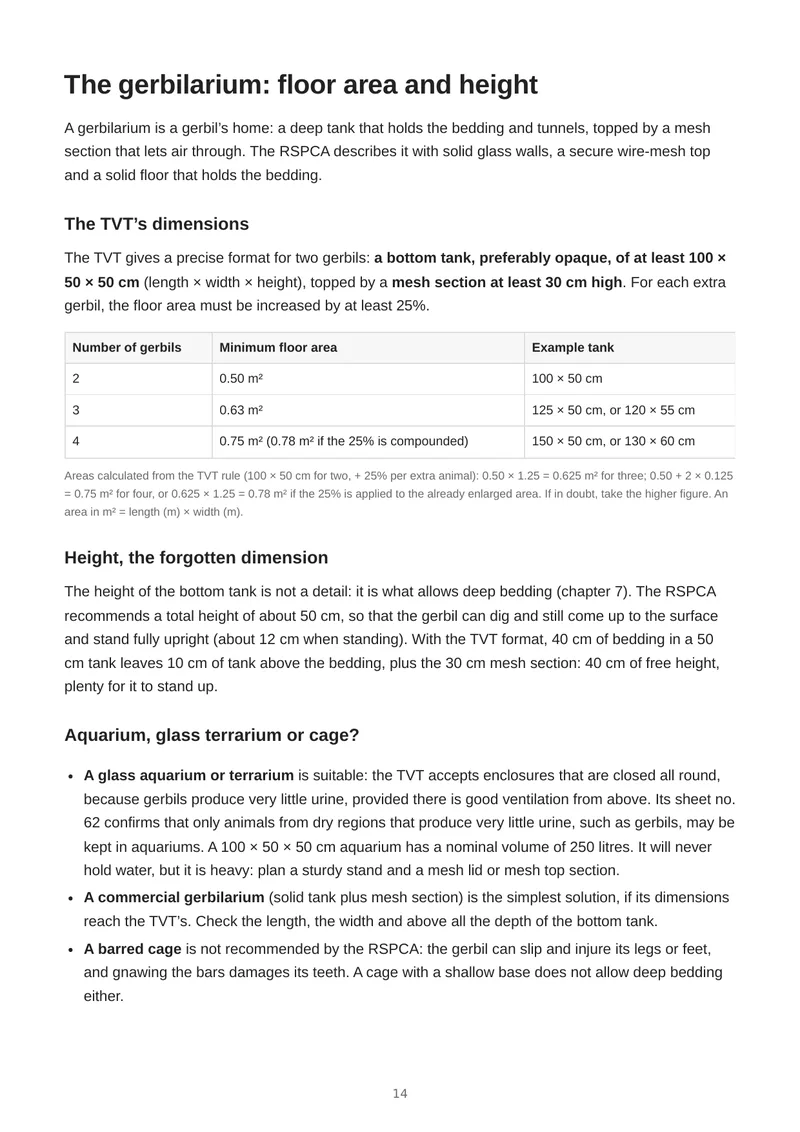
- The right housing, in figures: the TVT dimensions (100 × 50 × 50 cm + 30 cm of mesh for two, + 25% per gerbil), floor areas calculated for 2 to 4, the bedding volume calculated (200 litres for 40 cm) and the dark burrow at the end of a tube that, in studies, prevents compulsive digging
- Confident, well-watched gerbils: a 3-week taming programme with a criterion per stage, the right hold (never by the tail), what to do during a seizure, the weekly check, the list of signs that call for an exotic-pet vet, and six printable sheets
Checked48 automated checks on every site update (FR/EN parity, internal links, species data, guide PDF files), last checked on 2026-11-157 studies cited with their DOI in the bundle’s guides
Method
- Primary sources: studies with a DOI, official texts
- Every figure linked to its source
- Dated edition, updates included
StandardsBuilt on the guidance of RSPCA, TVT
Card, Apple Pay or Google Pay payment on Stripe’s secure page: your card details never touch our servers. Price VAT included.
“Gerbils: Choosing, Housing and Raising Your Pair” is a 43-page printable PDF guide published by Planète Pets (November 2026 edition), sold for €24 VAT included: 23 chapters, 7 studies cited with their DOI, checklists and fill-in sheets, instant download after payment.
Understand the gerbil’s family life, choose two gerbils that will get on, introduce a youngster and handle a fight, set up a gerbilarium to the TVT’s dimensions with 40 cm of bedding (volume calculated), give it the dark burrow at the end of a tube that prevents compulsive digging, feed it, tame it in 3 weeks with a criterion for each stage, respond to a seizure and spot the signs that call for a vet, with six printable sheets.
Key facts
- Price
- €24 VAT included, one-off payment
- Format
- A4 PDF, 43 pages, to read or print
- Languages
- English and French (two PDFs)
- Contents
- 23 chapters, checklists, fill-in sheets
- Sources
- 7 studies with verified DOI; full list at the end of the guide
- Edition
- November 2026
- Seller
- Lacangel Group (SAS, France), card payment via Stripe
- Guarantee
- 14-day money-back on a simple email
What the guide contains
23 chapters, 43 A4 pages, with tick-box checklists, fill-in sheets and templates. Studies are cited with their DOI. The French edition is included with your purchase.
- Before you start. Who it is for, what the guide contains, where the information comes from (7 studies, TVT sheets no. 161 and no. 62, RSPCA), what it does not do (no health claims, no medicines or doses).
- Who is the Mongolian gerbil? Its lifespan (2 to 5 years according to the TVT), its family life (Gromov 2021), its daytime rhythm, its ultrasonic calls, foot-thumping and scent-marking, its body, what it fears, the law in France.
- Never alone: family life. Why a pair rather than a group (TVT, RSPCA), the table of combinations that work, why a mixed pair is a problem (mature from 5 to 8 weeks), the gerbil already alone.
- Choosing your pair. Where to find them, the two decisive questions (same litter, checked sex), age at separation and bar-chewing (Waiblinger and König 2004), looking at them carefully, colour and coat.
- Introductions, fights and separations. Why it rejects strangers (Tchabovsky 2019, TVT), introducing a youngster under 5 weeks step by step (RSPCA), recognising a real fight, separating them without being bitten, when one of the two dies.
- The gerbilarium: floor area and height. The TVT dimensions and floor areas calculated for 2 to 4 gerbils, height, aquarium, gerbilarium or cage, the “for gerbils” cage recorded on the shelves and its measurements, levels.
- Deep bedding. 40 cm (TVT) or 20 to 30 cm (RSPCA), the mix, the table of calculated volumes (100 to 200 litres for a 100 × 50 cm tank), what never goes in.
- The burrow: a dark chamber at the end of a tube. What Wiedenmayer (1997) and Waiblinger and König (2004) showed about compulsive digging, the opaque nest box and its angled tube, hiding places, how to place it.
- Furnishing: platform, wheel, stone and things to gnaw. What goes up high, the wheel (at least 30 cm, solid: TVT sheet no. 62), the stone, allowed and forbidden branches, making them forage.
- Where to put it. 20 to 24 °C, away from ultrasound, radiators, sun and other animals.
- The sand bath. Why it keeps the coat dry (Thiessen and Pendergrass 1985), which sand, how often.
- Feeding. The basic food, animal protein, the fresh-food table where the TVT and the RSPCA disagree and what we take from it, food stores, water, watching what they eat and drink.
- Arriving home. What must be ready, travelling as a pair, the first days.
- Taming your pair in 3 weeks. The rules, the step-by-step programme with the criterion for moving on, why it works (Majkowski and Kaplan 1983), if it bites or runs away.
- Picking up and handling safely. The two-handed cupping hold, never by the tail, what you never do, time out of the gerbilarium.
- Reading its behaviour. The table of normal behaviours, the three stereotypic behaviours described by the TVT, their documented causes and what you do.
- Seizures. What you may see, what the Majkowski and Kaplan study says, what to do during a seizure, when to see a vet.
- Cleaning. What the TVT and the RSPCA say, our routine (daily, every 2-3 days, every 2 to 4 weeks) that keeps the group’s scent.
- Health: the weekly check and when to see a vet. The daily glance, the weekly check (teeth, claws, coat, tail, weight), the signs that call for a vet, two TVT warnings, finding an exotic-pet vet.
- Holidays and absences. What the RSPCA advises, the solution depending on how long.
- The equipment list, quantities calculated. Everything a pair needs, with benchmarks and quantities (200 litres of bedding, 3 hiding places), and for a group of three.
- Printable sheets. Before welcoming gerbils, setting up point by point, taming log, weekly check, sheet for the person looking after them, when to call the vet.
- Sources. 7 studies with verified DOIs, TVT sheets no. 161 and no. 62, RSPCA pages, SPA, cage recorded on 15 November 2026.
Who it is for, and who it is not for
This guide is for you if…
- You are about to welcome gerbils and want to choose the right pair and the right set-up first time, without trusting cages sold “for gerbils”.
- Your gerbils are already here: one scrabbles non-stop in a corner or chews the bars, they live in a cage you find shallow, or they run off as soon as you approach.
- One of your two gerbils has died, or they have fought, and you want to know what to do without putting the other at risk.
- You want a clear plan to feed, tame, monitor them and have them looked after, with printable sheets.
It will not help you if…
- Your gerbil seems ill (stopped eating, soft droppings, losing fur, injured, repeated seizures): call an exotic-pet vet first; the guide lists warning signs but does not replace a consultation.
- You are looking for a treatment, a medicine or a dose: the guide contains none.
- You want to breed your gerbils: the guide does not cover breeding.
- You have a hamster, a rat or a guinea pig: our small rodents guide (4 species), our hamster guide or our guinea pig guide will suit you better.
In pictures






Illustrative photos, published by their authors under free licences.
Free sample
The programme
| Stage | What you do | Criterion for moving on |
|---|---|---|
| Days 1 to 3: settling in | No contact. Food scattered at a fixed time while you sit next to the tank. Speak softly. | They eat, drink, dig, and come up to the surface while you are in the room. |
| Week 1: your presence and your hand | Sit by the tank at the same time every day. Lay your hand flat on the bedding, still, for a few minutes, with a pumpkin seed next to your fingers. | Each one comes to sniff your hand within a minute, without thumping or fleeing into the burrow. |
| Week 2: eating from the hand | Put the seed in the hollow of your palm, hand flat, then further and further into the palm. Do not move when it climbs onto your fingers. | Each one climbs into your palm to take the seed, three days in a row, and stays there while it eats. |
| Week 3: the cup and the tube | When it is in your palm, gently close your other hand into a cup around it and lift a few centimetres above the bedding for a second, then put it down. Also teach the “taxi”: a seed at the far end of a cardboard tube placed in the tank. | It stays calm in your cupped hands for a few seconds above the bedding and leaves without jumping; it goes into the tube by itself. |
Pick the right option
| Feature | This guide€24 | Best valueComplete library€149 |
|---|---|---|
| PDF guides | 1 | 64 |
| Pages | 43 | 2518 |
| Studies cited (DOI) | 7 | 414 |
| English and French | ✓ | ✓ |
| Price per guide | €24 | €2.33 |
| Refunded within 14 days | ✓ | ✓ |
| Get my guide — €24 | See what’s inside |
Library: €149 instead of €1460 if you buy the 62 guides sold on their own one by one, a saving of €1311 (+ 2 guides only sold in bundles).
€24 one-off payment, updates included
Get my guide — €24Refunded within 14 days on a simple email, no questions asked
Frequently asked questions
What format is the guide delivered in?
A PDF to download right after payment, in English and French, ready to print, with six sheets: before welcoming gerbils, setting up point by point, taming log, weekly check, sheet for the person looking after them, when to call the vet.
How is it different from the small rodents guide?
The small rodents guide covers four species (hamster, guinea pig, rat, gerbil) with one chapter per animal. This one is entirely about the Mongolian gerbil: choosing the pair and age at separation, introducing a youngster step by step, fights, floor areas calculated for 2 to 4 gerbils, the calculated bedding volume, the dark burrow and its tube, feeding where the TVT and the RSPCA disagree, 3-week taming with criteria, seizures, cleaning, the weekly check and six sheets.
My gerbil is on its own: will the guide help?
Yes: chapter 3 explains why it should not stay alone and chapter 5 details introducing a youngster under five weeks old, the RSPCA method, what to watch for and what to do if the introduction fails.
My gerbil scrabbles non-stop in a corner: will the guide help?
Chapter 8 explains what studies have shown about this compulsive digging (a dark chamber at the end of a tube prevents it, an opaque burrow works better than a transparent one) and how to set up this burrow; chapter 16 also covers bar-chewing and endless wheel running.
Does the guide cover health?
It explains how to monitor your gerbils (daily glance, weekly check and weighing), what to do during a seizure and lists the signs that call for an exotic-pet vet (chapters 17 and 19, sheet 6). It contains no health claims, no medicines and no doses.
Where does the information come from?
From 7 studies published in peer-reviewed journals, with DOIs checked on Crossref, sheets no. 161 (gerbils) and no. 62 (accessories) of the German veterinary association TVT and the RSPCA pages; tips that come from practice are flagged as such.
Can I get a refund?
Yes, by simple email to admin@tech-bharat.com within 14 days of purchase, no questions asked.
Seller: LACANGEL GROUP, SAS (French simplified joint-stock company) — SIREN 995 268 018 — registered office: 1 rue Marguerin, 75014 Paris, France — president: Clément Lacaille — EU VAT number FR21995268018 — administration@lacangel.fr. Price VAT included. Digital product delivered right after payment; 14-day money-back commercial guarantee. See the terms of sale.
🩺 This health information is general in nature and does not replace a consultation: at the slightest doubt about your animal’s condition, talk to your vet.
How it works
Seller: LACANGEL GROUP (SAS), Paris, France, VAT FR21995268018. Prices VAT included. Terms of sale