Stressed Cat or Meowing at Night: The 4-Week Course to Calm Your Cat
Who it is for: Your cat wakes you every night meowing at the door, or at 5 am demanding breakfast.
- 35 pages
- 16 chapters
- 16 studies (DOI)
- FR + EN
- Edition November 2026
€24VAT included · one-off payment
Get my guide — €24Refunded within 14 days on a simple email, no questions asked
After payment
- Download your PDFs straight away, on the page that opens.
- You also get the link by email, sent by “Planète Pets” (subject “Your download:” followed by the guide’s name).
- Lost it? Find my purchases with your email address.
- No calls, no texts; at most one email, a week later, asking for your review.
For €75 more, All training courses bundle: 23 PDF guides, €4.30 per guide.
- Know first what belongs with the vet (a new meow, thirst, appetite, litter box, senior cat, heat), then recognise stress from the most subtle sign to the most obvious
- A four-week programme: home map, evening routine with a calculated timetable, five stages to stop night-time meowing, each with its criterion for moving on
- Plans for moving house, visitors, thunderstorms and fireworks, a new baby or pet and the senior cat, plus eight printable sheets including the night log and the home map
Checked48 automated checks on every site update (FR/EN parity, internal links, species data, guide PDF files), last checked on 2026-11-2220 sources cited in the guide, including 16 studies with a DOI
Method
- Primary sources: studies with a DOI, official texts
- Every figure linked to its source
- Dated edition, updates included
Card, Apple Pay or Google Pay payment on Stripe’s secure page: your card details never touch our servers. Price VAT included.
“Stressed Cat or Meowing at Night: The 4-Week Course to Calm Your Cat” is a 35-page printable PDF guide published by Planète Pets (November 2026 edition), sold for €24 VAT included: 16 chapters, 16 studies cited with their DOI, checklists and fill-in sheets, instant download after payment.
The vet first, then spot the signs of stress, map your home, build an evening routine and stop night-time meowing in five stages, with a clear criterion at each step; moving house, visitors, storms, a new baby or pet included.
Key facts
- Price
- €24 VAT included, one-off payment
- Format
- A4 PDF, 35 pages, to read or print
- Languages
- English and French (two PDFs)
- Contents
- 16 chapters, checklists, fill-in sheets
- Sources
- 16 studies with verified DOI; 20 sources in all, full list at the end of the guide
- Edition
- November 2026
- Seller
- Lacangel Group (SAS, France), card payment via Stripe
- Guarantee
- 14-day money-back on a simple email
What the guide contains
16 chapters, 35 A4 pages, with tick-box checklists, fill-in sheets and templates. Studies are cited with their DOI. The French edition is included with your purchase.
- Before you start. What the course contains, how to use it, what it does not do, and the four rules: health first, predictable rather than perfect, replace rather than remove, the cat keeps the choice.
- The vet first: when it is not “just behaviour”. Stress that produces signs of illness (a 77-week study), the table of signs that need a vet and when, hyperthyroidism, the female in season, the senior cat, the questions to ask your vet.
- Recognising a stressed cat. Signs from the most subtle to the strongest, short-term stress or stress that lasts, what changing the environment does (46 cats followed for ten months) and the course’s 14-point tracking grid.
- Why your cat meows at night. What research says about the cat’s voice, the table of nine possible causes with their clues in the log and the chapter that deals with each, the cat’s rhythm, the observation week.
- Week 1: the map of your home. Drawing the map, checking the five AAFP/ISFM pillars, the calculated table of litter boxes, hiding places and water points for 1 to 4 cats, the night room by room, the criterion for moving on.
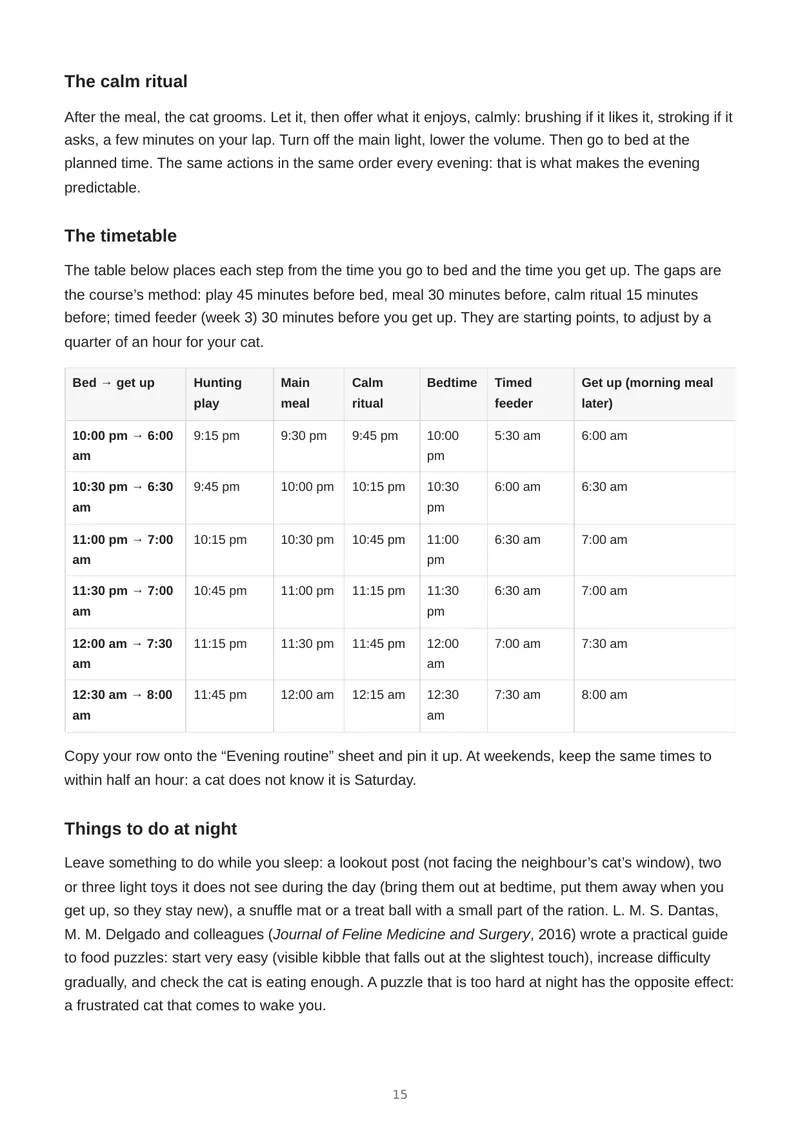
- Week 2: the evening routine. Hunting play step by step (a trial of 5 to 10 minutes of play a day), the meal straight after, the calm ritual, the timetable calculated for six bed and wake-up times, things to do at night.
- Week 3: night-time meowing step by step. The extinction burst and how to limit it, the thirty-second check, not answering in practice, the morning meal and the timed feeder, the five stages and their criteria, scratched doors and attacked feet.
- Week 4: consolidating and preventing relapses. What you keep, what you ease off, everyday predictability for the tense cat, what to do if it comes back, clock changes, the end-of-programme criterion.
- The senior cat that cries at night. Cognitive dysfunction in senior cats (from around 10 years), the vet first, the table of home adaptations, and why the “do not answer” rule needs care.
- Moving house. Before (three to four weeks), moving day, then the safe room in the new home (a randomised trial on hiding boxes) and going back outdoors.
- Visitors, building work and absences. Visitors, children, building-work days, absences and cat sitters, and coming home.
- Thunderstorms and fireworks. What a survey of 3,527 dogs and cats shows, the on-the-night checklist, the question of comforting, and gradual sound habituation a month ahead.
- A new baby or a new pet. The preparation calendar for a new baby, pregnancy and the litter box, a new pet, and what the studies on pheromone diffusers really say.
- When you are stuck, and when to ask for help. The programme’s troubleshooting table and the situations that call for a vet or a veterinary behaviourist.
- Printable sheets. Night log, weekly review, home map, resource inventory, stress signs grid, evening routine, calendar of risky moments, vet sheet.
- Sources. Sixteen studies with verified DOIs, Cats Protection, PDSA, CDC and Santé.fr, consulted on 22 November 2026.
Who it is for, and who it is not for
This guide is for you if…
- Your cat wakes you every night meowing at the door, or at 5 am demanding breakfast.
- Your cat seems tense, hides, eats or grooms differently since a move, building work or a change at home.
- A baby, another pet, a move, Fourth of July or Bonfire Night is coming and you want to prepare your cat.
- Your cat is getting older and is restless at night: you want to know what to ask your vet and how to adapt your home.
It will not help you if…
- You are looking for a medicine, supplement or “calming” product: the course recommends none; that is for your vet to decide.
- Your cat changed suddenly, drinks or eats differently, or strains to urinate: that is a vet visit first (the course tells you which signs are urgent).
- Your main problem is peeing outside the litter box, scratching or biting: our cat behaviour guide covers each of these in detail.
Free sample
What will happen: the “burst”
When a behaviour stops paying off, it sometimes increases before it decreases: this is called an extinction burst. D. C. Lerman and B. A. Iwata (Journal of Applied Behavior Analysis, 1995) analysed 113 data sets from extinction programmes (in humans, in applied behaviour analysis, not in cats). A burst appeared in 24% of cases; it was rarer when extinction was combined with other procedures (12%), than when it was used alone (36%). Two practical consequences for your cat:
- Expect a few harder nights at the start. This is when most owners give in, and a single response after twenty minutes of meowing teaches the cat to meow for twenty minutes.
- Never “just ignore”: the evening play, the late meal and the timed feeder are the replacement procedures that make a burst less likely.
The thirty-second check
Before ignoring a meow, you must be sure it is not a problem. Prepare the night so that you can answer “no” to everything without getting up:
- Litter box clean and reachable (scooped at bedtime).
- Fresh water in two places.
- No closed door in front of a resource (week 1).
- The cat was fine this evening: it played, ate, urinated.
- No unusual noise (a fall, a high-pitched cry, a meow of pain, vomiting).
If everything is ticked, the meow is a request: you do not answer. If something is out of the ordinary (a high-pitched cry, the sound of a fall, vomiting, a cat that does not stop for hours when this is not its habit), get up and check, calmly and without interaction: this is a safety exception, not a reward.
Pick the right option
| Feature | This guide€24 | All training courses bundle€99 | Best valueComplete library€149 |
|---|---|---|---|
| PDF guides | 1 | 23 | 64 |
| Pages | 35 | 966 | 2518 |
| Studies cited (DOI) | 16 | 149 | 414 |
| English and French | ✓ | ✓ | ✓ |
| Price per guide | €24 | €4.30 | €2.33 |
| Refunded within 14 days | ✓ | ✓ | ✓ |
| Get my guide — €24 | See what’s inside | See what’s inside |
Library: €149 instead of €1460 if you buy the 62 guides sold on their own one by one, a saving of €1311 (+ 2 guides only sold in bundles).
€24 one-off payment, updates included
Get my guide — €24Refunded within 14 days on a simple email, no questions asked
Frequently asked questions
What format is the course in?
A PDF to download right after payment, in English and French, ready to print (night log, home map, stress signs grid, evening routine and vet sheet included).
Will my cat stop meowing at night in four weeks?
The course does not promise that. Four weeks is a working pace: each week has a criterion for moving on, and if it is not met, you stay on the stage. It starts by ruling out medical causes, then deals with the most common ones: hunger, unspent energy, learned attention-seeking, a resource out of reach at night, stress.
Should I ignore a cat that meows at night?
Only after checking it is well. The course gives a thirty-second check to prepare at bedtime, and never asks you to ignore a cat that might be ill, or a disoriented senior cat.
How is it different from the cat behaviour guide?
The behaviour guide covers one problem per chapter (peeing outside the box, scratching, biting, conflicts, nights…). This course is a complete four-week programme devoted to stress and nights, with plans for moving house, visitors, storms, a new baby or a new pet.
Does the course replace the vet?
No. It makes no diagnosis and recommends no medicine. It starts with the signs to have examined and tells you when to see a veterinary behaviourist.
Can I get a refund?
Yes, by simple email to admin@tech-bharat.com within 14 days of purchase, no questions asked.
Free reading on the site
- Pheromone Diffusers for Cats: Do They Really Reduce Stress?
- Cat Scared of Thunderstorms or Fireworks: Creating a Calming Hideaway
- Moving house with your cat: the organisation that prevents escapes
Seller: LACANGEL GROUP, SAS (French simplified joint-stock company) — SIREN 995 268 018 — registered office: 1 rue Marguerin, 75014 Paris, France — president: Clément Lacaille — EU VAT number FR21995268018 — administration@lacangel.fr. Price VAT included. Digital product delivered right after payment; 14-day money-back commercial guarantee. See the terms of sale.
🩺 Our hygiene and health advice stays general: it never substitutes for an examination by a veterinarian, the only person qualified to advise on your animal.
How it works
Seller: LACANGEL GROUP (SAS), Paris, France, VAT FR21995268018. Prices VAT included. Terms of sale