Betta Fish Care: Tank, Heater, Filter and Health, the Complete Guide
Who it is for: Your betta lives in a bowl, a vase or a very small tank, and you want to know what to do today, then what it really needs.
- 37 pages
- 17 chapters
- 4 studies (DOI)
- FR + EN
- Edition November 2026
€19VAT included · one-off payment
Get my guide — €19Refunded within 14 days on a simple email, no questions asked
After payment
- Download your PDFs straight away, on the page that opens.
- You also get the link by email, sent by “Planète Pets” (subject “Your download:” followed by the guide’s name).
- Lost it? Find my purchases with your email address.
- No calls, no texts; at most one email, a week later, asking for your review.
For €130 more, Complete library: 64 PDF guides, €2.33 per guide.
- Betta tank size, calculated: at least 20 litres (about 5.3 gallons) of real water for a single male and 40 litres (about 10.6 gallons) with tank mates, and the table of nine common tanks showing that a “25-litre” tank holds only 18 litres of water once the substrate is in, with the right heater wattage for each (3 to 5 W per gallon)
- Warm, stable, safe water: 25 to 26 °C (77 to 79 °F), a low-flow filter that does not wear out its fins, the ammonia, nitrite and nitrate thresholds, the table of ammonia not to exceed at 24, 26 and 28 °C for your pH, and water changes calculated for your tank
- The right decisions: bowl or not and what to do today (two 2024 studies measured the effect of bowls), which decor does not damage fins, who it can live with (and why never two males), how much to feed, which signs should make you call a vet, and what the electricity costs
Checked48 automated checks on every site update (FR/EN parity, internal links, species data, guide PDF files), last checked on 2026-11-2310 sources cited in the guide, including 4 studies with a DOI
Method
- Primary sources: studies with a DOI, official texts
- Every figure linked to its source
- Dated edition, updates included
StandardsBuilt on the guidance of RSPCA
Card, Apple Pay or Google Pay payment on Stripe’s secure page: your card details never touch our servers. Price VAT included.
“Betta Fish Care: Tank, Heater, Filter and Health, the Complete Guide” is a 37-page printable PDF guide published by Planète Pets (November 2026 edition), sold for €19 VAT included: 17 chapters, 4 studies cited with their DOI, checklists and fill-in sheets, instant download after payment.
Why a bowl is a no and the emergency plan if your betta lives in one, its surface breathing and fragile fins, the real water volume calculated for nine common tanks with the heater wattage that matches each, temperature, a low-flow filter, the nitrogen cycle, fin-safe decor, feeding, tank mates, water changes calculated, the signs that should make you call a vet, the budget with calculated electricity use and six printable sheets.
Key facts
- Price
- €19 VAT included, one-off payment
- Format
- A4 PDF, 37 pages, to read or print
- Languages
- English and French (two PDFs)
- Contents
- 17 chapters, checklists, fill-in sheets
- Sources
- 4 studies with verified DOI; 10 sources in all, full list at the end of the guide
- Edition
- November 2026
- Seller
- Lacangel Group (SAS, France), card payment via Stripe
- Guarantee
- 14-day money-back on a simple email
What the guide contains
17 chapters, 37 A4 pages, with tick-box checklists, fill-in sheets and templates. Studies are cited with their DOI. The French edition is included with your purchase.
- Before you start. Who it is for, what the guide contains, where the information comes from (RSPCA Australia, OATA, a vet for PetMD, SPCA New Zealand, 4 publications with DOIs), what it does not do.
- Bowls: why not, and what to do if your betta already lives in one. What the care sheets say, what two 2024 studies measured (Oldfield and Murphy; Clark-Shen et al.), why a small volume does not work, the six-step emergency plan.
- Know your betta: origin, breathing, fins, male or female. A fish of calm, warm waters, surface breathing, long fins and domestication (Kwon et al. 2022), male or female, size and lifespan.
- The right volume: labelled litres, real litres. The table of care sheets and studies, labelled and real litres, the calculated table of nine common tanks with their heater, tank shape, weight.
- Heater and temperature. Temperature benchmarks, choosing and using the heater, power cuts, heatwaves and winter.
- Low-flow filtration: cleaning the water without sweeping the fish away. Why a filter, what flow, the table of filter types, spotting a current that is too strong, maintenance without killing the bacteria.
- The nitrogen cycle and tank cycling. The cycle in three steps, the table of thresholds (OATA, RSPCA Australia), the calculated table of ammonia by pH and temperature (Emerson et al. 1975), fishless or fish-in cycling, tap water.
- Fin-safe decor, plants, lighting and the lid. Decor that does not snag and the tights test, substrate, plants and cover, lid and lighting, setting up in order, acclimation.
- Feeding: what, how much, how often. What the care sheets say, the table of benchmarks, in practice, when you are away.
- Tank mates: who with, and who never. Two males never (Oldfield and Murphy 2024), male and female, groups of females, the who-with-whom table, introducing a tank mate, never release.
- Water and maintenance: water changes, calculated. The rule, the table of litres to change for six tanks, the calculated table of settled nitrate, step by step.
- The most common mistakes. Twelve mistakes, what happens and what you do instead.
- Health: the signs that should make you call a vet. Water and temperature first, a healthy betta, the table of signs in ten situations, finding a vet who treats fish, what to write down before calling.
- The budget: equipment and electricity, calculated. The full shopping list, what costs money every year, the calculated table of electricity use, the real cost: your time.
- The routine: day, week, month. Every task, from daily to yearly.
- Printable sheets. My tank and my betta, cycling log, water maintenance, meals, temperature and light, health and vet, shopping list and electricity.
- Sources. 4 publications with verified DOIs, the care sheets, water quality criteria and FishBase.
Who it is for, and who it is not for
This guide is for you if…
- Your betta lives in a bowl, a vase or a very small tank, and you want to know what to do today, then what it really needs.
- Your betta has a tank, but it stays on the bottom, its fins are getting damaged or the water turns cloudy, and you want to understand why.
- You are unsure about tank size, heater, filter, food or tank mates, and you want benchmarks in figures with their source.
- You are about to bring a betta home and want to set up the tank in the right order, before you pick it up.
It will not help you if…
- Your betta is sick and you are looking for a treatment: the guide says what should worry you and what to write down, but gives no medicine and no dose; that is the vet’s job.
- You want to breed bettas: the guide does not cover it.
- You want to keep two males together: the guide explains why that is never a good idea, even in a large tank.
- You are looking for equipment prices: the guide gives the full shopping list and calculates electricity, but quotes no prices and no brands.
In pictures
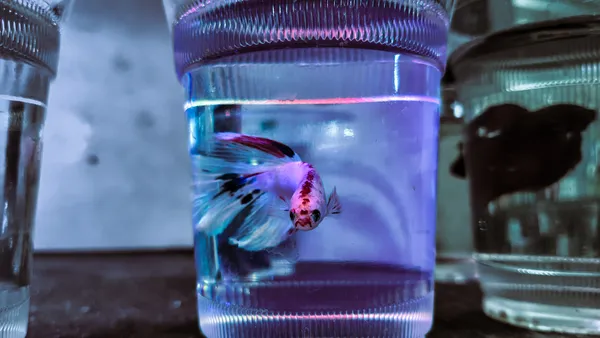

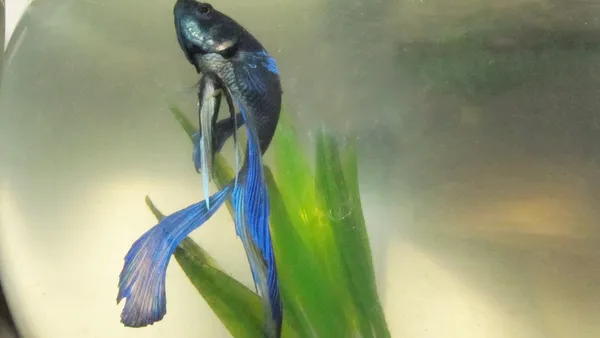

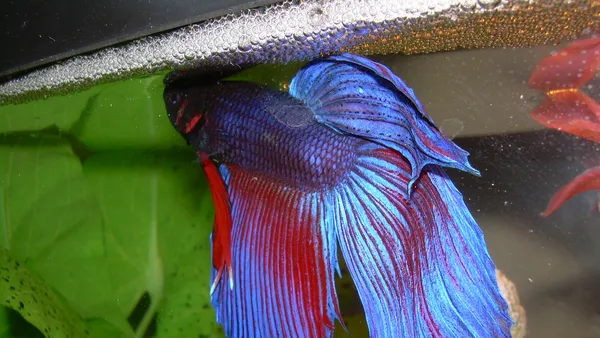

Illustrative photos, published by their authors under free licences.
Free sample
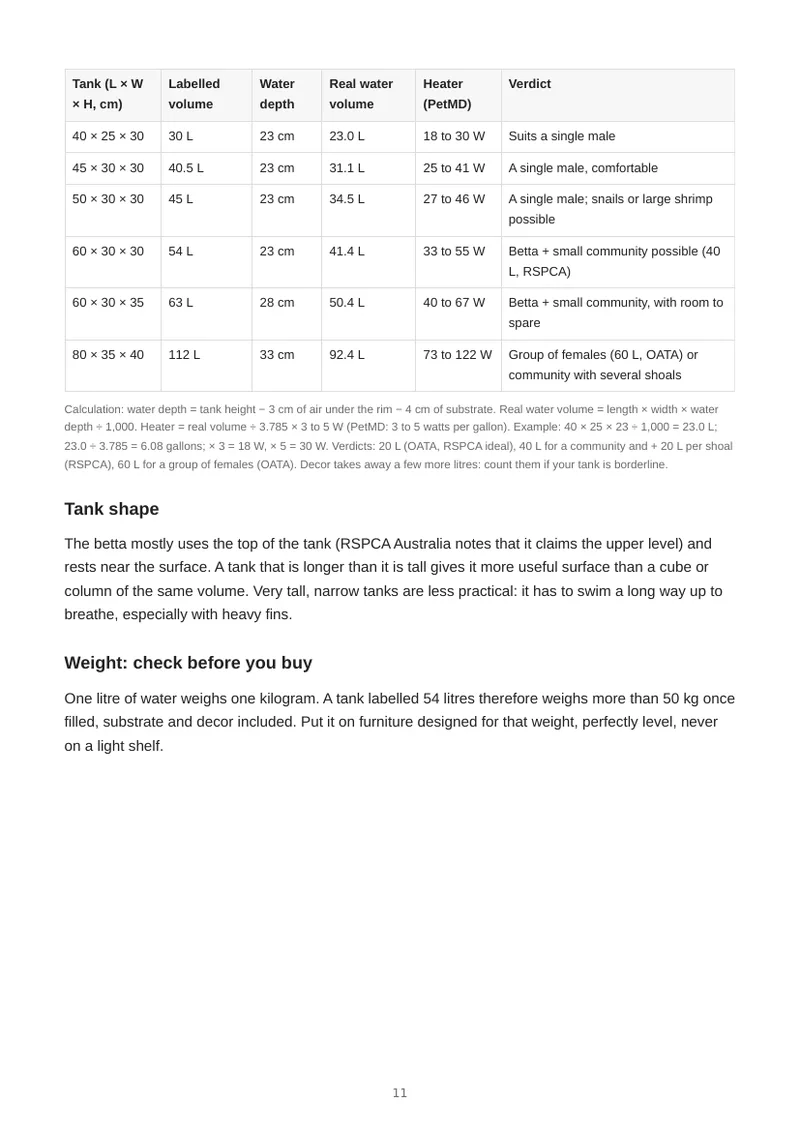
Table 2: nine common tanks, their real water volume and what they can house
| Tank (L × W × H, cm) | Labelled volume | Water depth | Real water volume | Heater (PetMD) | Verdict |
|---|---|---|---|---|---|
| 30 × 20 × 25 | 15 L | 18 cm | 10.8 L | 9 to 14 W | Too small: above RSPCA’s absolute minimum, under 20 L |
| 25 × 25 × 30 (cube) | 18.75 L | 23 cm | 14.4 L | 11 to 19 W | Too small: under 20 L |
| 40 × 25 × 25 | 25 L | 18 cm | 18.0 L | 14 to 24 W | Almost: under 20 L of real water |
| 40 × 25 × 30 | 30 L | 23 cm | 23.0 L | 18 to 30 W | Suits a single male |
| 45 × 30 × 30 | 40.5 L | 23 cm | 31.1 L | 25 to 41 W | A single male, comfortable |
| 50 × 30 × 30 | 45 L | 23 cm | 34.5 L | 27 to 46 W | A single male; snails or large shrimp possible |
| 60 × 30 × 30 | 54 L | 23 cm | 41.4 L | 33 to 55 W | Betta + small community possible (40 L, RSPCA) |
| 60 × 30 × 35 | 63 L | 28 cm | 50.4 L | 40 to 67 W | Betta + small community, with room to spare |
| 80 × 35 × 40 | 112 L | 33 cm | 92.4 L | 73 to 122 W | Group of females (60 L, OATA) or community with several shoals |
Calculation: water depth = tank height − 3 cm of air under the rim − 4 cm of substrate. Real water volume = length × width × water depth ÷ 1,000. Heater = real volume ÷ 3.785 × 3 to 5 W (PetMD: 3 to 5 watts per gallon). Example: 40 × 25 × 23 ÷ 1,000 = 23.0 L; 23.0 ÷ 3.785 = 6.08 gallons; × 3 = 18 W, × 5 = 30 W. Verdicts: 20 L (OATA, RSPCA ideal), 40 L for a community and + 20 L per shoal (RSPCA), 60 L for a group of females (OATA). Decor takes away a few more litres: count them if your tank is borderline.
Pick the right option
| Feature | This guide€19 | Best valueComplete library€149 |
|---|---|---|
| PDF guides | 1 | 64 |
| Pages | 37 | 2518 |
| Studies cited (DOI) | 4 | 414 |
| English and French | ✓ | ✓ |
| Price per guide | €19 | €2.33 |
| Refunded within 14 days | ✓ | ✓ |
| Get my guide — €19 | See what’s inside |
Library: €149 instead of €1460 if you buy the 62 guides sold on their own one by one, a saving of €1311 (+ 2 guides only sold in bundles).
€19 one-off payment, updates included
Get my guide — €19Refunded within 14 days on a simple email, no questions asked
Frequently asked questions
What format is the guide in?
A PDF to download right after payment, in English and French, print-ready, with six sheets: my tank and my betta, cycling log, water maintenance, meals, temperature and light, health and vet, shopping list and electricity.
What size tank does a betta need?
RSPCA Australia sets the absolute minimum at 10 litres and recommends ideally 20 litres or more; OATA asks for at least 20 litres for a single male. We go with 20 litres (about 5.3 gallons) of real water, and 40 litres with tank mates. Watch out: a tank sold as “25 litres” holds only 18 litres of water once the substrate is in and the air gap left. Chapter 4 calculates the real volume of nine common tanks.
Can a betta live in a bowl?
It can survive in one, because it breathes air at the surface, but not live well. A 2024 study shows it swims less in a 0.5-litre bowl than in a 10-litre or larger aquarium, and another that the largest furnished tank gives the most activity and the fewest abnormal behaviours. Chapter 2 gives the emergency plan if your betta lives in a bowl today.
Does a betta need a heater?
Yes. It is a tropical fish: RSPCA Australia aims for 24 to 26 °C with a submersible heater and writes that room temperature is unsuitable; PetMD considers a heater necessary even in a heated home, to prevent fluctuations. Table 2 gives the right wattage for each tank, and chapter 14 calculates the electricity cost.
What filter for a betta?
A filter is always essential (OATA), but with low flow: RSPCA Australia asks for adjustable flow set low, and PetMD names air-driven sponge filters as ideal. Strong current tires long-finned varieties. Chapter 6 explains how to spot a current that is too strong and what to do.
What fish can live with a betta?
Never another male, even in a very large tank. In 40 litres or more, RSPCA Australia lists snails, large shrimp, corydoras, otocinclus and neon tetras in a shoal; never fin-nipping fish. Chapter 10 gives the full table.
Does the guide replace the vet?
No. It says what should worry you (table of ten situations), what to write down before calling and how to find a vet who treats fish, but makes no diagnosis and gives no medicine and no dose.
Free reading on the site
- Betta tank of 20-30 litres: the ideal setup, step by step
- Betta in a bowl: what a welfare study actually shows
- Why Is a Male Betta Aggressive? What to Know Before Tank Mates
Seller: LACANGEL GROUP, SAS (French simplified joint-stock company) — SIREN 995 268 018 — registered office: 1 rue Marguerin, 75014 Paris, France — president: Clément Lacaille — EU VAT number FR21995268018 — administration@lacangel.fr. Price VAT included. Digital product delivered right after payment; 14-day money-back commercial guarantee. See the terms of sale.
🩺 Reminder: this page informs, it does not diagnose. For any symptom or health question, your veterinarian remains the only reference.
How it works
Seller: LACANGEL GROUP (SAS), Paris, France, VAT FR21995268018. Prices VAT included. Terms of sale