
Animal Training Techniques: Positive Reinforcement, Clicker, Targeting and Cooperative Care for Every Pet
Who it is for: You want to teach your pet, whatever its species, to come, settle, go into its carrier or step onto a scale without being grabbed.
- 42 pages
- 14 chapters
- 9 studies (DOI)
- FR + EN
- Edition November 2026
€29VAT included · one-off payment
Get my guide — €29Refunded within 14 days on a simple email, no questions asked
After payment
- Download your PDFs straight away, on the page that opens.
- You also get the link by email, sent by “Planète Pets” (subject “Your download:” followed by the guide’s name).
- Lost it? Find my purchases with your email address.
- No calls, no texts; at most one email, a week later, asking for your review.
For €70 more, All training courses bundle: 23 PDF guides, €4.30 per guide.
- Understand how your pet learns and why positive reinforcement works, whether it is a dog, a rabbit, a parrot, a gecko or a fish
- A seven-step path from the marker to cooperative care, with step-by-step instructions for each technique and a clear criterion for moving on
- Two species-by-species tables (rewards and stress signals), nine reviewed studies and printable sheets: session plan, training log, care tracker
Checked48 automated checks on every site update (FR/EN parity, internal links, species data, guide PDF files), last checked on 2026-11-0112 sources cited in the guide, including 9 studies with a DOI
Method
- Primary sources: studies with a DOI, official texts
- Every figure linked to its source
- Dated edition, updates included
StandardsBuilt on the guidance of AVSAB
Card, Apple Pay or Google Pay payment on Stripe’s secure page: your card details never touch our servers. Price VAT included.
“Animal Training Techniques: Positive Reinforcement, Clicker, Targeting and Cooperative Care for Every Pet” is a 42-page printable PDF guide published by Planète Pets (November 2026 edition), sold for €29 VAT included: 14 chapters, 9 studies cited with their DOI, checklists and fill-in sheets, instant download after payment.
The techniques zoo keepers use with tortoises, reptiles and fish, explained step by step for your dog, cat, rabbit, rodent, bird, ferret, reptile or fish.
Key facts
- Price
- €29 VAT included, one-off payment
- Format
- A4 PDF, 42 pages, to read or print
- Languages
- English and French (two PDFs)
- Contents
- 14 chapters, checklists, fill-in sheets
- Sources
- 9 studies with verified DOI; 12 sources in all, full list at the end of the guide
- Edition
- November 2026
- Seller
- Lacangel Group (SAS, France), card payment via Stripe
- Guarantee
- 14-day money-back on a simple email
What the guide contains
14 chapters, 42 A4 pages, with tick-box checklists, fill-in sheets and templates. Studies are cited with their DOI. The French edition is included with your purchase.
- Before You Start. What the course contains, the seven-step path with a criterion for moving on, what you need, what it does not do and when to see the vet first.
- How Animals Learn: The Four Quadrants Made Simple. Reinforcement and punishment, positive and negative: the four quadrants in one table, classical conditioning, accidental negative reinforcement and the Premack principle.
- Why We Choose Positive Reinforcement First. The LIMA principle, Susan Friedman’s six-level Humane Hierarchy, the 2020 study of 92 dogs, the AVSAB position statement (2021) and what punishment costs.
- Step 1: The Marker and the Clicker. Clicker or word (what a study of 90 puppies found), charging the marker, three rules, practising timing, keeping a good rate of reinforcement.
- Rewards and Stress Signals, Species by Species. A reward table for 14 species or groups (from dogs to fish) and a table of subtle and clear stress signals, species by species.
- Step 2: Luring, Capturing and Shaping. Luring and fading the lure, capturing, shaping and its rules, with a step-by-step plan to teach a rabbit to walk into its carrier.
- Step 3: Targeting, the Universal Technique. Choosing a target, the basic protocol, then cats, rabbits, rats, birds, lizards, tortoises and fish, with six studies from zoos, shelters and laboratories; the station.
- Step 4: Cues, Stimulus Control and Chains. When to add a cue, the four conditions of stimulus control, backchaining (example: a bird going back into its cage alone).
- Step 5: Generalizing, Proofing and Handling Extinction. The 3 Ds (duration, distance, distractions) and location, one dial at a time, the 8-out-of-10 rule, maintaining, extinction, the extinction burst and spontaneous recovery.
- Step 6: Habituation, Desensitization and Counterconditioning. Habituation and its limits, why no flooding, desensitization and counterconditioning step by step, the guinea pig and the towel, reptiles and the hand.
- Step 7: Cooperative Care, Consent, Choice and Control. Consent signals by species, start button behaviors, the bucket game, cooperative care in six stages, choice and control, the weekly weigh-in.
- The Universal Session Plan, Common Mistakes and What to Do When You Get Stuck. The path at a glance, the universal session plan, session length and frequency, eleven common mistakes, when you get stuck, when to see the vet.
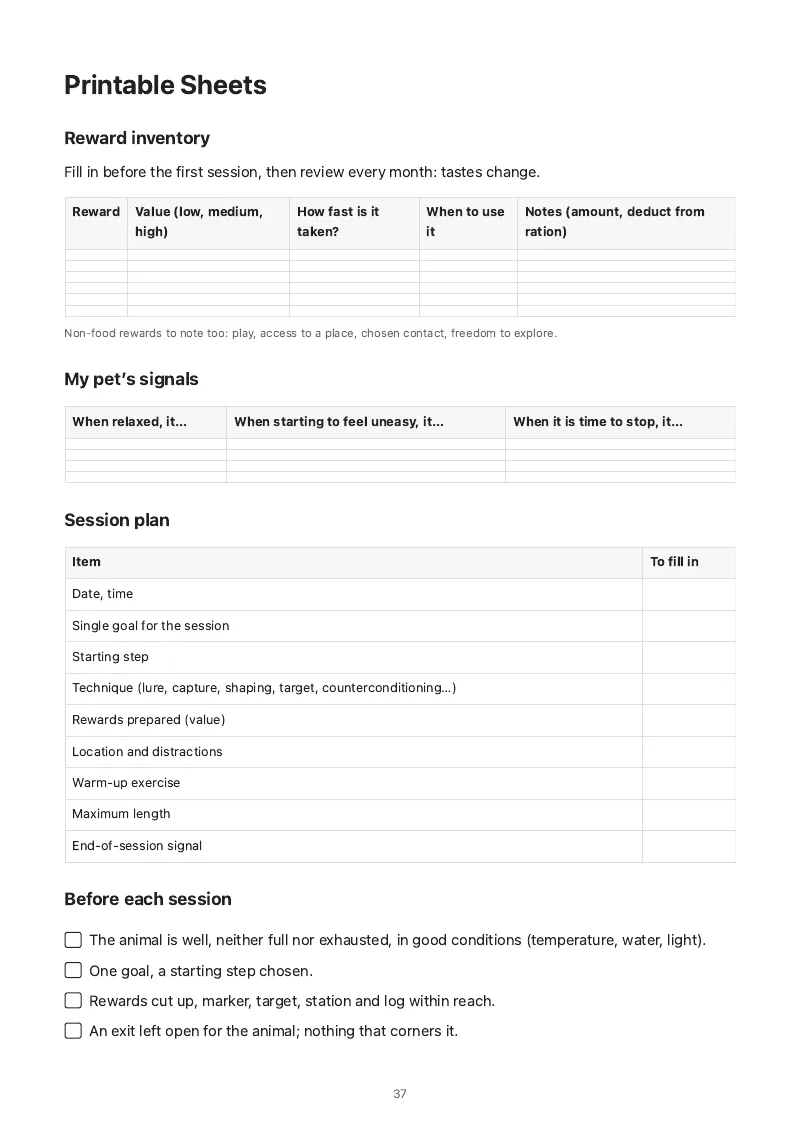
- Printable Sheets. Reward inventory, my pet’s signals, session plan, training log, shaping plan, household cues, cooperative care tracker, weigh-in, contacts.
- Sources. Nine studies with verified DOIs, AVSAB 2021, the UK Animal Welfare Act 2006 and electronic collar regulations, read on 2 November 2026.
Who it is for, and who it is not for
This guide is for you if…
- You want to teach your pet, whatever its species, to come, settle, go into its carrier or step onto a scale without being grabbed.
- Trimming nails, weighing, examining or treating your pet has become an ordeal for both of you.
- You keep small mammals, birds, reptiles or fish and thought they “couldn’t be trained”.
- You already train a dog or cat and want to understand the techniques well enough to apply them to anything.
It will not help you if…
- You are looking for a punishment-based method, a shock collar or forced restraint: this course offers none, with the studies to back it.
- Your pet has suddenly changed its behavior, stopped eating or seems to be in pain: that calls for a vet visit first.
- You want a complete program for one specific problem such as a reactive dog or a cat soiling the house: our species guides cover that, this course gives you the tools.
Free sample
The bucket game
The bucket game was devised by the British trainer Chirag Patel. A container of rewards is placed up high, visible but out of reach. The animal learns that as long as it looks at the container, a reward comes out of it from time to time, and that handling (a hand on the shoulder, cotton wool at the ear) only happens while it is looking at it. If it looks away or moves, you stop, and you start again when it goes back to the container. Developed for dogs, the principle (looking at an object = “I’m ready”) adapts well to cats, parrots and ferrets.
Pick the right option
| Feature | This guide€29 | All training courses bundle€99 | Best valueComplete library€149 |
|---|---|---|---|
| PDF guides | 1 | 23 | 64 |
| Pages | 42 | 966 | 2518 |
| Studies cited (DOI) | 9 | 149 | 414 |
| English and French | ✓ | ✓ | ✓ |
| Price per guide | €29 | €4.30 | €2.33 |
| Refunded within 14 days | ✓ | ✓ | ✓ |
| Get my guide — €29 | See what’s inside | See what’s inside |
Library: €149 instead of €1460 if you buy the 62 guides sold on their own one by one, a saving of €1311 (+ 2 guides only sold in bundles).
€29 one-off payment, updates included
Get my guide — €29Refunded within 14 days on a simple email, no questions asked
Frequently asked questions
What format is the course?
A PDF to download right after payment, in English and French, ready to print (session plan, training log, reward inventory, shaping plan and cooperative care tracker included).
Will it work for my species?
The techniques apply to every animal: the course explains what changes for dogs, cats, rabbits, rodents, ferrets, birds, lizards, snakes, tortoises and fish. The pace depends on the species and the individual.
Do I need a clicker?
No. A short word is enough; the course explains when a clicker helps and what the research says.
Does it overlap with your species guides?
No. This course is the toolbox; the species guides apply it to specific problems. It points to them where useful.
Does it replace a vet?
No. It makes no diagnosis and recommends no medication or supplement. Any sudden change in behavior should be checked by a vet first.
Can I get a refund?
Yes, by simple email to admin@tech-bharat.com within 14 days of purchase, no questions asked.
Seller: LACANGEL GROUP, SAS (French simplified joint-stock company) — SIREN 995 268 018 — registered office: 1 rue Marguerin, 75014 Paris, France — president: Clément Lacaille — EU VAT number FR21995268018 — administration@lacangel.fr. Price VAT included. Digital product delivered right after payment; 14-day money-back commercial guarantee. See the terms of sale.
🩺 Reminder: this page informs, it does not diagnose. For any symptom or health question, your veterinarian remains the only reference.
How it works
Seller: LACANGEL GROUP (SAS), Paris, France, VAT FR21995268018. Prices VAT included. Terms of sale