Home Renovation and Paint: How to Protect Your Aquarium From Toxic Fumes
Published by Planète Pets · managing editor: Clément Lacaille · how our guides are written
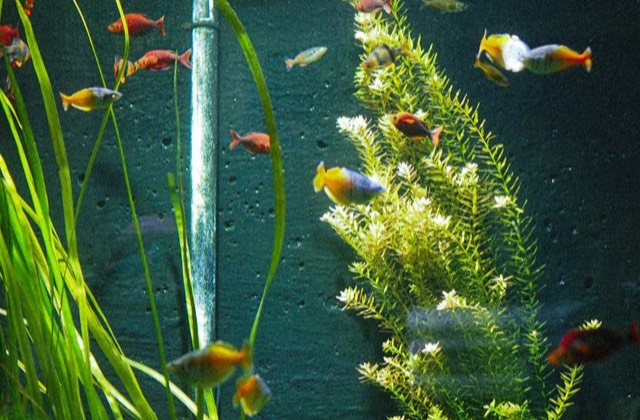
Repainting a room or treating furniture against insects seems unrelated to an aquarium a few meters away, yet some fumes dissolve directly into the tank water and can poison fish without any direct contact. A review by Bradbury and Coats published in 1989 in Environmental Toxicology and Chemistry (see the study) documents the high toxicity of many spray insecticides to fish, even at very low concentrations in water. Find our other pointers in the travel and safety section and on the fishkeeping hub.
Contents · 5 sections
How can a product sprayed far from the tank still reach it?
Aerosols and solvent fumes stay suspended in the air for hours and gradually settle on every surface in a room, including the water surface of an open or poorly covered aquarium. Continuous filtration further speeds up this dissolution by constantly stirring the water in contact with air laden with particles.
Which home renovation jobs carry the most risk?
Paint, solvent-based glues, spray moth or mosquito treatments, and strong degreasing cleaners are among the most problematic products near a tank. Spray insecticides remain among the most dangerous, as shown by the review cited above, since even brief exposure can durably affect fish nervous systems.
What precautions should you take before starting work?
Fully covering the aquarium with a tarp or a sealed lid and temporarily switching off filtration for the duration of the work sharply limits exchanges between the room air and the tank water. Ventilating the room thoroughly for several hours after finishing, before removing the cover and restarting the equipment, gives residual fumes time to dissipate.
What should you do if contamination is already suspected?
A substantial partial water change, combined with adding activated carbon to the filter to absorb dissolved chemical residue, remains the most effective response when accidental contamination is suspected. If filtration equipment happens to fail at the same time as the work, the usual emergency kit for a heater or filter failure is also useful to limit cumulative stress on the fish.
- Some products sprayed far from the tank can still contaminate the water through the air
- Spray insecticides, paint and solvent-based glues rank among the riskiest
- Covering the tank and switching off filtration during work sharply limits exposure
- A water change plus activated carbon helps after accidental contamination
Frequently asked questions
Does a simple glass lid protect the tank during renovation work?
A standard lid already limits direct splashes, but a tarp or film covering every opening stays safer against fumes that settle gradually.
How long should you wait before restarting filtration after painting?
A few hours of intensive ventilation with windows open is generally enough before removing the tank's cover and safely restarting the equipment.
Should the aquarium be moved before major renovation work?
That isn't always necessary if the room can be well ventilated and the tank properly covered, but a temporary move remains preferable for long or heavily polluting work such as sanding.
In our shop, for this use: Ceramic pebble hide for shrimp and small fish (€20.90) · the whole shop
This guide is part of Planète Pets’s Fishkeeping universe. Our advice is general in nature: for any health concern, your veterinarian remains the only reference.