Tank Background Color: A Real Stress Factor
Published by Planète Pets · managing editor: Clément Lacaille · how our guides are written
Choosing a background color for the tank often comes down to pure aesthetics, but the color a fish perceives also affects its physiology: several species adjust their pigmentation and cortisol levels depending on their surroundings' hue. A study by Dopeikar, Khoshkholgh, Ghasemi and Morshedi published in 2024 in Aquaculture Research compared Oscar fish raised in blue, white, yellow and red tanks: plasma cortisol, glucose and lactate were markedly higher in fish from blue tanks, while those in red tanks showed the best growth. Find all our pointers on the fishkeeping hub and in the bedding and habitat section.
Contents · 5 sections
Why does background color affect a fish's stress level?
Many fish adjust their camouflage based on the background they perceive: a pale background prompts lighter coloring, a dark one prompts darker coloring, a hormonal mechanism tied directly to the stress glands. When the ambient color doesn't match any effective camouflage strategy, the animal stays on prolonged alert, which keeps cortisol higher than it needs to be.
What exactly did the study on Oscar fish find?
Across 120 fish split into twelve tanks of different colors, the researchers measured growth, blood biochemistry and the expression of growth-related genes. Blue tanks turned out to be the worst across all these markers, while red tanks produced the best weight gain and the most efficient feed conversion.
Does that mean a red background is always ideal?
Not necessarily for every species: responses vary by fish, and an overly pale background raises cortisol in some species such as zebrafish, the opposite pattern to what darker backgrounds usually cause. What matters most is avoiding highly reflective backgrounds or a color that clashes strongly with the fish's natural hue, as covered in our guide on easy aquascaping for beginners.
How should you actually pick a background and substrate color?
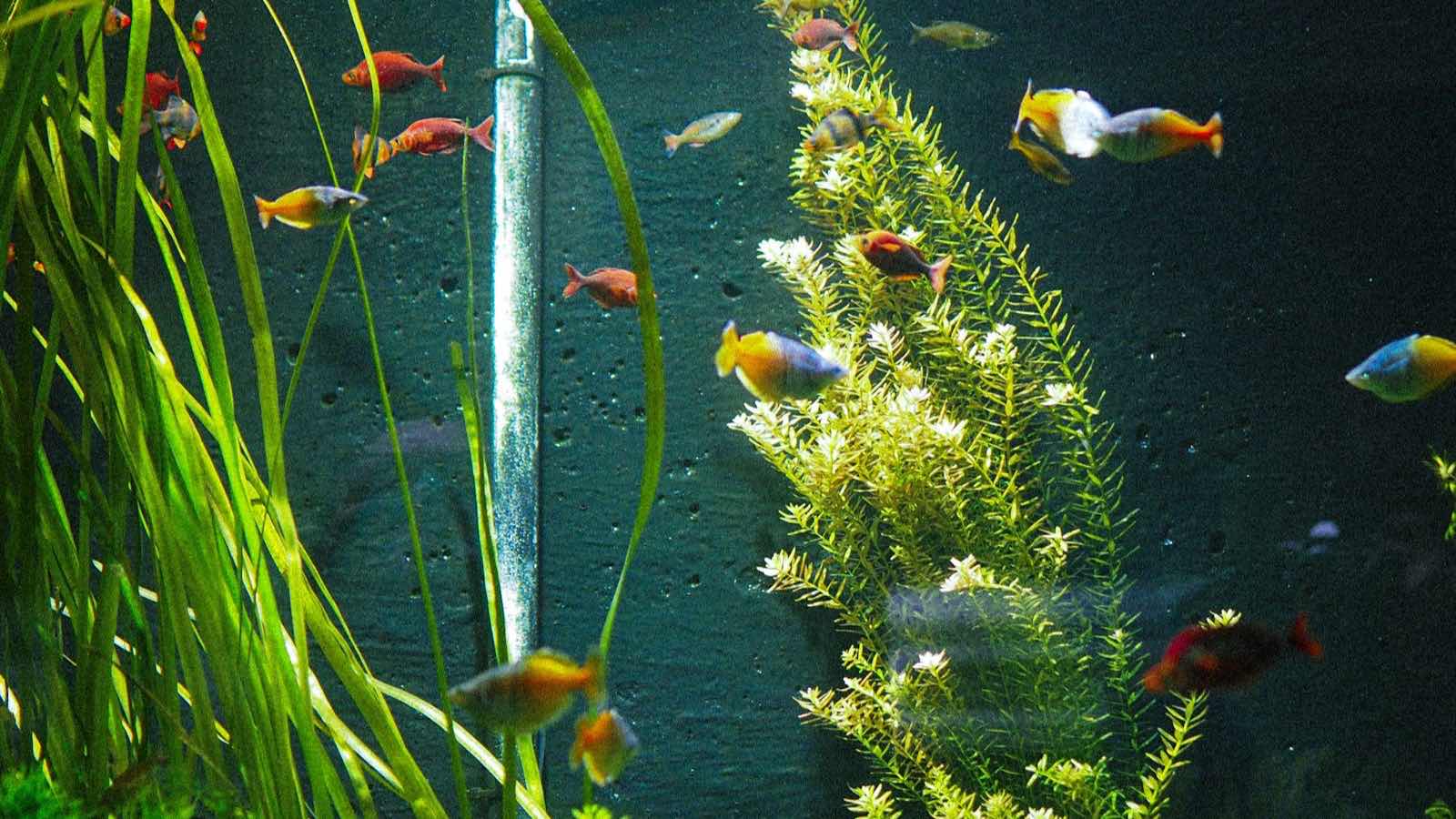
Favor a matte, dark or neutral background rather than bright white or blue, in keeping with the decor and the substrate chosen for the tank. A dark background also limits reflections that can stress some fish, while making the natural colors of the more vivid species stand out more.
- Oscar fish cortisol was markedly higher in blue tanks than in any other color tested
- Red tanks produced the best growth and the most efficient feed conversion
- Color response varies by species: an overly pale background stresses zebrafish more
- A matte, dark or neutral background remains the safest choice for most tanks
Frequently asked questions
Does a black background suit every species?
It suits most common freshwater fish, but some pale or albino species may appear more stressed if the contrast with their coloring is too stark.
Do decor and plants make up for a pale background?
They help by providing hiding spots and visual landmarks, but they don't fully replace the direct effect of background color on a fish's sense of security.
Should you change an existing background if the tank is running well?
Not urgently: if the fish behave normally and hold good color, the benefit of a change is limited, especially since any decor change is itself a temporary source of stress.
An accessory from our shop for this use: Ceramic pebble hide for shrimp and small fish (€20.90) · the whole shop
This guide is part of Planète Pets’s Fishkeeping universe. Our advice is general in nature: for any health concern, your veterinarian remains the only reference.