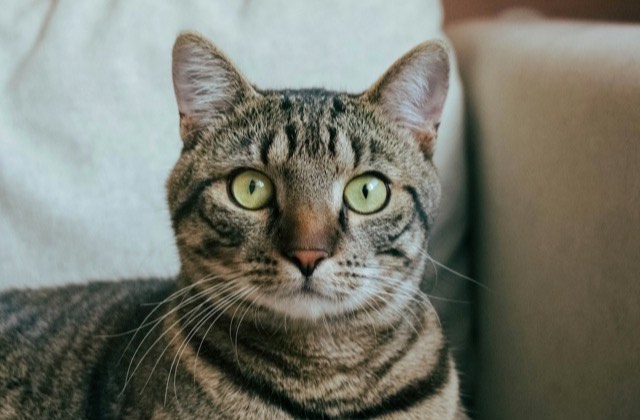
Devon Rex: sparse coat, warmth needs and the right bedding
Published by Planète Pets · managing editor: Clément Lacaille · how our guides are written
A Devon Rex does not seek out your lap purely out of affection: it is also looking for a heat source. Its wavy, short, sparse coat is not a cosmetic quirk. A study by Barbara Gandolfi, Leslie Lyons and colleagues, published in 2010 in Mammalian Genome, identified the KRT71 mutations behind the Devon Rex's curly coat and the Sphynx's near-hairlessness (see the study). Both breeds therefore share the same gene at different degrees: the Devon keeps a coat, but a structurally fragile, thin one that insulates poorly. The Devon Rex breed profile covers its other particularities.
Contents · 5 sections
A cat that loses heat faster
In practice, a Devon Rex cools down faster than a double-coated cat in a flat kept at 18 °C in winter, and it compensates by hunting for the radiator, the laptop, the bed or another cat. That matters over time: a cat spending its days pressed against a hot surface risks quiet contact burns, particularly on the belly, where the skin is barest.
Setting up safe warm spots
The right answer is not to overheat the room, but to create two or three warm refuges the cat chooses freely. A covered igloo bed lined with fleece traps the air the cat warms itself: it is the simplest and safest option. Place it high up, away from door and window draughts, and never directly on tiles. If you add a heat mat, choose a low-temperature model designed for animals, set it to minimum, and always leave half the bed unheated so the cat can move away. The principle is the same as in a terrarium: it is the gradient that protects, not the set temperature.
Warmth and oily skin: the link to know
Devon Rex cats often combine a fine coat with abundant sebum, which makes areas of prolonged contact — folds, armpits, tail base — more sensitive when they stay warm and damp. Machine-washable bedding changed weekly limits that risk; our article on Devon Rex and Cornish Rex skin care covers the routine. For extreme bare-skin cases, the benchmarks from bathing a Sphynx remain instructive.
A few winter adjustments are enough
Keeping the living room at 20–22 °C, closing draughts, avoiding a sleeping spot against a cold window and adding one bed near a gentle heat source covers the essentials. Our size and placement benchmarks are in the cat bedding and habitat section.
Frequently asked questions
Should I dress a Devon Rex?
Rarely useful indoors, and never unsupervised: an ill-fitting garment hampers thermoregulation and can injure. Adjust bedding and room temperature instead.
Is a heat mat dangerous?
Not if it is designed for animals, set low and covers only part of the bed. The danger comes from small very hot sources, such as a bare radiator or an unwrapped hot-water bottle.
My Devon Rex is trembling: is it cold?
Possibly, but repeated tremors can also signal pain or a neuromuscular disorder, which is more common in this breed. If the cat trembles in a warm room, see your vet.
An accessory from our shop for this use: Stainless-steel pin brush for cats (€18.90) · the whole shop
For the gear, at Le Félin (same family, zero commission): Arbre à chat XXL pour Maine Coon (from €139.99)
This guide is part of Planète Pets’s Cats universe. Our advice is general in nature: for any health concern, your veterinarian remains the only reference.