Guppy: gear and buying guides
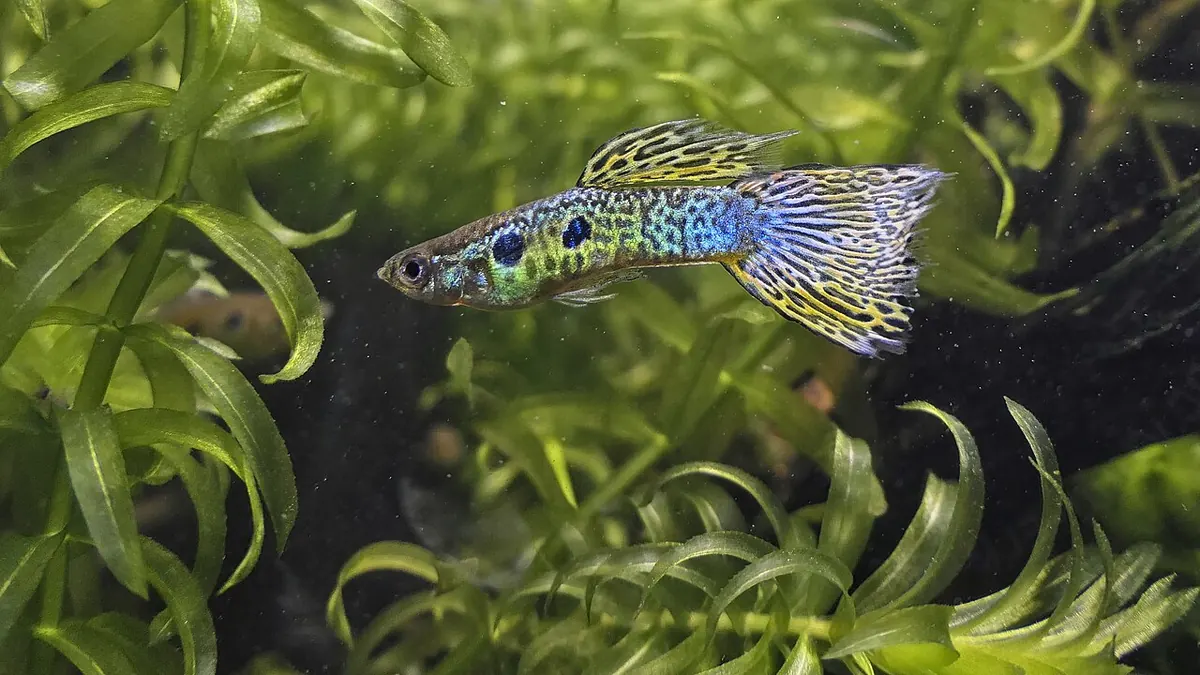

The guppy is a colorful, lively and very prolific livebearer, ideal for beginners as long as births are managed. It lives in groups with roughly two to three females per male, in a tank of at least 60 L heated between 22 and 26 °C. It prefers fairly hard water and a planted tank; the equipment is simple but a heater and filter are essential.
Profile : 3 to 6 cm as an adult depending on sex, 60 L minimum for a group, water between 22 and 26 °C.
See it in the Planète Pets shop: Hollow moss-effect resin log for aquariums (€20.90) · the whole shop
Our products don’t ship to you yet, but the PDF practical guide is instant: Beginner axolotl: aquarium and care (€19)
Species profile
- Lifespan
- 2 to 3 years
- Adult size
- 6 cm
- Minimum tank
- 60 L
- Water temperature
- 22 to 26 °C
- pH
- 7 to 8
- Temperament
- Peaceful and sociable, yet males court relentlessly: keep two to three females per male to spread the pressure.
- Health watch
- white spot disease in stressed fish · fin rot in unstable water
🩺 Reminder: this page informs, it does not diagnose. For any symptom or health question, your veterinarian remains the only reference.
Guppy gear, family by family
-
🍖
Food
An easy omnivore: quality flakes as a staple, with plant matter such as spirulina and baby brine shrimp. Two small meals a day are enough, even though it constantly begs.
-
🧴
Care & grooming
Hardy in moderately hard to hard, slightly alkaline water, it copes poorly with very soft acidic water. A 20 to 25 percent weekly water change and quarantining newcomers are recommended.
-
🎾
Toys & enrichment
Fine-leaved plants such as Java moss or cabomba provide refuge for fry and areas to explore. Leave an open swimming zone at the front of the tank for this active swimmer.
-
🏠
Bedding & habitat
A tank of at least 60 L, well planted, with stable parameters rather than perfect values. Plan for overpopulation: one female can produce dozens of fry per month.
-
🧳
Travel & safety
Transport in bags in small groups, protected from the cold. Acclimate slowly, especially if the source water is harder than yours, mixing the waters over 30 minutes.
-
🧰
Accessories
A standard filter, a 50 to 100 W heater, a fine net for fry and possibly a breeding box. Equipment budget of around 80 to 150 euros for a 60 to 100 L tank.
🍖 Feeding a Guppy: omnivore diet, frequency, mistakes
Feeding a Guppy: diet and habits
The Guppy is an omnivore: a quality staple (flakes or granules) varied with frozen foods and greens. Since it eats in midwater, pick slow-sinking food and stop at what gets eaten in two minutes: beyond that you are feeding the water, not the fish.
Frequency and variety
Feed little and often — one or two small servings a day — and grant a weekly fast without guilt: excess, never shortage, is what ruins tanks. In a group of 6 or more, check everyone reaches the food: dominants serve themselves first. Alternate dry, frozen and rinsed thawed prey across the week.
The costly mistakes
A fish does not “beg” from hunger but from conditioning: hold firm — the ration is whatever is truly eaten in two minutes. Bottom-shelf food disintegrates before it is eaten and loads the water; the price gap to a reliable brand is measured in euros per year. The rest of the profile is on the full Guppy profile.
Quick answers
- How often should a Guppy be fed?
- One or two small daily feeds eaten within two minutes, plus one fasting day a week. In doubt, underfeed: the water will thank you.
- What food suits a Guppy?
- An omnivore: a quality staple (flakes or granules) varied with frozen foods and greens — served in a form matched to its swimming zone.
See it in the Planète Pets shop: Programmable automatic aquarium fish feeder (€32.90) · the whole shop
Outside our shipping area? The downloadable practical guide: Beginner axolotl: aquarium and care (€19)
🧴 Water care for a Guppy: 22 to 26°C, pH 7 to 8
The Guppy’s water: its real parameters
The Guppy’s water contract has four clauses: 22 to 26°C, pH between 7 to 8, zero detectable nitrite, nitrates capped at 25 mg/L. A drop-test kit (NO2, NO3, GH, KH, pH) beats any strip — and the nitrogen cycle, three to four weeks before any fish, is non-negotiable.
Water changes and tank upkeep
10 to 20% of the volume weekly, with water pre-heated to tank temperature: thermal shock stresses more than imperfect water, gentle substrate siphoning as you go and filter media rinsed in tank water, never under the tap: chlorine sterilises your filter.
Health: what stalks the Guppy
Known watch-points: white spot disease in stressed fish and fin rot in unstable water. Nearly every aquarium disease stems from degraded water or chronic stress: test the water BEFORE treating — medicine poured into loaded water makes everything worse. Well kept, a Guppy lives 2 to 3 years.
Quick answers
- What water parameters for a Guppy?
- 22 to 26°C, pH 7 to 8, zero nitrites and nitrates under 25 mg/L — checked with drop tests, not by eye.
- How often should a Guppy tank get water changes?
- 10 to 20% weekly, water brought to temperature, filter rinsed only in tank water. Consistency beats volume.
An accessory from our shop for this use: Hang-on isolation and breeding box for aquariums (€28.90) · the whole shop
Our products don’t ship to you yet, but the PDF practical guide is instant: Beginner axolotl: aquarium and care (€19)
🎾 Enriching a Guppy tank: hardscape, shoal and occupation
Hardscape designed for its swimming zone
The Guppy lives in midwater: structure the space with tall plants along the back, wood shelters and swimming lanes left clear. An aquarium’s enrichment is its hiding places and its currents — not fluorescent ornaments.
Group life: the first enrichment
Kept at 6 or more, the Guppy shows its true behaviours: hierarchies, displays, coordinated swimming. Below that, chronic stress sets in and colours fade — group size is the species’ first “toy”, before any decor purchase.
Food as occupation
Feeding is occupation lever number one: prey in the current, multiple shifting feeding points — the underwater equivalent of a mammal’s snuffle mat.
Quick answers
- How many Guppy should be kept together?
- 6 minimum, more if the tank allows: it is a shoaling species, and numbers shape its behaviour and colours alike.
- How do you enrich a Guppy tank?
- Through layout above all: decor designed for its living zone (in midwater), meals served in varied ways and a complete group — gadgets add nothing.
In our shop, for this use: Resin shipwreck hide for aquariums, 4 models (€26.90) · the whole shop
Our products don’t ship to you yet, but the PDF practical guide is instant: Beginner axolotl: aquarium and care (€19)
🏠 The Guppy tank: 60 L, hardware and start-up
60 litres minimum: why that number
For a group of 6+ Guppy reaching 6 cm as an adult, plan 60 real litres — and remember a big tank is more STABLE, hence easier, than a small one: parameters drift slowly, leaving time to correct. This volume suits a sturdy standard cabinet — just verify perfect levelness.
Hardware: filter, heater, lighting
The Guppy tank’s technical trio starts with filtration — three to five volume turnovers per hour, a heater around 1 W per litre set to 22 to 26°C, backed by an independent thermometer — built-in thermostats sometimes lie, and lighting on a timer at 8 to 10 hours a day: any longer and the algae win.
Substrate, plants and start-up
Nutrient substrate under fine sand or quartz, robust plants (anubias, vallisneria, Java moss) and wood to structure the territory. Then patience: a complete nitrogen cycle (3 to 4 weeks, nitrites back to zero) before the first Guppy — the step every hurried beginner pays for dearly.
Quick answers
- What tank size for Guppys?
- A real 60 litres minimum for a group of 6+ — below that, parameters drift too fast to catch.
- Does a Guppy need a heater?
- Yes, about 1 W per litre set to 22 to 26°C, with an independent thermometer double-checking the thermostat.
See it in the Planète Pets shop: Ceramic pebble hide for shrimp and small fish (€20.90) · the whole shop
Our products don’t ship to you yet, but the PDF practical guide is instant: Beginner axolotl: aquarium and care (€19)
🧰 Accessories for a Guppy: tests, upkeep and budget
Water tests: your dashboard
The first smart buy for a Guppy costs €15 to 30: the drop-test kit, out weekly for NO2-NO3 and at any doubt for GH, KH and pH. Then come the net sized for 6 cm, the substrate siphon and the dedicated bucket — never the cleaning one, whose detergent traces contaminate the water.
The Guppy specifics
a battery backup air pump: at full stocking, a filtration failure is measured in hours.
The full budget, no surprises
An equipped 60 L setup (tank, filter, heater, lighting, substrate, decor, tests): expect €200 to 450 upfront, then €10 to 25 a month (food, electricity, conditioner). Second-hand often halves the tank price — only the filter and heater deserve to be new. Details on the full Guppy profile.
Quick answers
- Which accessories are essential for a Guppy tank?
- Drop tests, siphon, net, dedicated bucket, an independent thermometer: the whole kit stays under €60.
- What budget for keeping a Guppy?
- €200 to 450 to set up an equipped 60 L tank, then €10 to 25 a month in routine costs.
See it in the Planète Pets shop: 6 cm nano air diffuser with suction cups for aquariums (€19.90) · the whole shop
Our products don’t ship to you yet, but the PDF practical guide is instant: Beginner axolotl: aquarium and care (€19)
Guides to read
- Community aquarium or species-only tank: which is right for a first setup?Bedding & habitat
Community aquarium or species-only tank: pros, cohabitation risks and advice for choosing how to set up your first aquarium.
- Best easy aquarium plants without CO2 for beginnersToys & enrichment
Which aquarium plants can you choose without CO2 injection? A selection of hardy, easy plants for a beginner's planted tank.
- Budget for a first brackish water aquarium: the real cost to get startedBedding & habitat
How much does a first brackish water aquarium cost? Tank, filtration, salt and salinity monitoring, budgeted item by item.
- Changing filter media too often: the mistake that wrecks your aquarium's cycleCare & grooming
Why you should never replace all your filter media at once: nitrifying bacteria, replacement frequency and the right habits.
- Restarting a neglected aquarium: a step-by-step guideCare & grooming
How do you restart an aquarium that's been left neglected without endangering the fish? Steps, water changes and mistakes to avoid.
- GH, KH and pH: understanding and adjusting aquarium water hardnessCare & grooming
GH, KH, pH: what do these three readings actually measure, and how do you adjust aquarium water hardness without stressing the fish?
- Upgrading to a bigger aquarium: moving your fish without the stressBedding & habitat
How do you upgrade to a bigger aquarium without breaking the biological cycle or stressing your fish? Steps and mistakes to avoid.
- Aquarium electrical safety: GFCI protection and good habitsTravel & safety
Heater, filter, lighting near the water: what electrical precautions keep an aquarium safe for fish and people?