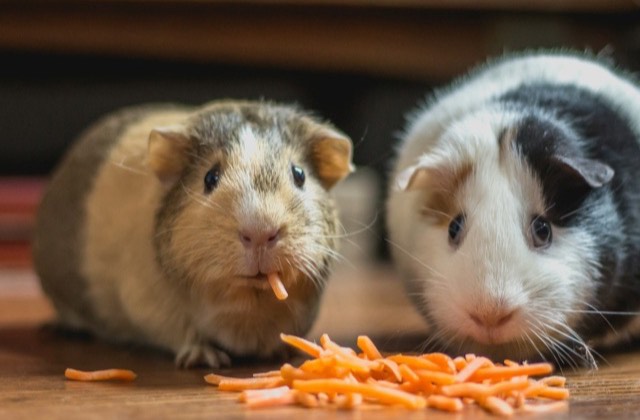
Guinea pig enrichment: hideouts and free-access hay
Published by Planète Pets · managing editor: Clément Lacaille · how our guides are written
Guinea pig enrichment rests on two pillars: multiple hideouts — at least one per animal, with two entrances — and free-access hay presented in varied ways. A prey animal by nature, the guinea pig only explores and plays when it feels safe: enrichment therefore starts with shelter.
Contents · 5 sections
Why are hideouts the foundation of everything?
A guinea pig without a hideout lives in a permanent state of alert: it freezes, eats less, interacts little. Multiply the double-entrance shelters (no dead ends where a dominant animal can corner another): wooden houses (15 to 30 €), hay tunnels, flexible bridges, fabric tents, simple upturned cardboard boxes — free and endlessly replaceable. Spread them across the whole enclosure — ideally a large C&C enclosure — to create protected travel routes.
How do you turn hay into an activity?
- A rack kept constantly topped up: unlimited hay is vital for digestion and teeth.
- Foraging balls and bags (5 to 12 €): hay that has to be earned keeps them busy longer.
- A pile of hay on the floor once or twice a week: burrowing into it is a game in itself.
- Mixed dried herbs (dandelion, chamomile) to vary the scents and flavours.
What food-based games can you offer?
Scatter the daily vegetables across several spots, hang a vegetable skewer at muzzle height, hide pieces in a snuffle mat. Guinea pigs also take very well to clicker training and simple rewarded courses — five minutes a day is enough, and it strengthens the bond.
How do you keep things fresh without stressing the group?
Change one or two elements per week, never the whole enclosure at once: guinea pigs like novelty within a stable framework. Watch the group after each change: happy wheeking, popcorning (joyful leaps) and exploration mean success; an animal that hides continuously or stops eating should raise the alarm — if any doubt persists, consult an exotics vet. More ideas in the toys and enrichment category.
Frequently asked questions
Are throwable rodent toys any use?
Not much: guinea pigs rarely manipulate objects. They prefer foraging, nibbling, hiding and interacting with their companions.
Can a lone guinea pig be "enriched" with toys?
No toy replaces a companion: the species is strictly social. Adopting a second animal is the first and greatest enrichment.
How much does a good enrichment programme cost?
10 to 20 € per month is plenty, with cardboard and hay doing most of the work; imagination counts for more than budget.
An accessory from our shop for this use: Natural loofah chew carrot for rabbits and rodents, 20 cm (€17.90) · the whole shop
This guide is part of Planète Pets’s Rodents universe. Our advice is general in nature: for any health concern, your veterinarian remains the only reference.