What Cage Should You Choose for Budgies? Dimensions and Bars Explained
Published by Planète Pets · managing editor: Clément Lacaille · how our guides are written
The cage is the single most important purchase for a budgerigar’s wellbeing. Too small, badly proportioned or fitted with the wrong bars, it restricts flight, encourages boredom and can even cause injuries. Here are the criteria that genuinely matter before you head to the checkout.
Contents · 5 sections
Dimensions designed for horizontal flight
Contrary to popular belief, a budgie needs length far more than height: it flies horizontally, from one perch to another. For a pair, aim for at least 80 cm in length, ideally 100 cm or more. Tall, narrow cages, often sold as “parrot cages”, are a poor fit for small species. Expect to pay between 60 and 150 € for a decent-quality cage, and 150 to 300 € for large models on castors. If you have the space, an indoor aviary remains the best option.
Bars: spacing and orientation
Two essential points to watch:
- Spacing: 10 to 12 mm maximum for a budgerigar, to prevent it from getting its head stuck between the bars.
- Orientation: favour horizontal bars on at least two sides. Budgies love to climb, and horizontal bars act as a natural ladder.
- Material: stainless steel or unchipped epoxy-coated metal. Steer clear of old cages with dubious coatings, which may be laden with zinc or lead.
A layout that leaves room to fly
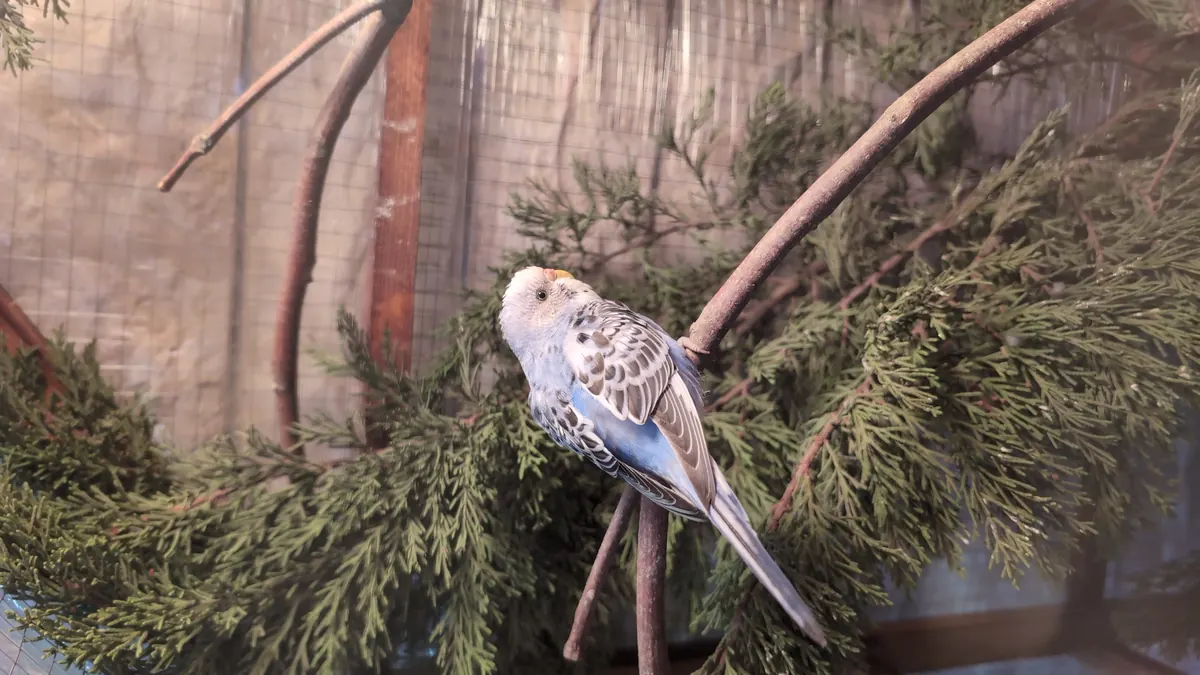
A large cage that is cluttered becomes a small cage again. Install natural wood perches of varied diameters at the ends rather than in the middle, a few toys in rotation, and well-positioned feeders away from the perches to limit soiling. A pull-out tray base makes daily cleaning far easier.
Placement matters as much as the cage
Put the cage in a living area, against a wall (budgies feel vulnerable in the middle of a room), at eye level, away from the kitchen and from draughts. Natural light is welcome, but never full sun without a shaded area. Also think about bird-proofing the room for daily out-of-cage time: our guide to bird-proofing your home details the traps to avoid.
In a nutshell
Length before height, horizontal bars spaced 10 to 12 mm apart, safe metal and an uncluttered layout: these four criteria cover the essentials. Browse our cage and equipment comparisons in the bird housing section of Planète Pets, where every model is measured against these very standards.
This guide is part of Planète Pets’s Birds universe. Our advice is general in nature: for any health concern, your veterinarian remains the only reference.