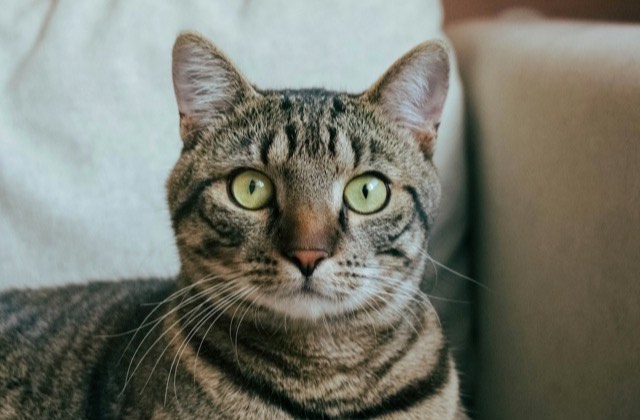
Senior cat: adapting your home for its golden years
Published by Planète Pets · managing editor: Clément Lacaille · how our guides are written
Adapting the home for a senior cat means lowering its territory: after 10 or 12 years, arthritis affects most cats, often without visible complaint, and yesterday’s jumps become obstacles. A few adaptations totalling under 150 € let the old cat keep its habits — sleeping up high, watching the window — without pain.
Contents · 5 sections
Which signs show your cat is ageing within its environment?
It no longer reaches the sofa in one bound but in stages, hesitates before jumping, sleeps lower than before, grooms its back less (greasy or matted fur), scratches less. New house-soiling in an older cat often comes from a box that has become hard to climb into, not from whim. These changes deserve a vet check-up first: arthritis, hyperthyroidism and kidney disease are all treated far better when caught early.
How do you adapt the home for a senior cat, room by room?
- Litter: a box with a low entry (under 10 cm), one per floor to avoid emergency staircases.
- Access to height: a step stool, ramp or relay pouf up to the sofa, the bed and its favourite window post.
- Bedding: an orthopaedic memory-foam cushion (30 to 60 €), placed somewhere warm and away from foot traffic.
- Bowls raised by 5 to 8 cm: eating without bending an arthritic neck.
- Slippery floors: a non-slip mat at the landing points of the remaining jumps.
- Water multiplied: several water points — a senior should drink more, not walk more.
Should you replace the cat tree of its youth?
Not necessarily remove it — height remains a need — but make it accessible: platforms brought closer together like stairs, or a low, wide tree. Some senior models have steps 20 cm apart instead of 40. The logic of the right equipment in the right place applies at any age, as with the choice of ceramic or stainless steel bowls.
How do you keep a senior stimulated without tiring it?
Play does not stop at 12: shorter sessions (3 to 5 minutes), prey on the ground rather than in the air, easy food-puzzle toys. Brushing becomes a daily care task as its flexibility declines. Our adapted ideas are in the bedding and habitat and toys and enrichment categories.
Frequently asked questions
From what age is a cat senior?
Around 10-11 for comfort adaptations, with an annual vet check-up, then twice-yearly after 12.
Is a heated pad useful for an older cat?
Gentle warmth soothes arthritic joints and seniors actively seek it out. Choose a low-voltage model with a thermostat.
My old cat meows at night — is it the layout?
Rarely the sole cause: night-time meowing in a senior suggests hypertension, hyperthyroidism or disorientation. See a vet before rearranging; a night light helps as a complement.
In our shop, for this use: Automatic tail ball for cats (€17.90) · the whole shop
For your cat, at Le Félin (same family, zero commission): Arbre à chat maine coon style désert (from €159.99)
This guide is part of Planète Pets’s Cats universe. Our advice is general in nature: for any health concern, your veterinarian remains the only reference.