Silica or Clumping Cat Litter? How to Choose the Right One
Published by Planète Pets · managing editor: Clément Lacaille · how our guides are written
To choose between silica and clumping litter, start with your cat, then with your routine. Clumping clay litter has a fine, sand-like texture that suits most cats, and you scoop out each clump so the rest stays clean. Silica crystals absorb urine and hold odours for longer, so you mainly remove solids and change the whole tray less often, but some cats dislike the feel of the crystals. Plant-based litters (wood, corn, paper, hemp) are lighter and often less dusty. Whatever you pick, change it gradually and let your cat decide. More in our cat care and grooming section.
Contents · 5 sections
Silica, clumping clay, non-clumping clay or plant-based: the comparison
| Type | How it works | Strengths | Watch out for |
|---|---|---|---|
| Clumping clay (bentonite) | Forms firm lumps with urine; you scoop them out | Fine, sand-like texture most cats accept; easy daily cleaning | Dust with some brands, heavy bags, tracking |
| Silica crystals | Crystals absorb urine and odours until saturated | Light, long intervals between full changes, little smell when fresh | Hard texture some cats refuse; urine colour harder to watch; full change once saturated |
| Non-clumping clay | Absorbs urine without forming lumps | Simple, widely available | Urine stays in the tray: frequent full changes |
| Plant-based (wood, corn, paper, hemp) | Pellets or fibres that absorb, some of which clump | Light, often low dust, made from renewable materials | Texture varies a lot by product; some cats dislike pellets |
How to choose between silica and clumping litter
- Your cat is fussy, a kitten or elderly: start with a fine clumping litter, the texture closest to the sand and loose soil cats naturally use.
- You have little time and one cat: silica lets you change the tray less often, as long as you remove solids every day.
- You want to keep an eye on urine: with clumping litter, the size and number of clumps show changes quickly, which helps spot a urinary problem early.
- Dust is an issue at home: look for a low-dust clumping litter or a plant-based one.
- Several cats: plan one tray per cat plus one extra, whatever the litter, and scoop at least daily.
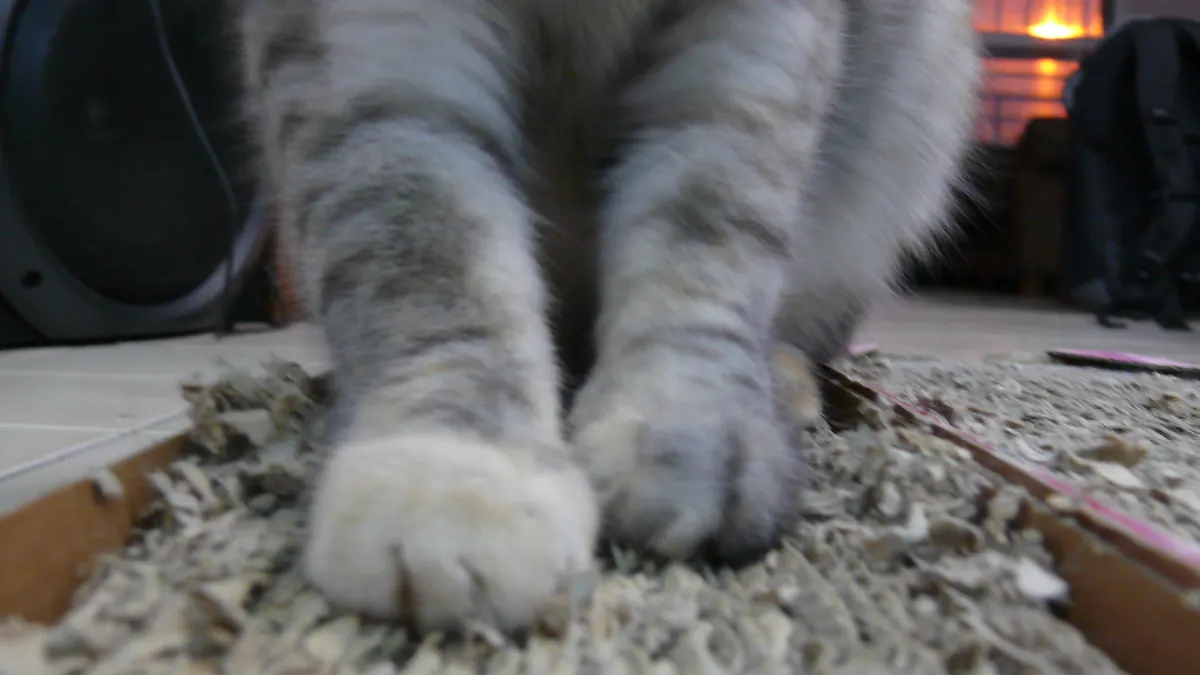
Plant-based litter: a choice for vegan and eco-minded households
Owners who avoid animal products and mined materials often turn to plant-based litters: wood, corn, wheat, recycled paper or hemp. They are made from renewable materials and are lighter to carry. Some can be composted with the soiled parts removed, depending on the product and local rules; never put cat waste on compost used for food crops. Check the label: some plant litters clump, others only absorb.
Switching litter without upsetting your cat
Change gradually, mixing old and new over one to two weeks. Watch how your cat uses the tray: if it digs and covers calmly, the texture suits it; if it perches on the rim or shakes its paws on the way out, reconsider. A cat that suddenly avoids a clean tray, strains, or passes urine often in small amounts may have a urinary problem: see your vet without delay, especially for a male cat.
And the tray itself?
The best litter cannot make up for a tray that is too small or badly placed. Open, hooded or self-cleaning, the container matters as much as what goes in it. Find all our comparisons in the cat hub.
This guide is part of Planète Pets’s Cats universe. Our advice is general in nature: for any health concern, your veterinarian remains the only reference.